World Heritage Identification Number: 551
World Heritage since: 1990
Category: Natural Heritage
WHE Type: Natural Landscapes & Geographic Features
Transboundary Heritage: No
Endangered Heritage: No
Country: 🇳🇿 New Zealand
Continent: Oceania
UNESCO World Region: Asia and the Pacific
Map
Te Wahipounamu - A Unique World Heritage Landscape in South West New Zealand
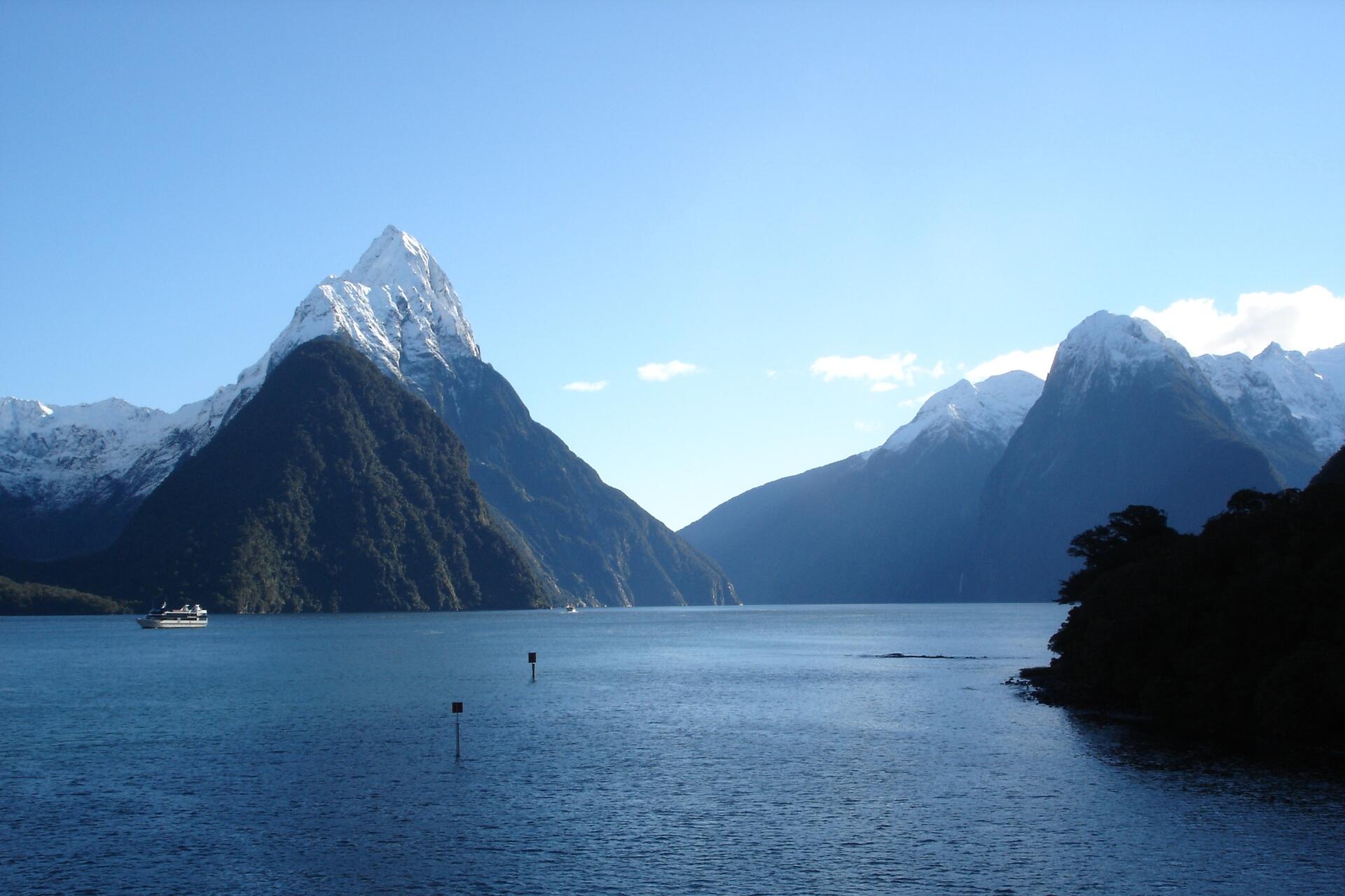
Te Wāhipounamu, meaning “the place of greenstone (pounamu)” in Māori, is a UNESCO World Heritage Site located in the southwest corner of New Zealand’s South Island. Inscribed in 1990, it encompasses a vast and largely untouched natural landscape shaped by successive glacial periods. These forces have carved dramatic fjords, rugged coastlines, steep mountains, deep lakes, and powerful waterfalls, creating one of the most visually striking wilderness regions on Earth.
For Māori, Te Wāhipounamu holds deep cultural and historical significance beyond its name. The region was an important source of pounamu (greenstone), which was highly valued for tools, weapons, and ornaments, and played a central role in trade and social relationships between iwi (tribes). Traditional routes across the Southern Alps, including alpine passes and river valleys, were used for travel and resource gathering, embedding the landscape within Māori patterns of movement, knowledge, and identity.
The landscapes of Te Wāhipounamu also reflect a much deeper geological history linked to the ancient supercontinent Gondwana. New Zealand separated from Gondwana around 80 million years ago, and many of its plant and animal lineages are considered living remnants of this ancient landmass. The uplift of the Southern Alps along the Alpine Fault, combined with repeated glacial cycles during the Quaternary period, has produced the dramatic contrast between steep alpine peaks and deeply carved fjords that defines the region today.
Covering approximately 2.6 million hectares, Te Wāhipounamu is one of the largest protected natural areas in the world, incorporating four major national parks: Fiordland National Park, Westland Tai Poutini National Park, Mount Aspiring National Park, and Aoraki / Mount Cook National Park. Around two-thirds of the area is covered in native forest, dominated by southern beech (Nothofagus spp.) and podocarp species, some of which are over 800 years old. These ecosystems provide critical habitats for a wide range of endemic flora and fauna found nowhere else on Earth.
One such unique inhabitant is the kea (Nestor notabilis), the world’s only truly alpine parrot, renowned for its intelligence and curiosity. Often seen interacting with human activity in alpine environments, the kea is considered one of the most behaviorally complex bird species in the world. Another notable resident is the takahe (Porphyrio hochstetteri), a large flightless bird once believed extinct in the late 19th century and rediscovered in 1948. With its deep blue-green plumage and bright red beak, the takahe has become an important symbol of New Zealand’s conservation efforts.
The region is also home to several rare and endangered species, including the Fiordland crested penguin (Eudyptes pachyrhynchos), the yellow-eyed penguin (Megadyptes antipodes), and Hector’s dolphin (Cephalorhynchus hectori), the world’s smallest marine dolphin species. Offshore waters support additional marine life, including fur seals, sea lions, and seasonal whale populations such as sperm and humpback whales.
The ecosystems of Te Wāhipounamu are among the most intact examples of temperate rainforest in the world, particularly along the wet western coast where extreme rainfall supports dense, moss-covered forests and high levels of endemism. The region is also notable for ongoing conservation challenges. Predator control and species recovery efforts have been crucial in protecting vulnerable species such as the takahe and several kiwi species within the protected areas.
Beyond its biological diversity, Te Wāhipounamu contains some of the most striking landscapes in the Southern Hemisphere. Notable sites include Milford Sound and Doubtful Sound in Fiordland, both renowned for their steep cliffs and glacially carved fjords. Visitors can also explore Mitre Peak, one of New Zealand’s most photographed mountains, or traverse internationally recognized hiking routes such as the Kepler Track and Routeburn Track.
Despite its global popularity, Te Wāhipounamu remains a largely wild and sparsely developed region. Its remoteness, combined with strict environmental protection and conservation management, has helped preserve its ecological integrity. Recognized by UNESCO for its Outstanding Universal Value, the site represents one of the finest remaining examples of temperate rainforest and glacially sculpted landscapes in the world.
UNESCO Description of the World Heritage Site
The landscape in this park, situated in south-west New Zealand, has been shaped by successive glaciations into fjords, rocky coasts, towering cliffs, lakes and waterfalls. Two-thirds of the park is covered with southern beech and podocarps, some of which are over 800 years old. The kea, the only alpine parrot in the world, lives in the park, as does the rare and endangered takahe, a large flightless bird.
UNESCO Justification of the World Heritage Site
Criterion (vii): Te Wähipounamu - South West New Zealand contains many of the natural features which contribute to New Zealand's international reputation for superlative landscapes: its highest mountains, longest glaciers, tallest forests, wildest rivers and gorges, most rugged coastlines and deepest fiords and lakes, as well as the remnant of an extinct volcano in Solander Island. The temperate rainforests of the property are unmatched in their composition, extent and intactness by any such forests anywhere in the world. From the vast wilderness of Fiordland in the south to the spectacular upthrust of the Southern Alps in the north, the landscapes are world class for the sheer excellence of their scenic beauty. It is an area of magnificent primeval vistas: snow-capped mountains, glaciers, forests, tussock grasslands, lakes, rivers, wetlands and over 1000km of wilderness coastline. Only traces of human influence are evident and then mainly in peripheral areas.
Criterion (viii): Te Wähipounamu - South West New Zealand is considered to be the best modern example of the primitive taxa of Gondwanaland seen in modern ecosystems – and as such the property is of global significance. The progressive break-up of the southern super-continent of Gondwanaland is considered one of the most important events in the earth’s evolutionary history. New Zealand’s separation before the appearance of marsupials and other mammals, and its long isolation since, were key factors enabling the survival of the ancient Gondwanan biota on the islands of New Zealand to a greater degree than elsewhere. The living representatives of this ancient biota include flightless kiwis, carnivorous land snails, 14 species of podocarp and genera or beech. The South West is also an outstanding example of the impact of the Pleistocene epoch of earth history. Ice-carved landforms created by these “Ice Age” glaciers dominate the mountain lands, and are especially well-preserved in the harder, plutonic igneous rocks of Fiordland. Glacier-cut fiords, lakes, deep U-shaped valleys, hanging valleys, cirques, and ice-shorn spurs are graphic illustrations of the powerful influence of these glaciers on the landscape. Depositional landforms of Pleistocene glacial origin are also important, especially in Westland, west of the Alpine Fault. Chronological sequences of outwash gravels, and moraine ridges in elegant curves and loops, outline the shapes of both former piedmont glaciers and Holocene post-glacial valley glaciers.
Criterion (ix): A continuum of largely unmodified habitats, the property exhibits a high degree of geodiversity and biodiversity. Fresh-water, temperate rainforest and alpine ecosystems are all outstandingly well represented over an extensive array of landforms and across wide climatic and altitudinal gradients. Notable examples of on-going biological processes can be found in the large expanses of temperate rainforest, the plant succession after glacial retreat, soil/plant chronosequences on beach ridges, plant succession on alluvial terraces, vegetation gradients around the margins of glacial lakes and ecotypic differentiation of plants on ultramafic soils. The extensive and little modified freshwater habitats, the impressive diversity of alpine ecosystems, extensive alpine plant endemism, and on-going evolution associated with long-standing geographical isolation of animal populations, like the kiwi taxa of South-Westland, are further examples of on-going biological evolution. While there is little permanent physical evidence of past human interaction with the natural environment, tangata whenua (the indigenous people who have customary authority in a place) have long associations with the area which was significant to them for natural resources, particularly pounamu (nephrite). European associations are more recent and initially based on natural resource exploitation. The predominant human uses today are associated with sustainable tourism.
Criterion (x): The habitats of Te Wähipounamu contain an extensive range of New Zealand’s unusual endemic fauna, a fauna which reflects its long evolutionary isolation and absence of mammalian predators. The property contains the entire wild population of the rare and endangered takahë (Notornis mantelli), the entire population of the South Island subspecies of brown kiwi (Apteryx australis), New Zealands rarest Kiwi, the rowi (Apteryx rowi), the only significant remaining populations of the seriously declining mohua / yellowhead (Mohoua ochrocephala), the only large populations remaining of käkä and käkäriki / yellow-crowned parakeet, the only remaining population of pateke / Fiordland brown teal in the South Island. The world's rarest and heaviest parrot, käkäpö (Strigops habroptilus) survived in Fiordland until the early 1980s. It is now thought to be extinct on the mainland and its survival depends on careful management of a limited number of offshore island populations.
Encyclopedia Record: Te Wahipounamu
Te Wāhipounamu is a World Heritage Site in the south west corner of the South Island of New Zealand.Additional Site Details
Area: 2,600,000 hectares
Number of Components: 1
(viii) — Outstanding example representing major earth stages
(ix) — Outstanding example representing ecological and biological processes
(x) — Contains most important habitats for biodiversity
Coordinates: -45.03602778 , 167.3196111
IUCN World Heritage Outlook
The 2025 Conservation Outlook on Te Wāhipounamu – South West New Zealand reports the following assessment:
Source: International Union for Conservation of Nature (IUCN) · View assessment