World Heritage Identification Number: 1052
World Heritage since: 2001
Category: Cultural Heritage
WHE Type: Buildings & Architectural Ensembles
Transboundary Heritage: No
Endangered Heritage: No
Country: 🇨🇿 Czechia
Continent: Europe
UNESCO World Region: Europe and North America
Map
A Pioneer of Modern Architecture: The Tugendhat Villa in Brno
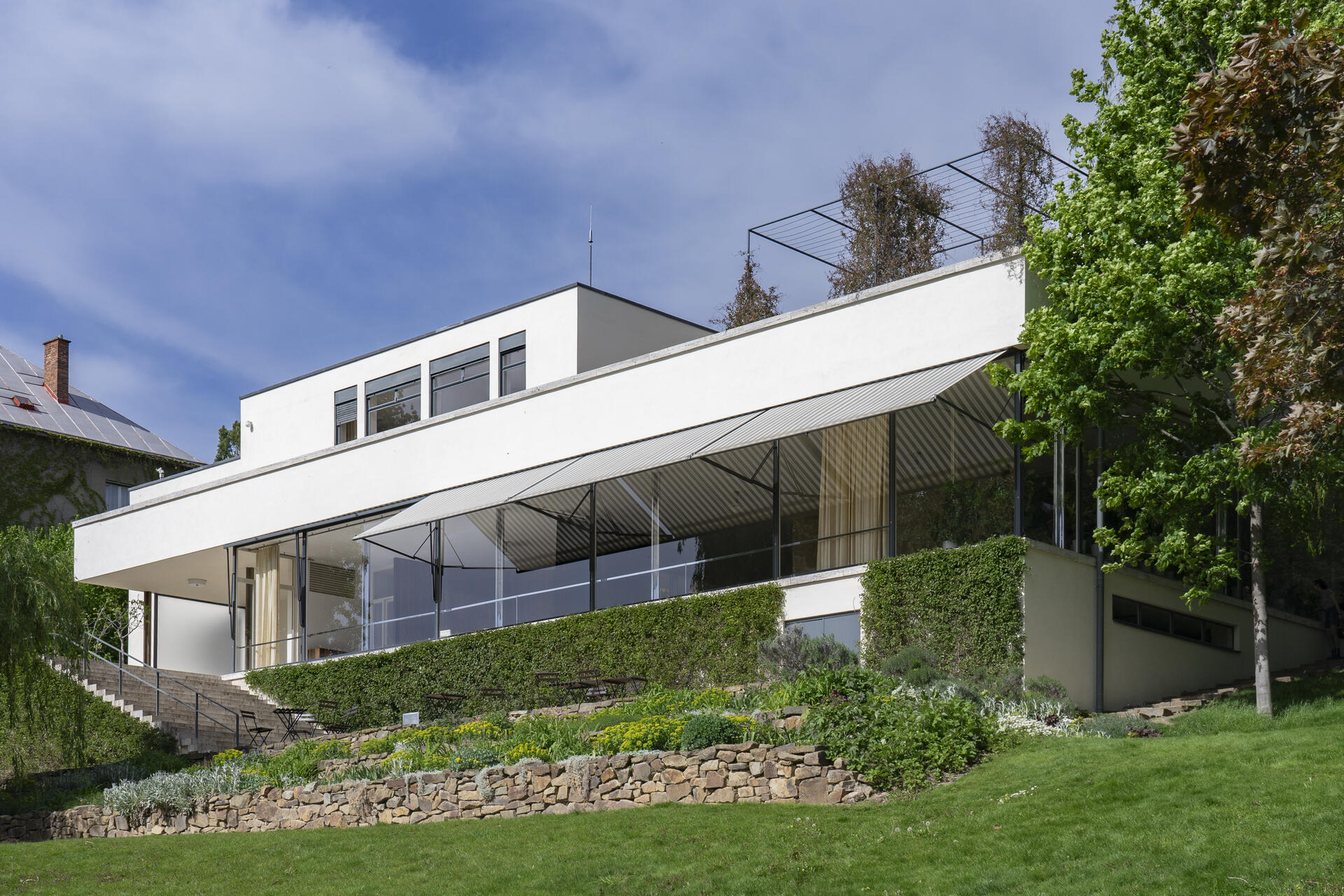
The Tugendhat Villa in Brno, a city in the Czech Republic, stands as a testament to the evolution of modern architecture in Europe during the 1920s. This architectural masterpiece, designed by the renowned German architect Ludwig Mies van der Rohe and his collaborator Lilly Reich, was inscribed as a UNESCO World Heritage Site in 2001.
More to come…UNESCO Description of the World Heritage Site
The Tugendhat Villa in Brno, designed by the architect Mies van der Rohe, is an outstanding example of the international style in the modern movement in architecture as it developed in Europe in the 1920s. Its particular value lies in the application of innovative spatial and aesthetic concepts that aim to satisfy new lifestyle needs by taking advantage of the opportunities afforded by modern industrial production.
UNESCO Justification of the World Heritage Site
Criterion (ii): The German architect Mies van der Rohe applied the radical new concepts of the Modern Movement triumphantly to the Tugendhat Villa to the design of residential buildings.
Criterion (iv): Architecture was revolutionized by the Modern Movement in the 1920s and the work of Mies van der Rohe, epitomized by the Tugendhat Villa, played a major role in its worldwide diffusion and acceptance.
Encyclopedia Record: Villa Tugendhat
Villa Tugendhat is an architecturally significant building in Brno, Czech Republic. It is one of the pioneering prototypes of modern architecture in Europe, and was designed by the German architects Ludwig Mies van der Rohe and Lilly Reich. It was built between 1928 and 1930 for Fritz Tugendhat and his wife Greta, of the wealthy and influential Jewish Czech Tugendhat family. Of reinforced concrete, the villa soon became an icon of modernism. Famous for its revolutionary use of space and industrial building materials, the building was added to the UNESCO World Heritage List in 2001.Additional Site Details
Area: 0.73 hectares
Number of Components: 1
(iv) — Outstanding example of a type of building or landscape
Coordinates: 49.2071833333 , 16.6160555556
World Heritage Research
Discover scientific research and academic studies that deepen our understanding of Tugendhat Villa in Brno from its history and significance to its conservation, management, and contemporary challenges.
-
Modern Use of the World Heritage Site – Villa Tugendhat in Brno and Its Significance for Modern Architecture
Villa Tugendhat, a UNESCO World Heritage Site and museum in Brno, exemplifies the fusion of modern functionalism with Eastern architectural techniques. The study identifies unique design elements such as 'garden within a garden,' 'borrowing the landscape,' 'flowing spaces,' and 'immaterial glass walls' that integrate the building with its natural surroundings while maintaining functionalist principles. Unlike traditional sliding architecture, Villa Tugendhat achieves this effect through transparent glass barriers, offering distant views of Špilberk Castle and the city. This analysis highlights the villa's role as a transformed adaptation of Chinese and Japanese techniques, positioning it as a classic example of modern architectural innovation.
IVASHKO, Y., SERAFIN, A., SLEPTSOV, O., PAWŁOWSKA, A., IVASHKO, O.,. (2025). MODERN USE OF THE WORLD HERITAGE SITE – VILLA TUGENDHAT IN BRNO AND ITS SIGNIFICANCE FOR MODERN ARCHITECTURE. International Journal of Conservation Science, 16(Special Issue), 623–632. https://doi.org/10.36868/ijcs.2025.si.19
View Publication Record | Read Publication -
The modern house: conservation and (re)use through the narrative approach
A narrative approach to heritage conservation offers a promising balance between preserving modern houses' historical integrity and enabling adaptive reuse, addressing the challenges posed by modernity's ephemeral nature. This study evaluates four iconic modern houses—Villa Tugendhat in Brno (frozen as a museum), Chabot Museum in Rotterdam (refunctioned as an art museum), Haus Schminke in Löbau (used as a guest house), and Maison Guiette in Antwerp (still in residential use)—using criteria such as significance, reversibility, expandability, and craftsmanship. The analysis reveals that while the narrative approach may introduce subjectivity or dilute valuations, it effectively sustains multifaceted historical perspectives and accommodates future changes without compromising core heritage values. This cross-case study provides actionable insights for theorizing the adaptive conservation of modernist architecture, ensuring its relevance for both contemporary and future contexts.
Augustiniok, N., & Özmen, A. (2024). The modern house: conservation and (re)use through the narrative approach. Open House International. https://doi.org/10.1108/ohi-02-2024-0071
View Publication Record | Read Publication -
Tugendhat-villa, Brno – újjászületés, új nézőpontok • Villa Tugendhat, Brno – Rebirth, New Perspectives
The Tugendhat Villa, designed by Ludwig Mies van der Rohe and located in Brno, Czech Republic, has undergone significant restoration to its original state. This iconic modernist structure, a key work of the 20th century's most influential architects, now stands as a testament to its architectural brilliance. The recent rehabilitation not only preserves its historical integrity but also offers new perspectives on its design and cultural significance. Mies van der Rohe's masterpiece, characterized by its innovative use of materials and spatial organization, continues to captivate both academic scholars and the general public.
Nagy, I. (2023). Tugendhat-villa, Brno – újjászületés, új nézőpontok • Villa Tugendhat, Brno – Rebirth, New Perspectives. Magyar Tudomány. https://doi.org/10.1556/2065.184.2023.6.8
View Publication Record | Read Publication -
The construction joint analysis of the villa Tugendhat interior furnishing
A detailed analysis of the structural joints in the interior furniture of the UNESCO-listed Tugendhat Villa, designed by Ludwig Mies van der Rohe, reveals innovative construction and material solutions that are critical for its preservation. The study, conducted by the Department of Furniture, Design, and Habitation, provides comprehensive production-technical documentation for 53 pieces of furniture, including surface treatment details and manufacturing specifics. This work aims to support the villa's renewal, addressing its deteriorating technical condition while adhering to original design principles. Despite the completed project documentation, legal disputes have delayed the reconstruction process.
Holouš, Z., & Šimek, M. (2014). The construction joint analysis of the villa Tugendhat interior furnishing. Acta Universitatis Agriculturae et Silviculturae Mendelianae Brunensis, 58(1), 53–60. https://doi.org/10.11118/actaun201058010053
View Publication Record | Read Publication -
Investigation and Production of Furniture for Villa Tugendhat 2009–2012
A significant rediscovery has shed light on the lost heritage of Villa Tugendhat, a UNESCO-listed masterpiece by Mies van der Rohe. The study confirms that the majority of the original furniture, including the iconic Makassar wall—previously believed missing for seven decades—remained in the possession of the Tugendhat family. This finding completes the villa's historic restoration, allowing it to reopen with its 1938 furnishings intact. The research involved a meticulous investigation into the villa's contents, revealing how Mies van der Rohe's design philosophy extended seamlessly from architecture to interior elements, dictating precise spatial organization and limiting functional flexibility for the owners. The study also highlights the political context of the Tugendhats' exile in 1938, which accelerated the villa's abandonment.
Ambroz, M. (2012). Investigation and Production of Furniture for Villa Tugendhat 2009–2012. Docomomo Journal, (46), 26–31. https://doi.org/10.52200/46.a.oaexjppm
View Publication Record | Read Publication