World Heritage Identification Number: 981
World Heritage since: 2014
Category: Cultural Heritage
WHE Type: Archaeological Sites
Transboundary Heritage: No
Endangered Heritage: No
Country: 🇷🇺 Russian Federation
Continent: Europe
UNESCO World Region: Europe and North America
Map
Bolgar Historical and Archaeological Complex: A Testament to Ancient Civilization and Cultural Diversity
The Bolgar Historical and Archaeological Complex, located on the banks of the Volga River in Russia, stands as a testament to the rich history, cultural exchanges, and transformations that have shaped Eurasia over centuries. Inscribed as a UNESCO World Heritage Site in 2014, this significant site offers a unique glimpse into the early civilization of the Volga-Bolgars, spanning from the 7th to the 15th centuries AD.
More to come…UNESCO Description of the World Heritage Site
This property lies on the shores of the Volga River, south of its confluence with the River Kama, and south of the capital of Tatarstan, Kazan. It contains evidence of the medieval city of Bolgar, an early settlement of the civilization of Volga-Bolgars, which existed between the 7th and 15th centuries AD, and was the first capital of the Golden Horde in the 13th century. Bolgar represents the historical cultural exchanges and transformations of Eurasia over several centuries that played a pivotal role in the formation of civilizations, customs and cultural traditions. The property provides remarkable evidence of historic continuity and cultural diversity. It is a symbolic reminder of the acceptance of Islam by the Volga-Bolgars in AD 922 and remains a sacred pilgrimage destination to the Tatar Muslims.
UNESCO Justification of the World Heritage Site
Criterion (ii): The historical and archaeological complex of Bolgar illustrates the exchange and re-integration of several subsequent cultural traditions and rulers and reflects these in influences on architecture, city-planning and landscape design. The property illustrates the cultural exchanges of Turkic, Finno-Ugric, Slavic and other traditions. Evidence of exchanges in architectural styles includes wooden constructions which emerged in the forest-rich region, the steppe component of Turkic language tribes, oriental influences connected with the adoption of Islam and European-Russian styles which dominated after it became part of the Russian state.
Criterion (vi): Bolgar remains a regional reference point for Tatar Muslims and likely other Muslim groups of the wider region in Eurasia. It carries associated religious and spiritual values which are illustrated predominantly during the annual pilgrimage season. Bolgar provides evidence of an early and northernmost Muslim enclave established in connection with the official acceptance of Islam by the Volga Bolgars as the state religion in 922 AD, which had a lasting impact on the cultural and architectural development of the wider geographical region.
Encyclopedia Record: Bolghar
Bolghar or Bolgar was intermittently the capital of Volga Bulgaria from the 10th to the 13th centuries, along with Bilyar and Nur-Suvar. It was situated on the bank of the Volga River, about 30 km downstream from its confluence with the Kama River and some 130 km from modern Kazan in what is now Spassky District. To the west of it lies a small modern town known as Bolgar since 1991. The UNESCO World Heritage Committee inscribed Bolgar Historical and Archaeological Complex to the World Heritage List in 2014.Additional Site Details
Area: 424 hectares
Number of Components: 2
(vi) — Directly associated with events or living traditions
Coordinates: 54.9788888889 , 49.0563888889
Image
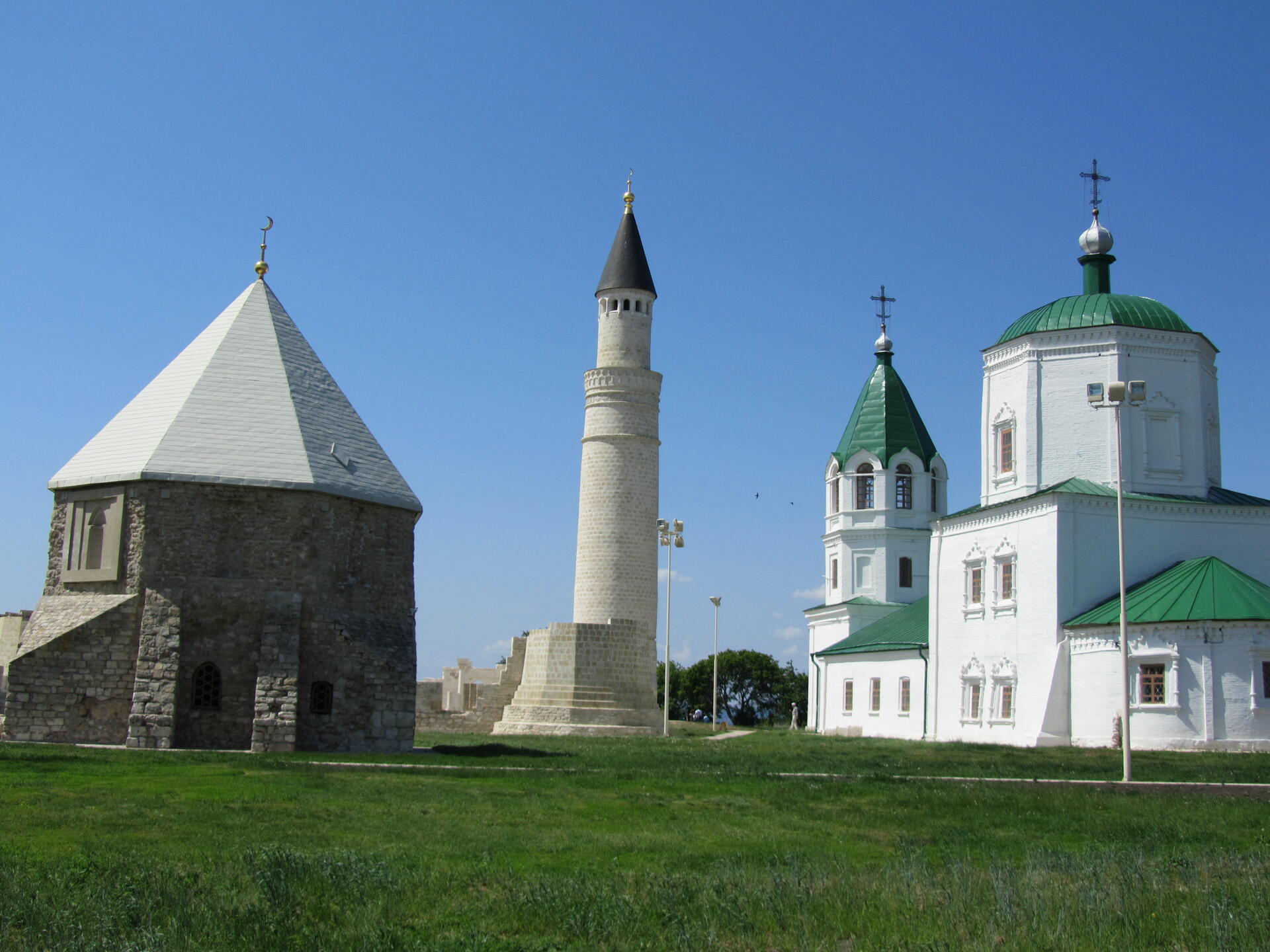
© Indeikin, CC BY-SA 3.0 Resized from original. (This derivative is under the same CC BY-SA license.)
World Heritage Research
Discover scientific research and academic studies that deepen our understanding of Bolgar Historical and Archaeological Complex from its history and significance to its conservation, management, and contemporary challenges.
-
Spatial Distribution and Hydrographic Characteristics Analysis in Detached Bays of the Tetyushsky Reach of the Kuibyshev Reservoir
Research identifies 103 isolated bays within the Tetyushsky reach of the Kuibyshev Reservoir, covering 246 hectares and primarily located on left-bank islands formed after reservoir flooding. These detached bays, classified as 'small water bodies,' exhibit predominantly oval or near-circular shapes with slightly indented shorelines. A notable trend toward reduction in water surface area was observed, particularly for bays not connected to the main water body during flood periods. The study leverages satellite imagery from Google Earth Engine and Sentinel-2, combined with field research data from 2024, analyzed using QGIS software at a normal water level of 52.7 m BS. Significantly, these findings are situated within the 'Spassky' Biosphere Reserve and the buffer zone of the UNESCO World Heritage Site – historical and archaeological complex of Bolgar, underscoring their ecological and cultural importance.
Ziganshin, I. I., Ziganshin, I. I., & Safin, I. M. (2025). SPATIAL DISTRIBUTION AND HYDROGRAPHIC CHARACTERISTICS ANALYSIS IN DETACHED BAYS OF THE TETYUSHSKY REACH OF THE KUIBYSHEV RESERVOIR. Российский Журнал Прикладной Экологии, (2), 66–70. https://doi.org/10.24852/2411-7374.2025.2.66.70
View Publication Record | Read Publication -
Pedo-antrocological characteristics of anthropogenically transformed soils in a case study of the Bolgar historical and archaeological complex in the Republic of Tatarstan (Russia)
A key insight from the study of anthropogenically transformed soils at the Bolgar Historical and Archaeological Complex reveals that antrocomass—charred particles—is not universally present in such soils, with its accumulation being optional depending on the soil's genesis and age. The research analyzed four distinct soil layers: a 20th-century garden soil, a 13th-century urban cultural layer, an upper arable soil from the 9th–10th centuries (Bolgar culture), and a lower arable soil from the 5th–7th centuries (Imen'kovo culture). The findings indicate that while the Bolgar culture utilized wood ash and charred bone as a fertilizer, this practice was not evident in earlier soils. Particle-size distribution and charcoal preservation varied by soil genesis type, with 'turbational' soils showing higher fragmentation compared to 'sedimentational' ones.
Golyeva, A. A., Yu Koval, V., Yu Badeev, D., & Fazuldinova, N. M. (2021). Pedo-antrocological characteristics of anthropogenically transformed soils in a case study of the Bolgar historical and archaeological complex in the Republic of Tatarstan (Russia). IOP Conference Series: Earth and Environmental Science, 862(1), 12067. https://doi.org/10.1088/1755-1315/862/1/012067
View Publication Record | Read Publication -
Proceedings of the 8th International Scientific Conference “Dialogue of Urban And Steppe Cultures in the Eurasian Space” Dedicated to the Memory of G.А. Fedorov-Davydov
A comprehensive interdisciplinary study of the Bolgar Historical and Archaeological Complex was conducted through the 8th International Scientific Conference held in 2018. The research focused on the dialogue between urban and steppe cultures within the Eurasian space, particularly examining the Mongol Empire and Golden Horde's influence on material culture and technological advancements. A key aspect of the study involved a systematic analysis of Bolgar settlement, supported by the Bolgar Archaeological Expedition, which delved into the continuity of medieval cultural traditions and the establishment patterns of urban settlements in steppe Eurasia. The findings were part of a broader project investigating the ancient towns of Bolgar and Sviyazhsk from 2010 to 2018, providing significant insights into the historical geography and topographical characteristics of these regions.
Sitdikov, A. G., Shakirov, Z. G.,. (2018). Proceedings of the 8th International Scientific Conference “Dialogue of Urban And Steppe Cultures in the Eurasian Space” Dedicated to the Memory of G.А. Fedorov-Davydov. Povolzhskaya Arkheologiya (the Volga River Region Archaeology), 4(26), 334–343. https://doi.org/10.24852/2018.4.26.334.343
View Publication Record | Read Publication -
О работе международного семинара «Мониторинг объектов всемирного наследия ЮНЕСКО: опыт Российской Федерации и стран СНГ»
An international workshop on UNESCO World Heritage monitoring, held at the Bolgar Historical and Archaeological Complex in 2017, brought together experts from Russia, CIS countries, and abroad to exchange experiences in preserving cultural heritage sites. The event focused on monitoring techniques for World Heritage and preliminary list monuments, particularly assessing the condition of Bolgar and other Tatarstan sites while preparing proposals for new UNESCO listings. A key outcome was the establishment of the Association of World Heritage Experts of the CIS and Eastern Europe, aiming to strengthen regional collaboration in heritage conservation.
Aituganova, N., Valeev, R., Sitdikov, A., Khayrutdinov, R.,. (2017). О работе международного семинара «Мониторинг объектов всемирного наследия ЮНЕСКО: опыт Российской Федерации и стран СНГ». Povolzhskaya Arkheologiya (the Volga River Region Archaeology), 4(22), 331–336. https://doi.org/10.24852/pa2017.4.22.331.336
View Publication Record | Read Publication