World Heritage Identification Number: 659
World Heritage since: 1993
Category: Cultural Heritage
WHE Type: Archaeological Sites
Transboundary Heritage: No
Endangered Heritage: No
Country: 🇮🇪 Ireland
Continent: Europe
UNESCO World Region: Europe and North America
Map
Exploring the Ancient Wonders of Brú na Bóinne - Archaeological Ensemble of the Bend of the Boyne
The Brú na Bóinne, or Boyne Valley tombs, located in County Meath, Ireland, offers a captivating glimpse into the rich history and cultural heritage of prehistoric Europe, more than 5,200 years ago. Inscribed as a UNESCO World Heritage Site in 1993, this remarkable archaeological ensemble, situated approximately 50 km north of Dublin, is considered one of the most significant Neolithic landscapes globally.
Comprised of over ninety monuments, the Brú na Bóinne complex includes passage tombs, burial mounds, standing stones, and enclosures. The site is primarily defined by its three principal passage tombs: Newgrange, Knowth, and Dowth, all constructed around 3200 BC. These impressive structures stand as testaments to the advanced architectural skills and artistic prowess of the people who inhabited the region during the Neolithic period.
Newgrange, the most renowned of the three tombs, is perhaps best known for its intricate carvings and the famous passageway aligned with the winter solstice sunrise. Visitors can enter the tomb and experience the magical alignment of light that illuminates the chamber for just a brief moment each year.
Knowth, another prominent site within the Brú na Bóinne complex, boasts more than five hundred carved symbols adorning its massive stone façade. These engravings represent some of the oldest examples of megalithic art in Europe, providing valuable insights into the beliefs, mythology, and societal structure of the time.
Dowth, the third major passage tomb, shares many similarities with Newgrange and Knowth but remains less explored due to its more challenging accessibility. Despite this, Dowth still holds numerous secrets waiting to be uncovered by archaeologists and historians alike.
In addition to these well-known tombs, the immediate Brú na Bóinne complex also contains numerous other satellite monuments, such as smaller passage tombs, standing stones, and henges. The wider Boyne Valley region is home to other significant — but separate — Neolithic sites not included within the UNESCO World Heritage boundary, such as the passage tombs of Loughcrew, the large circular enclosure of Fourknocks, and the Hill of Tara.
The archaeological traditions associated with Brú na Bóinne belong to the wider Neolithic passage-tomb culture of Ireland, which spanned approximately 4000 BC to 2500 BC, sometimes labelled as the "Boyne culture". This culture played a crucial role in shaping the early societies of Ireland and left behind an enduring legacy that continues to fascinate scholars and visitors today.
Ultimately, the Brú na Bóinne - Archaeological Ensemble of the Bend of the Boyne stands as a testament to the ingenuity, creativity, and spirituality of our ancestors. By exploring these ancient wonders, we gain a deeper understanding of our shared human past and the incredible achievements of our prehistoric forebears.
UNESCO Description of the World Heritage Site
The three main prehistoric sites of the Brú na Bóinne Complex, Newgrange, Knowth and Dowth, are situated on the north bank of the River Boyne 50 km north of Dublin. This is Europe's largest and most important concentration of prehistoric megalithic art. The monuments there had social, economic, religious and funerary functions.
UNESCO Justification of the World Heritage Site
Criterion (i): The Brú na Bóinne monuments represent the largest and most important expression of prehistoric megalithic plastic art in Europe.
Criterion (iii): The concentration of social, economic and funerary monuments at this important ritual centre and the long continuity from prehistory to the late medieval period make this one of the most significant archaeological sites in Europe.
Criterion (iv): The passage grave, here brought to its finest expression, was a feature of outstanding importance in prehistoric Europe and beyond.
Encyclopedia Record: Brú na Bóinne
Brú na Bóinne, also called the Boyne Valley tombs, is an ancient monument complex and ritual landscape in County Meath, Ireland, located in a bend of the River Boyne. It is one of the world's most important Neolithic landscapes, comprising at least ninety monuments including passage tombs, burial mounds, standing stones and enclosures. The site is dominated by the passage tombs of Newgrange, Knowth and Dowth, built during the 32nd century BC. Together these have the largest assemblage of megalithic art in Europe. The associated archaeological culture is called the "Boyne culture".Additional Site Details
Area: 770 hectares
Number of Components: 1
(iii) — Unique or exceptional testimony to a cultural tradition
(iv) — Outstanding example of a type of building or landscape
Coordinates: 53.6946944444 , -6.4755
Image
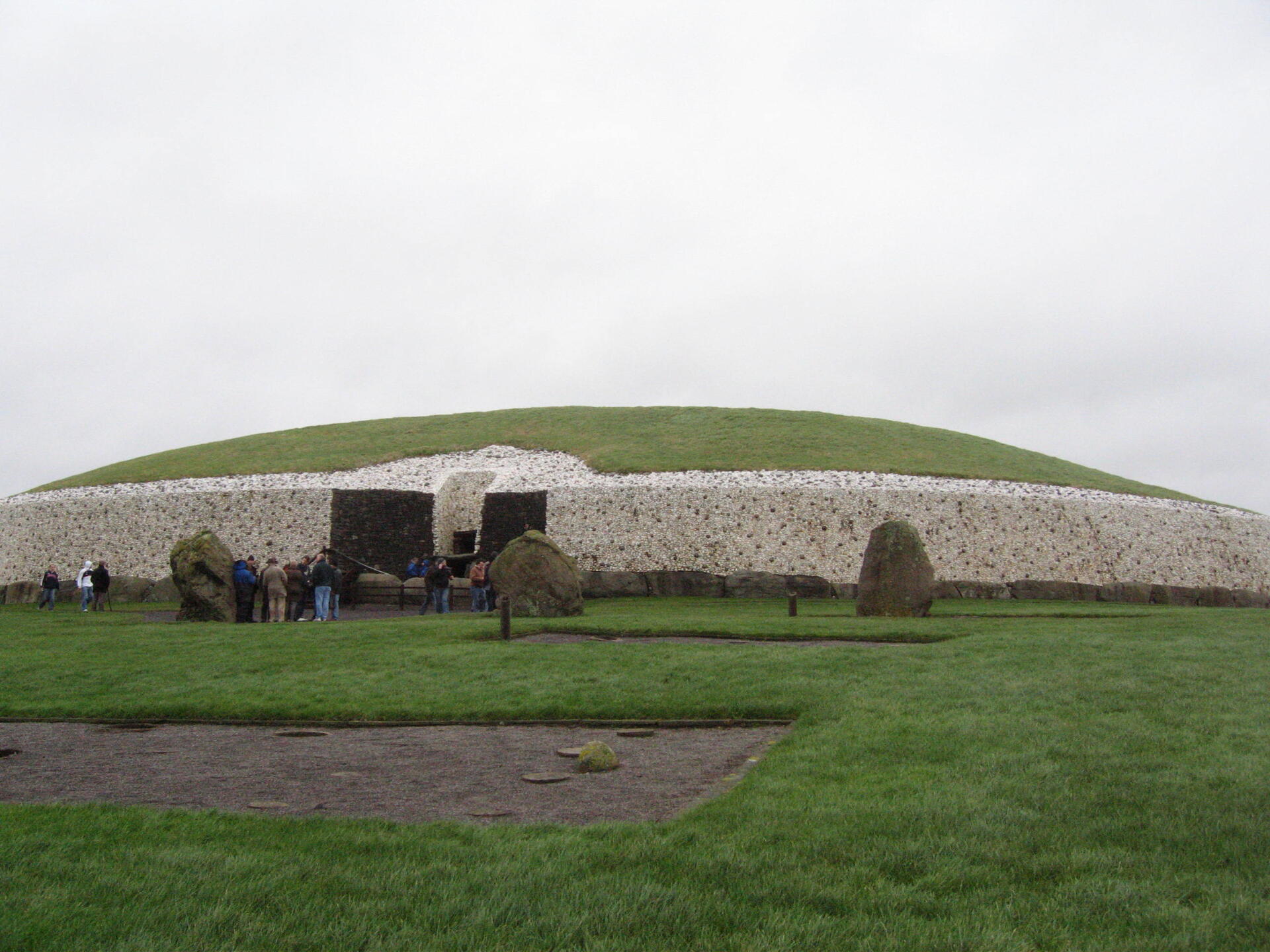
© Barbara y Eugenio - https://www.flickr.com/photos/12482011@N00, CC BY 2.0 Resized from original.
World Heritage Research
Discover scientific research and academic studies that deepen our understanding of Brú na Bóinne - Archaeological Ensemble of the Bend of the Boyne from its history and significance to its conservation, management, and contemporary challenges.
-
Knowth in Process
Recent analysis of the megalithic art at Knowth, part of the UNESCO-listed Brú na Bóinne archaeological ensemble, has unveiled intricate carvings that offer new insights into Neolithic symbolism and ritual practices in Ireland. The study, based on George Eogan and Elizabeth Shee Twohig's publication, highlights the significance of Knowth as a ceremonial site within this ancient passage tomb cemetery. Surrounded by 21 smaller mounds, Knowth's main mound features two passages aligned with astronomical events, suggesting its role in ritualistic or calendrical functions. The research approach combines archaeological excavation data with detailed analysis of the megalithic art, providing a deeper understanding of the cultural and symbolic significance of this World Heritage Site.
Jones, A. M. (2026). Knowth in Process. Time and Images after the European Ice Age, 82–92. https://doi.org/10.4324/9781003425663-11
View Publication Record | Read Publication -
Pigs, pannage, and the solstice: isotopic insights from prehistoric feasting at Newgrange
A new study reveals that feasting at Newgrange, the iconic Neolithic monument within the UNESCO-listed Brú na Bóinne complex, was likely tied to the winter solstice for centuries after its construction. Using isotopic analysis of pig remains, researchers found evidence of rapid weight gain through pannage (foraging) followed by slaughter, suggesting a seasonal pattern around 2600–2450 BC. This indicates that later activities at Newgrange maintained the original monument's solstice-focused significance. Additionally, a unique isotopic signature linked to mast (tree nuts) provides insights into prehistoric pig diets and human-woodland interactions across Europe.
Guiry, E., Beglane, F., Carlin, N., Orton, D., Teeter, M., & Szpak, P. (2025). Pigs, pannage, and the solstice: isotopic insights from prehistoric feasting at Newgrange. Proceedings of the Prehistoric Society, 91, 195–215. https://doi.org/10.1017/ppr.2025.10063
View Publication Record | Read Publication -
Ritual Landscapes and Sacred Spaces: A Landscape Archaeology Perspective on Megalithic and Neolithic Monument Complexes An Investigation of Spatial Organization, Phenomenology, and Social Memory in Prehistoric Ritual Sites
Ritual landscapes, particularly those involving megalithic and Neolithic monument complexes, function as multisensory, performative spaces that encode cosmological beliefs and social relationships. This study reveals how prehistoric communities constructed sacred geographies through carefully choreographed spatial organization, leveraging topography, celestial phenomena, and environmental contexts. Using a combination of Geographic Information Systems (GIS) analysis, viewshed modeling, and phenomenological surveys, researchers demonstrate that these landscapes served as theaters of memory, where communities negotiated identity, power, and cosmological understanding through embodied practices. Comparative case studies from Stonehenge, Avebury, the Orkney Islands, and Brú na Bóinne highlight the interconnections between monument morphology and social memory, offering new insights into how prehistoric societies ritualized their environments.
M., B. (2025). Ritual Landscapes and Sacred Spaces: A Landscape Archaeology Perspective on Megalithic and Neolithic Monument Complexes An Investigation of Spatial Organization, Phenomenology, and Social Memory in Prehistoric Ritual Sites. International Journal of History and Archaeology Research Studies (IJHARS), 2(4), 111. https://doi.org/10.63090/ijhars/3049.1622.0024
View Publication Record | Read Publication -
Professor George Eogan, MRIA FSA HonFSAScot
Professor George Eogan, Professor Emeritus of Celtic Archaeology at University College Dublin (UCD), made groundbreaking contributions to the understanding of Neolithic and Bronze Age cultures in Ireland. His extensive research on the Knowth passage tomb complex within the Brú na Bóinne World Heritage site revealed significant insights into the architectural sophistication and symbolic significance of these ancient structures. Eogan's work, which combined meticulous excavation techniques with innovative analytical methods, shed light on the social and ritual practices of Neolithic communities. Additionally, his studies on Bronze Age metalwork and goldwork expanded our knowledge of craftsmanship and trade during this period. His legacy lies in both his scholarly publications and his role as a mentor to future generations of archaeologists.
Cooney, G. (2022). Professor George Eogan, MRIA FSA HonFSAScot. Proceedings of the Society of Antiquaries of Scotland, 151, 1–5. https://doi.org/10.9750/psas.151.1343
View Publication Record | Read Publication -
Beyond Newgrange: Brú na Bóinne in the later Neolithic
Recent surveys of the Brú na Bóinne World Heritage Site, Ireland, have uncovered a diverse array of late Neolithic ritual and ceremonial structures, including earthen henges, square-in-circle monuments, palisaded enclosures, and pit/post-alignments. These discoveries, made possible by advanced non-invasive technologies like LiDAR and geophysical surveys, as well as the 2018 drought-induced cropmarks, reveal a landscape of extraordinary diversity yet architectural commonality with earlier passage tombs. The findings suggest both parallels with British Neolithic traditions and insular developments unique to Brú na Bóinne, offering new insights into the later Neolithic period without relying on excavation.
Davis, S., & Rassmann, K. (2021). Beyond Newgrange: Brú na Bóinne in the later Neolithic. Proceedings of the Prehistoric Society, 87, 189–218. https://doi.org/10.1017/ppr.2021.6
View Publication Record | Read Publication -
Archaeology and Myth in Early Medieval Europe: Making the Gods of Early Ireland
Recent research into early medieval Ireland reveals that many deities associated with iconic sites like Tara and Brú na Bóinne were likely invented during the 8th century for political, allegorical, or exegetical purposes rather than reflecting prehistoric cult practices. This challenges traditional assumptions about pre-Christian cosmologies, highlighting a creative process tied to the flourishing of saga literature and monumental architecture. The study critiques the use of mythology, place names, and folklore in reconstructing mentalities, emphasizing the need for systematic scrutiny of such methods across European medieval archaeology. By analyzing case studies from Tara, Brú na Bóinne (Co Meath), and Nenagh (Co Tipperary), the research underscores the complexities of linking medieval evidence to pre-Christian beliefs.
Gleeson, P. (2020). Archaeology and Myth in Early Medieval Europe: Making the Gods of Early Ireland. Medieval Archaeology, 64(1), 65–93. https://doi.org/10.1080/00766097.2020.1754646
View Publication Record | Read Publication -
The Role of Solar Deities in Irish Megalithic Monuments
Irish megalithic monuments, particularly those within the UNESCO World Heritage Site Brú na Bóinne, hold deep mythological significance tied to solar deities. Analysis of Irish mythology reveals that these sites, especially Newgrange, were central to narratives involving sun gods like Dagda and Lugh, as well as the conception and birth of the warrior hero Cú Chulainn. The study suggests that myths may reflect the monuments' symbolic meaning across different historical periods, offering insights into their cultural and spiritual importance.
Clynes, F. (2020). The Role of Solar Deities in Irish Megalithic Monuments. Culture and Cosmos, 24(0102), 9–25. https://doi.org/10.46472/cc.1224.0203
View Publication Record | Read Publication