World Heritage Identification Number: 1361
World Heritage since: 2014
Category: Cultural Heritage
WHE Type: Buildings & Architectural Ensembles
Transboundary Heritage: No
Endangered Heritage: No
Country: 🇸🇦 Saudi Arabia
Continent: Asia
UNESCO World Region: Arab States
Map
The Gateway to Makkah: A Journey Through Historic Jeddah
Historic Jeddah, officially recognized as a UNESCO World Heritage Site in 2014, stands as a testament to the rich cultural and commercial history that has shaped the city over centuries. Situated on the eastern coast of the Red Sea, this ancient port city has served as a crucial link between the Indian Ocean trade routes and the holy city of Mecca, making it a vibrant melting pot of diverse cultures and architectural styles.
More to come…UNESCO Description of the World Heritage Site
Historic Jeddah is situated on the eastern shore of the Red Sea. From the 7th century AD it was established as a major port for Indian Ocean trade routes, channelling goods to Mecca. It was also the gateway for Muslim pilgrims to Mecca who arrived by sea. These twin roles saw the city develop into a thriving multicultural centre, characterized by a distinctive architectural tradition, including tower houses built in the late 19th century by the city’s mercantile elites, and combining Red Sea coastal coral building traditions with influences and crafts from along the trade routes.
UNESCO Justification of the World Heritage Site
Criterion (ii): The cityscape of Historic Jeddah is the result of an important exchange of human values, technical Know-how, building materials and techniques across the Red Sea region and along the Indian Ocean routes between the 16th and the early 20th centuries. Historic Jeddah represents this cultural world that thrived, thanks to international sea trade; possessed a shared geographical, cultural and religious background; and built settlements with specific and innovative technical and aesthetic solutions to cope with the extreme climatic conditions of the region (humidity and heat). Jeddah was, for centuries, the most important, largest and richest among these settlements and today, Historic Jeddah is the last surviving urban site along the Red Sea coast that still preserves the ensemble of the attributes of this culture: commercial-based economy, multi-cultural environment, isolated outward-oriented houses, coral masonry construction, precious woodwork decorating the facades, and specific technical devices to aid internal ventilation.
Criterion (iv): Historic Jeddah is an outstanding reflection of its final flourishing as a trading and pilgrimage city and, the only surviving urban ensemble of the Red Sea cultural world. Jeddah’s Roshan tower houses are an outstanding example of a typology of buildings unique within the Arab and Moslem world. Their specific aesthetic and functional patterns - absence of courtyard, decorated Roshan façades, ground floor room used for offices and commerce, rooms rented for pilgrims - reflect their adaptation to both the hot and humid climate of the Red Sea and to the specificity of Jeddah, the Gate to the Holy City of Makkah for the pilgrims arriving by sea, and an important international commercial pole. The development of the Roshan tower houses in the second half of 19th century illustrates the evolution of the patterns of trade and pilgrimages in the Arabian Peninsula and in Asia following the opening of the Suez Canal in 1869 and the development of steamboat navigation routes linking Europe with India and East Asia. The extraordinary relevance of Jeddah’s tower houses is further increased by the fact that they are not only unique within the Red Sea culture region, an architectural typology born in Jeddah that spread to the nearby Hejaz cities of Al-Madinah, Makkah and Taif from where it has since completely disappeared under the pressure of modern development. The overall landscape of Jeddah is characterised not only by the aesthetically remarkable tower houses, but also by the dense accumulations of lower houses, the ensembles of structures that related to trade, religion and the accommodation of pilgrims, and for the overall urban form and its division into clearly defined quarters.
Criterion (vi): Historic Jeddah is directly associated, both at the symbolic intangible level and at the architectural and urban level with the Hajj, the yearly Muslim pilgrimage to the Holy City of Makkah. Jeddah was the landing harbour for all the pilgrims that reached Arabia by sea, and for centuries, up to the present, the city lived in function of the pilgrimages.The goods the pilgrimage brought with them from Asia and Africa and sold in the city, the religious debates with Ulama(s) from Java and India, the spices, the food, and the intangible heritage of the city were all related to the pilgrimage that has immensely contributed to defining the identity of Jeddah. The association with Hajj is also very evident in the urban structure of the nominated property and is found in the traditional souks running East –West from the sea to Makkah Gate, the Ribat(s) and the Wakala(s) that used to host the pilgrims; in the architecture, notably in the facades and internal structure of the houses; and in the very social fabric of the city, where Muslims from all over the world mingled, lived, and worked together. The ensemble of these elements, tangible and intangible, demonstrates the intimate and long-lasting connection between the pilgrimage and the nominated property and is an example of the very rich cultural diversity resulting from this religious event unique in the whole Islamic World.
Encyclopedia Record: Al-Balad, Jeddah
Al-Balad, also known as Jeddah Historic District, is the historical area of Jeddah, the second largest city of Saudi Arabia. Al-Balad can literally be translated to "The Town". Al-Balad is the historic center of the City of Jeddah.Additional Site Details
Area: 17.92 hectares
Number of Components: 1
(iv) — Outstanding example of a type of building or landscape
(vi) — Directly associated with events or living traditions
Coordinates: 21.4838888889 , 39.1875
Image
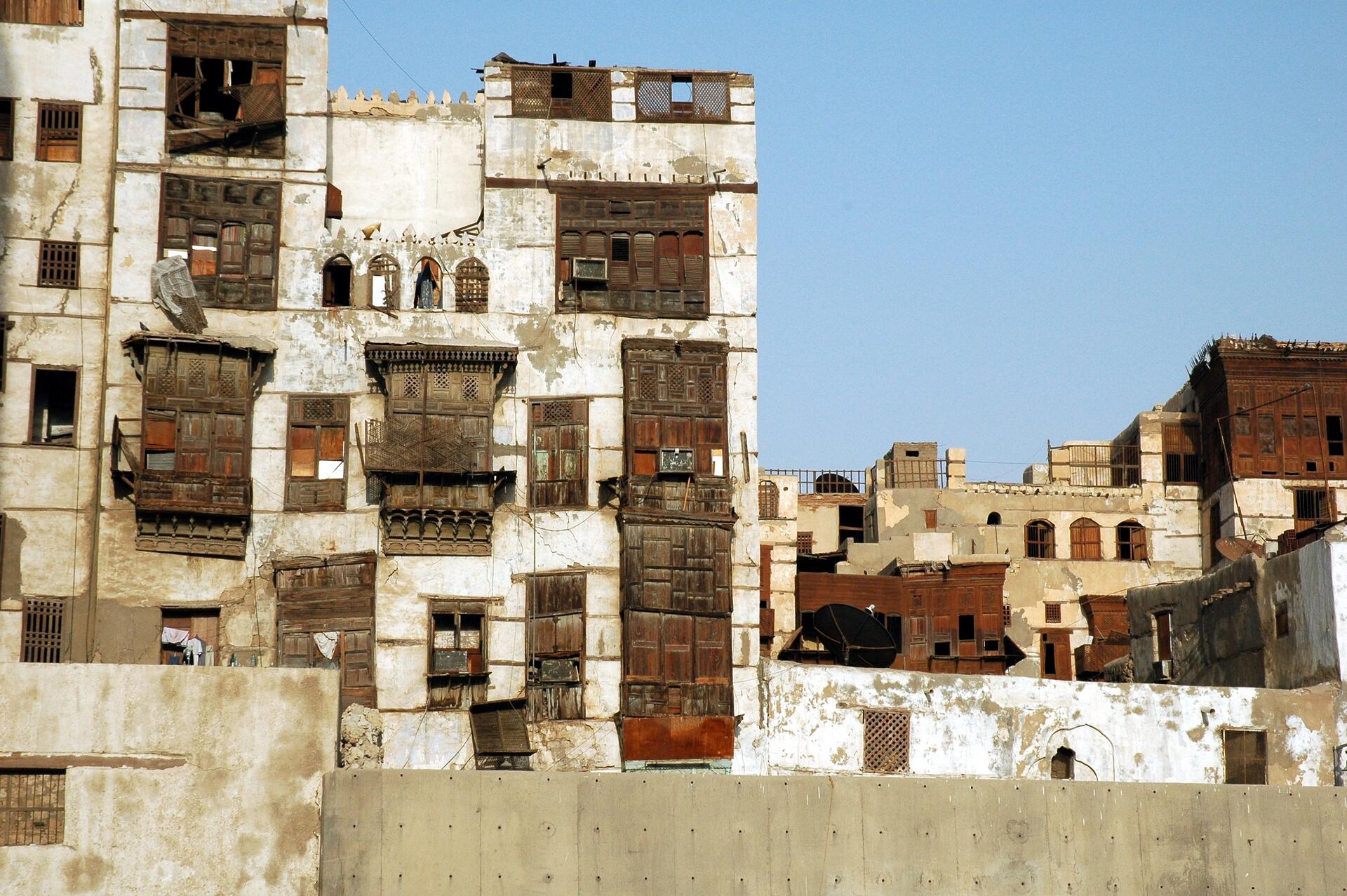
© User:Jpatokal, CC BY-SA 4.0 Resized from original. (This derivative is under the same CC BY-SA license.)