World Heritage Identification Number: 870
World Heritage since: 1998
Category: Cultural Heritage
WHE Type: Buildings & Architectural Ensembles
Transboundary Heritage: No
Endangered Heritage: No
Country: 🇯🇵 Japan
Continent: Asia
UNESCO World Region: Asia and the Pacific
Map
Exploring the Historic Monuments of Ancient Nara: A Journey Through Japan's Rich Past
The Historic Monuments of Ancient Nara, inscribed as a UNESCO World Heritage Site in 1998, offer a captivating glimpse into the rich history and cultural evolution of Japan during its formative years. Situated in the Nara Prefecture, these monuments serve as a testament to the political and cultural transformation that took place in the 8th century, when Nara served as the capital of Japan for over seven decades.
More to come…UNESCO Description of the World Heritage Site
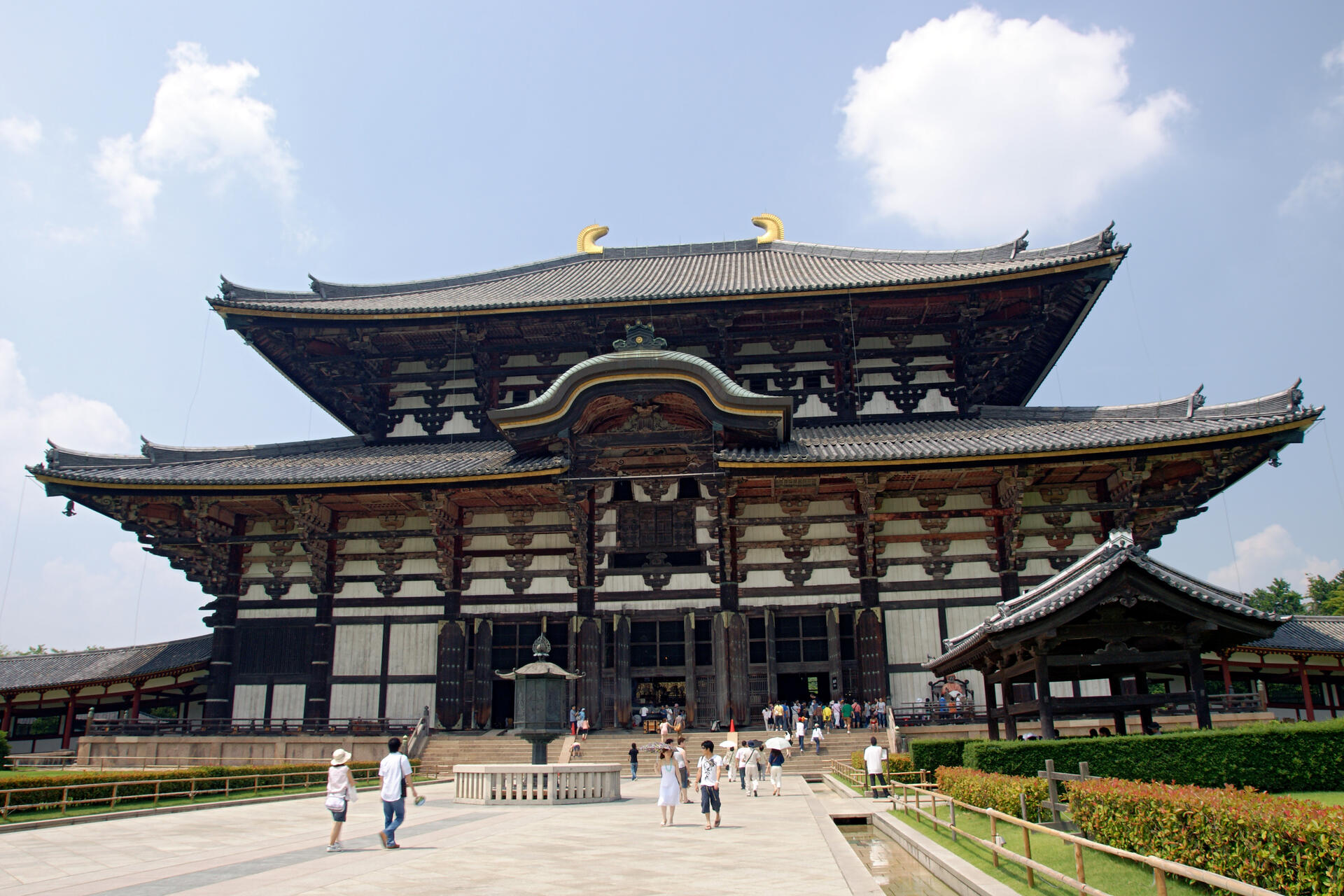
Nara was the capital of Japan from 710 to 784. During this period the framework of national government was consolidated and Nara enjoyed great prosperity, emerging as the fountainhead of Japanese culture. The city's historic monuments – Buddhist temples, Shinto shrines and the excavated remains of the great Imperial Palace – provide a vivid picture of life in the Japanese capital in the 8th century, a period of profound political and cultural change.
UNESCO Justification of the World Heritage Site
Criterion (ii): The historic monuments of Ancient Nara bear exceptional witness to the evolution of Japanese architecture and art as a result of cultural links with China and Korea which were to have a profound influence on future developments.
Criterion (iii): The flowering of Japanese culture during the period when Nara was the capital is uniquely demonstrated by its architectural heritage.
Criterion (iv): The layout of the Imperial Palace and the design of the surviving monuments in Nara are outstanding examples of the architecture and planning of early Asian capital cities.
Criterion (vi): The Buddhist temples and Shinto shrines of Nara demonstrate the continuing spiritual power and influence of these religions in an exceptional manner.
Encyclopedia Record: Historic Monuments of Ancient Nara
Historic Monuments of Ancient Nara is a UNESCO World Heritage Site consisting of eight places in the old capital Nara in Nara Prefecture, Japan. Five are Buddhist temples, one is a Shinto shrine, one is a Palace and one a primeval forest. The properties include 26 buildings designated by the Japanese Government as National Treasures as well as 53 designated as Important Cultural Properties. All compounds have been recognized as Historic Sites. The Nara Palace Site was designated as Special Historic Site and the Kasugayama Primeval Forest as Special Natural Monument. Tōdai-ji, Kōfuku-ji and the Kasugayama Primeval Forest overlap with Nara Park, a park designated as one of the "Places of Scenic Beauty" by the Ministry of Education, Culture, Sports, Science and Technology (MEXT). UNESCO listed the site as World Heritage in 1998.Additional Site Details
Area: 617 hectares
Number of Components: 7
(iii) — Unique or exceptional testimony to a cultural tradition
(iv) — Outstanding example of a type of building or landscape
(vi) — Directly associated with events or living traditions
Coordinates: 34.67555556 , 135.8394444
World Heritage Research
Discover scientific research and academic studies that deepen our understanding of Historic Monuments of Ancient Nara from its history and significance to its conservation, management, and contemporary challenges.
-
World Heritage Site as the place for education: the case of the Gango-ji Temple in Japan
World Heritage Sites serve as dynamic educational platforms, blending tangible and intangible heritage to foster learning. A study on the Gango-ji Temple in Japan's 'Historic Monuments of Ancient Nara' reveals that such sites facilitate social education through interactive experiences. The temple's main hall and exhibition room offer visitors the opportunity to engage with authentic cultural materials, promoting deeper understanding. Staff recommendations suggest a structured approach: studying exhibits for an hour before reflecting in the main hall. This study highlights heritage as an ongoing process where contemporary communities and tourists alike participate in preserving and learning from the past.
Serizawa, S., & Sunami, S. (2019). World Heritage Site as the place for education: the case of the Gango-ji Temple in Japan. Asian Education and Development Studies, 8(4), 454–462. https://doi.org/10.1108/aeds-02-2018-0052
View Publication Record | Read Publication -
Yamato as cultural memory: Maekawa Samio's poetry on Nara
Maekawa Samio, a celebrated 20th-century tanka poet and modernist pioneer, deeply embedded the landscape of Nara—his birthplace and cultural heartland—in his poetry, crafting over 1,000 verses that celebrate its Arcadian beauty and historical richness. Through a detailed analysis of his works, including Shokubutsusai (1930), Yamato roppyakuka (1971), and Yamato mahoroba no ki (1982), this study reveals how Nara's topography and traditions shaped Maekawa's poetic evolution. His verse not only reflects the enduring allure of rural Yamato but also traces shifts in his perception of landscape, from youthful reverence to a mature synthesis of history, culture, and personal memory. The research employs close textual analysis to illustrate Nara's significance as both a physical and symbolic foundation for Maekawa's poetic identity.
Morton, L. (2015). Yamato as cultural memory: Maekawa Samio’s poetry on Nara. Proceedings of the Association for Japanese Literary Studies, 14. https://doi.org/10.26812/pajls.v14i.1358
View Publication Record | Read Publication -
A Study of the Construction Methods for the Preservation of Important Underground Remains
A novel approach to preserving underground archaeological remains, dubbed 'Intelligent Construction,' successfully minimized structural damage during excavation at the Asuka-Nara Palace Site, a UNESCO World Heritage component. This method leverages geotechnical modeling—specifically Boussinesq's formula—to predict stress impacts from construction machinery and guide precision execution. By pre-mapping remains with 3D positioning systems and avoiding direct cutting or excessive stress, researchers achieved flawless preservation despite surface-level construction activities. The findings underscore the feasibility of advanced, data-driven techniques for safeguarding fragile historical sites without compromising development needs.
Fujino, K. (2011). A Study of the Construction Methods for the Preservation of Important Underground Remains. 28th International Symposium on Automation and Robotics in Construction (ISARC 2011). https://doi.org/10.22260/isarc2011/0182
View Publication Record | Read Publication