
World Heritage Identification Number: 1181
World Heritage since: 2005
Category: Cultural Heritage
WHE Type: Historic Cities & Urban Areas
Transboundary Heritage: No
Endangered Heritage: No
Country: 🇫🇷 France
Continent: Europe
UNESCO World Region: Europe and North America
Map
Le Havre, the City Rebuilt by Auguste Perret: A Post-War Architectural Marvel
Le Havre, a significant port city in the Seine-Maritime department of Normandy, France, stands as a testament to architectural innovation and urban planning prowess. Inscribed as a UNESCO World Heritage Site in 2005, this city, rebuilt after extensive damage during World War II, represents a unique blend of historical preservation and modernist design.
More to come…UNESCO Description of the World Heritage Site
The city of Le Havre, on the English Channel in Normandy, was severely bombed during the Second World War. The destroyed area was rebuilt according to the plan of a team headed by Auguste Perret, from 1945 to 1964. The site forms the administrative, commercial and cultural centre of Le Havre. Le Havre is exceptional among many reconstructed cities for its unity and integrity. It combines a reflection of the earlier pattern of the town and its extant historic structures with the new ideas of town planning and construction technology. It is an outstanding post-war example of urban planning and architecture based on the unity of methodology and the use of prefabrication, the systematic utilization of a modular grid, and the innovative exploitation of the potential of concrete.
UNESCO Justification of the World Heritage Site
Criterion (ii): The post-war reconstruction plan of Le Havre is an outstanding example and a landmark of the integration of urban planning traditions and a pioneer implementation of modern development in architecture, technology and town planning.
Criterion (iv): Le Havre is an outstanding post-war example of urban planning and architecture, based on the unity of methodology and system of prefabrication, the systematic use of a modular grid and the innovative exploitation of the potential of concrete.
Encyclopedia Record: Le Havre
Le Havre is a major port city in the Seine-Maritime department in the Normandy region of northern France. It is situated on the right bank of the estuary of the river Seine on the English Channel southwest of the Pays de Caux, very close to the Prime Meridian. Le Havre is the busiest port on the northern French Coast and largest container port in France. it is the second largest city in the Normandy region of France with total population of the greater Le Havre conurbation being smaller than that of Rouen.It is also the second largest subprefecture in France, after only Reims. The name Le Havre means 'the harbour' or 'the port'. Its inhabitants are known as havrais or havraises.Additional Site Details
Area: 133 hectares
Number of Components: 1
(iv) — Outstanding example of a type of building or landscape
Coordinates: 49.49278 , 0.1075
Image
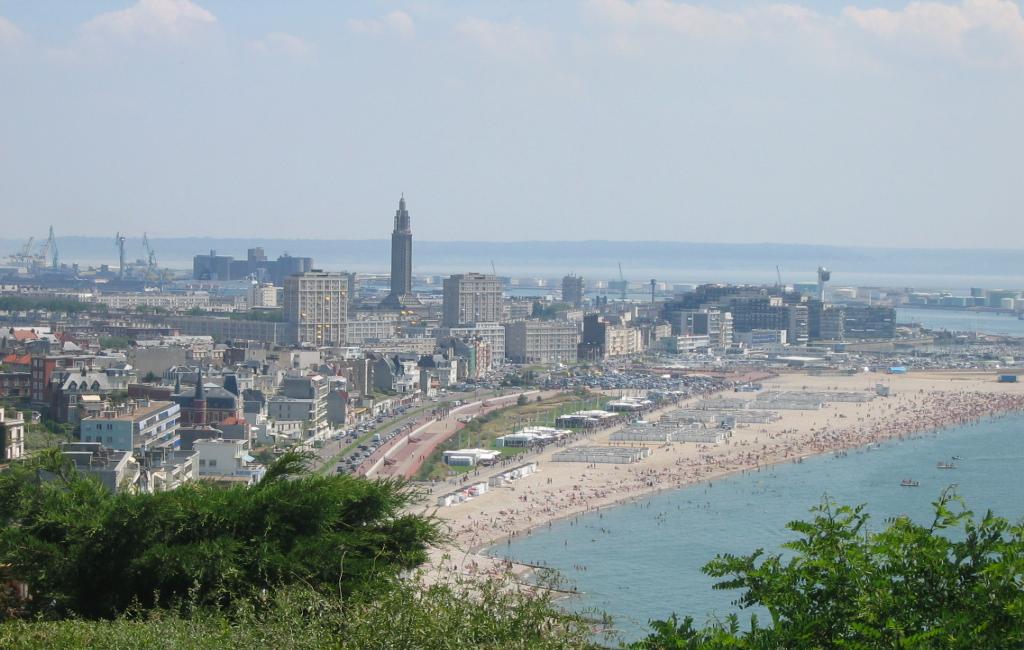
©
- derivative work:Ignis
- Le_Havre_Vue_Plage_14_07_2005.jpg: Urban
World Heritage Research
Discover scientific research and academic studies that deepen our understanding of Le Havre, the City Rebuilt by Auguste Perret from its history and significance to its conservation, management, and contemporary challenges.
-
Brasília, Tel-aviv e Le Havre: três cidades modernas, três dossiês de candidatura a patrimônio mundial, uma análise comparativa | Brasília, TelAviv, and Le Havre: three modern cities, three nomination files for World Heritage, a comparative analysis
A comparative analysis of the nomination dossiers for Brasília, Tel-Aviv, and Le Havre—three modern cities inscribed as UNESCO World Heritage Sites—reveals distinct yet overlapping narratives of urban patrimonialization. The study highlights how each city's dossier strategically framed its historical significance, architectural innovation, and cultural value to meet UNESCO criteria. While all three cities emphasize their modernist heritage, differences emerge in their approaches to documentation, preservation challenges, and the broader socio-political contexts shaping their candidacies. This analysis offers insights into the complexities of urban patrimonialization, underscoring both universal themes and unique local dynamics.
Da Silva, J. G., & Medeiros, A. E. d. A. (2022). Brasília, Tel-aviv e Le Havre: três cidades modernas, três dossiês de candidatura a patrimônio mundial, uma análise comparativa | Brasília, TelAviv, and Le Havre: three modern cities, three nomination files for World Heritage, a comparative analysis. Oculum Ensaios, 19. https://doi.org/10.24220/2318-0919v19e2022a5060
View Publication Record | Read Publication -
Reconstruction 1945–56: rebuilding or modernisation?
Post-war reconstruction in France revealed a tension between modernizing ambitions and traditionalist preferences, with the Ministry of Reconstruction and Urbanism (MRU) wielding significant power to reshape cities despite local resistance. While MRU pursued urban planning reforms—such as road widening and land-use separation—its architectural approach under Raoul Dautry remained conservative, favoring established designs over modernist visions like those proposed by Le Corbusier in Saint-Dié or Auguste Perret’s conservative modernism in Le Havre. Only after 1950 did MRU align with CIAM principles and innovative construction methods, marking a shift from planning-focused modernization to architectural innovation.
Bullock, N. (2022). Reconstruction 1945–56: rebuilding or modernisation? Modernising Post-War France, 11–36. https://doi.org/10.4324/9781003094562-3
View Publication Record | Read Publication -
Extraordinary Modernism in The Reconstruction of The City Center of Le Havre on The Example of The Church of St. Joseph According to The Design of Auguste Perret
Auguste Perret's Church of St. Joseph stands as a forgotten yet extraordinary example of modernist sacred architecture, showcasing the innovative use of raw materials like concrete and reinforced concrete during Le Havre's post-war reconstruction. This study highlights its enduring spatial, aesthetic, and functional values, demonstrating how Perret's design not only mastered technological challenges but also redefined artistic expression in urban reconstruction. The church, alongside the town hall and cathedral, forms a pivotal element of the city's historical urban composition, offering a coherent vision of modernist thought that remains relevant today.
Szumigała, P. P., & Szumigała, K. O. (2022). Extraordinary Modernism in The Reconstruction of The City Center of Le Havre on The Example of The Church of St. Joseph According to The Design of Auguste Perret. Teka Komisji Architektury, Urbanistyki I Studiów Krajobrazowych, 18(3), 41–50. https://doi.org/10.35784/teka.3115
View Publication Record | Read Publication

