World Heritage Identification Number: 83
World Heritage since: 1979
Category: Cultural Heritage
WHE Type: Buildings & Architectural Ensembles
Transboundary Heritage: No
Endangered Heritage: No
Country: 🇫🇷 France
Continent: Europe
UNESCO World Region: Europe and North America
Map
The Palace and Park of Versailles: A Grandiose Symbol of Absolute Monarchy
The Palace and Park of Versailles, inscribed as a UNESCO World Heritage Site in 1979, stands as a testament to the grandeur and power of absolute monarchy during the Ancien Régime in France. This opulent palace complex, located approximately 18 kilometers west of Paris, offers a unique insight into the lifestyle, politics, and artistic achievements of the Bourbon dynasty, particularly under the reign of King Louis XIV.
The Palace of Versailles serves as the central focus of this vast estate, which spans over 2,000 hectares. Commissioned by King Louis XIV in 1661, the palace was designed by the renowned architect Louis Le Vau, with key contributions from Charles Le Brun, Claude Perrault, and André Le Nôtre. Jules Hardouin-Mansart was the chief architect for later and more significant constructions. The construction of the palace took nearly three decades to complete, reflecting the immense resources and manpower available to the king. Louis XIV continued to modify and expand the palace until his death in 1715.
The palace itself is a marvel of Baroque architecture, characterized by its symmetrical design, intricate details, and grand scale. The Hall of Mirrors, one of the most famous rooms in the palace, stretches over 73 meters long and features 357 mirrors, offering a breathtaking reflection of the palace's grandeur. Other notable rooms include the Royal Chapel, the Queen's Bedchamber, and the State Apartments, each adorned with exquisite artwork, tapestries, and furniture.
Beyond the palace lies the expansive park, designed by André Le Nôtre, who also created the gardens at the Palace of Vaux-le-Vicomte and the Tuileries Garden in Paris. The park, covering 800 hectares, features geometrically arranged parterres, fountains, groves, and the Grand Trianon, a smaller palace built by Louis XIV for his secret wife, Madame de Maintenon, and later used by his mistress Madame de Montespan. The park culminates in the Petit Trianon, a more intimate retreat built by Louis XV for his mistress Madame de Pompadour, used by his subsequent mistress, Madame du Barry, and later occupied by Marie Antoinette.
The Palace and Park of Versailles not only served as the seat of political power but also as a center for cultural and intellectual exchange. The palace hosted numerous salons, where philosophers, scientists, and artists gathered to discuss ideas that would shape the Enlightenment. The palace's library housed over 60,000 volumes by the 18th century, but is collection was not as renowned or influential as that of the Bibliothèque du Roi in Paris, which later became the Bibliothèque nationale de France, which housed the largest royal collection.
In conclusion, the Palace and Park of Versailles offer a fascinating glimpse into the world of absolute monarchy, showcasing the power, wealth, and artistic achievements of the Bourbon dynasty. Today, the site continues to attract millions of visitors annually, providing a tangible connection to France's rich historical and cultural heritage.
UNESCO Description of the World Heritage Site
The Palace of Versailles was the principal residence of the French kings from the time of Louis XIV to Louis XVI. Embellished by several generations of architects, sculptors, decorators and landscape architects, it provided Europe with a model of the ideal royal residence for over a century.
UNESCO Justification of the World Heritage Site
Criterion (i): The ensemble of the Palace and Park of Versailles constitutes a unique artistic realisation, by virtue not only of its size but also of its quality and originality.
Criterion (ii): Versailles exercised great influence throughout Europe from the end of the 17th century to the end of the 18th century. Wren incorporated reminiscences of Versailles into Hampton Court, Schlüter into Berlin, in designing the façades of the Palais Royal. “Little Versailles” have sprung up: Nymphenburg, Schleissheim, Karlsruhe, Würtzbourg, Postdam, Stockholm, etc. Le Nôtre’s gardens, designed by the architect himself, or by his imitators are innumerable: from Windsor to Cassel, to the Granja, Sweden, Denmark and Russia.
Criterion (vi): The absolute seat of power of the monarch, Versailles was the best formulated and best adapted crucible for French court life for a century and a half (Louis XIV perfectioned “etiquette”) and artistic creation in the domain of music, theatre and the decorative arts. Numerous scientific discoveries were presented there, encouraged by the kings, founders of royal academies. It was at Versailles that, on 6 October 1789, the people came to carry off Louis XVI and Marie-Antoinette, once again shifting the centre of power back to Paris.
Encyclopedia Record: Palace of Versailles
The Palace of Versailles is a former royal residence commissioned by King Louis XIV located in Versailles, about 18 kilometres (11 mi) west of the city centre of Paris, in the Yvelines Department of Île-de-France region in France.Additional Site Details
Area: 1,070 hectares
Number of Components: 1
(ii) — Significant interchange of human values
(vi) — Directly associated with events or living traditions
Coordinates: 48.805 , 2.119444444
Image
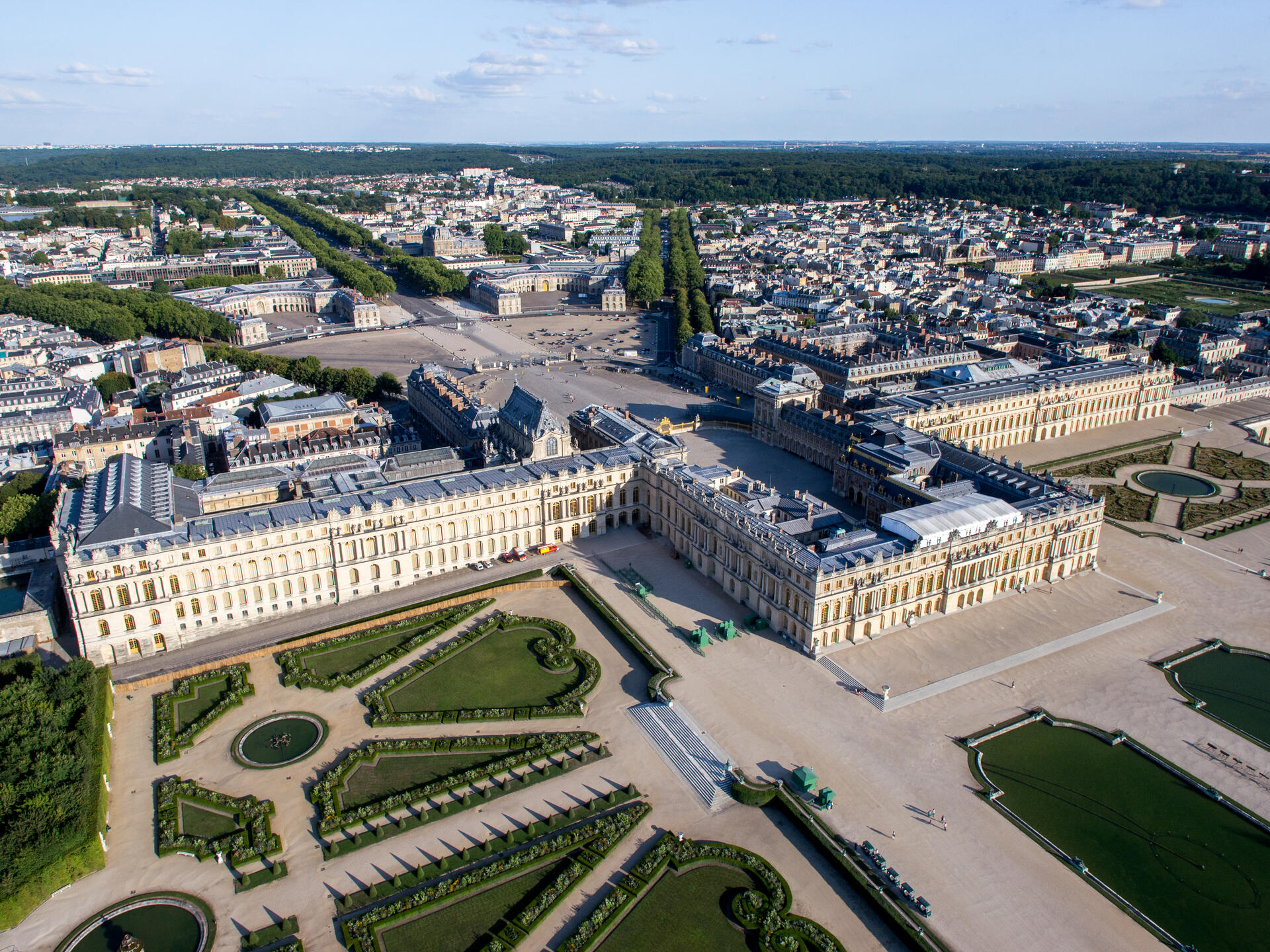
© ToucanWings, CC BY-SA 3.0 Resized from original. (This derivative is under the same CC BY-SA license.)
World Heritage Research
Discover scientific research and academic studies that deepen our understanding of Palace and Park of Versailles from its history and significance to its conservation, management, and contemporary challenges.
-
The systemisation of classical topomythopoiesis in seventeenth-century France
Seventeenth-century France witnessed the systematization of classical topomythopoiesis, where Italian Renaissance garden influences were integrated into aristocratic landscapes under Louis XIV's reign. The Palace and Park of Versailles exemplify this transformation, blending elaborate waterworks and horticulture with mythological iconography created by a collective of artists and writers. Initially, visitor reception relied on familiarity with Greco-Roman mythology, but as the gardens became more accessible, guidebooks standardized experiences through scripted interpretations. This study reveals how classical topomythopoiesis oscillated between imaginative engagement and analytic interpretation, reflecting an era of both wonderment and rationalization. It also highlights its dissemination through influential treatises like Dézallier d’ Argenville’s La theorie et la pratique du jardinage, marking a shift toward structured mythological representation in designed landscapes.
Prinsloo, J. N. (2025). The systemisation of classical topomythopoiesis in seventeenth-century France. Studies in the History of Gardens & Designed Landscapes, 45(1), 14–40. https://doi.org/10.1080/14601176.2025.2483110
View Publication Record | Read Publication -
A Comparative Study of The Palace of Versailles and Imperial Garden Yuanmingyuan
A comparative analysis of the Palace of Versailles and the Imperial Garden Yuanmingyuan reveals distinct architectural and garden design principles shaped by cultural and imperial influences. While Versailles, under Louis XIV, embodied Western opulence with its grand French gardens symbolizing power and luxury, Yuanmingyuan reflected Emperor Kangxi's reverence for traditional Chinese culture through its intricate garden layouts and exquisite structures. This study highlights the disparities in construction backgrounds, planning, architectural styles, and landscaping techniques between these two 18th-century royal palaces, offering insights into how cultural heritage and imperial personalities influence architectural evolution.
Lin, X. (2024). A Comparative Study of The Palace of Versailles and Imperial Garden Yuanmingyuan. Communications in Humanities Research, 32(1), 72–77. https://doi.org/10.54254/2753-7064/32/20240015
View Publication Record | Read Publication -
Naumachia and Scientific Research in the Shade of the Trees: Experiments on Hulls in the Park of a Royal Palace
The Grand Canal at the Palace of Versailles, often seen as a symbol of court splendor and park design, also served a dual purpose: it was a testing ground for war and merchant hulls. This study reveals that the canal's construction in the 17th century under Louis XIV was not only an architectural marvel but also a site for empirical naval experiments. These experiments, rooted in classical and Renaissance naumachia traditions, laid the groundwork for future advancements in naval architecture, culminating in the scientific methodologies of figures like Gaspard Monge and Duhamel de Monceau in the following century. The research highlights the significance of these early trials in shaping the field's methodological development.
Ruggiero, M. E. (2024). Naumachia and Scientific Research in the Shade of the Trees: Experiments on Hulls in the Park of a Royal Palace. Nautical and Maritime Culture, from the Past to the Future. https://doi.org/10.3233/pmst240005
View Publication Record | Read Publication -
A catalog of gardens by André Le Nôtre and their characteristics
A comprehensive catalog of 70 gardens designed by André Le Nôtre reveals that his workload peaked during Louis XIV's reign, coinciding with the rise of French-style garden fame. The study found that most benefactors had ties to Louis XIV and surviving gardens were repurposed as public facilities, a strategy that prevented their destruction, as seen in the Palace of Versailles. Additionally, segmentation during nationalization efforts and later reinvention into landscape gardens contributed to the loss of 52 other gardens. This research provides insights into Le Nôtre's influence, the historical context of garden patronage, and the preservation strategies that shaped the legacy of these sites.
HIRAOKA, N. (2023). アンドレ・ル・ノートルの関わった庭園一覧とその特徴. Journal of the Japanese Institute of Landscape Architecture, 86(5), 413–418. https://doi.org/10.5632/jila.86.413
View Publication Record | Read Publication -
Empfindsamkeitsarchitektur
A new study reveals that the Hameau de la Reine, a rustic village-like ensemble built for Marie-Antoinette within the Palace and Park of Versailles, embodies the paradoxical nature of 18th-century aesthetic ideals. Despite its outward rural appearance, some buildings were inhabited by staff or used for agricultural purposes, while others served as lavish entertainment spaces for the court, with interiors adorned in opulence. The research, led by Felix Vogel, leverages previously overlooked archival sources to reconstruct the Hameau's origins, functions, and usage during the emerging epoch of sensibility (Empfindsamkeit). It explores themes such as the objectification of architecture, the status of displayed bodies, and the artificial creation of naturalness, demonstrating how authenticity became an aesthetic calculation with lasting implications. This study challenges conventional perceptions of the Hameau's purpose and significance, offering insights that extend beyond Versailles to broader cultural and historical contexts.
Vogel, F. (2023). Empfindsamkeitsarchitektur. https://doi.org/10.4000/books.editionsmsh.55558
View Publication Record | Read Publication -
Louis XIV’s “The City of the Sun”
The Palace and Park of Versailles, under Louis XIV's reign, epitomizes the fusion of utopian ideals from Tommaso Campanella and the Baroque urban transformations of Rome. This grand landscape serves as a metaphor for absolute power, contrasting with the dense urban structures of Rome and Paris. The park's design, replete with didactic symbolism, reflects Louis XIV's ambition to educate worthy successors and project his authority through intricate planning and sensory experiences. The study reveals that Versailles is not merely an architectural achievement but a Baroque Gesamtkunstwerk, integrating earth, air, fire, and water to stimulate imagination and thought. Through meticulous stage direction and extravagant day-and-night revelries, the park becomes a center of sensual pleasures, glorifying the Sun King's rule.
Stepanov, A. (2023). Louis XIV’s “The City of the Sun”. Versus, 3(1), 75–99. https://doi.org/10.58186/2782-3660-2023-3-1-75-99
View Publication Record | Read Publication -
Versailles: The phenomenology of architectural form
The architectural evolution of the Palace and Park of Versailles is revealed as a unique spatial artistic experience that transitions from Baroque theatricality to Rococo and early classicism, reflecting the socio-cultural dynamics of court society. This study identifies how the palace's form-making process constitutes a distinct semantic space, evolving from mythologized absolutist grandeur to pre-revolutionary private structuration. The research approaches this transformation through the lens of Western European architectural trends, analyzing its shift from Italian classical Baroque to national Rococo traditions.
Dymchenko, M. (2023). Versailles: The phenomenology of architectural form. Проект Байкал, (78), 85–89. https://doi.org/10.51461/issn.2309-3072/78.2241
View Publication Record | Read Publication