
World Heritage Identification Number: 1127
World Heritage since: 2004
Category: Cultural Heritage
WHE Type: Agriculture Landscapes, Parks & Gardens
Transboundary Heritage: Yes
Endangered Heritage: No
Country: Germany, Poland
Continent: Europe
UNESCO World Region: Europe and North America
Map
Muskauer Park / Park Mużakowski: A Landscape Painting in Central Europe
Muskauer Park, also known as Park Mużakowski, is a remarkable example of English garden design in Central Europe. Situated in the Upper Lusatia region, straddling the Neisse River and the border between Poland and Germany, this 559.9-hectare landscaped park was created by Prince Hermann von Puckler-Muskau from 1815 to 1844. Inscribed as a UNESCO World Heritage Site in 2004, Muskauer Park is celebrated for its innovative approach to landscape architecture, influencing the development of this art form in Europe and America.
More to come…UNESCO Description of the World Heritage Site
A landscaped park of 559.9 ha astride the Neisse River and the border between Poland and Germany, it was created by Prince Hermann von Puckler-Muskau from 1815 to 1844. Blending seamlessly with the surrounding farmed landscape, the park pioneered new approaches to landscape design and influenced the development of landscape architecture in Europe and America. Designed as a ‘painting with plants’, it did not seek to evoke classical landscapes, paradise, or some lost perfection, instead using local plants to enhance the inherent qualities of the existing landscape. This integrated landscape extends into the town of Muskau with green passages that formed urban parks framing areas for development. The town thus became a design component in a utopian landscape. The site also features a reconstructed castle, bridges and an arboretum.
UNESCO Justification of the World Heritage Site
Criterion (i): Muskauer Park / Park Mużakowski is an exceptional example of a European landscape park that broke new ground in terms of development towards an ideal human-made landscape.
Criterion (iv): Muskauer Park / Park Mużakowski was the forerunner for new approaches to landscape design in cities, and influenced the development of landscape architecture as a discipline.
Encyclopedia Record: Muskau Park
Muskau Park is a landscape park in the Upper Lusatia region of Germany and Poland. It is the largest and one of the most famous English gardens in Central Europe, stretching along both sides of the German–Polish border on the Lusatian Neisse. The park was laid out from 1815 onwards at the behest of Prince Hermann von Pückler-Muskau (1785–1871), centered on his Schloss Muskau residence.Additional Site Details
Area: 352.14 hectares
Number of Components: 1
(iv) — Outstanding example of a type of building or landscape
Coordinates: 51.547653 , 14.729389
Image
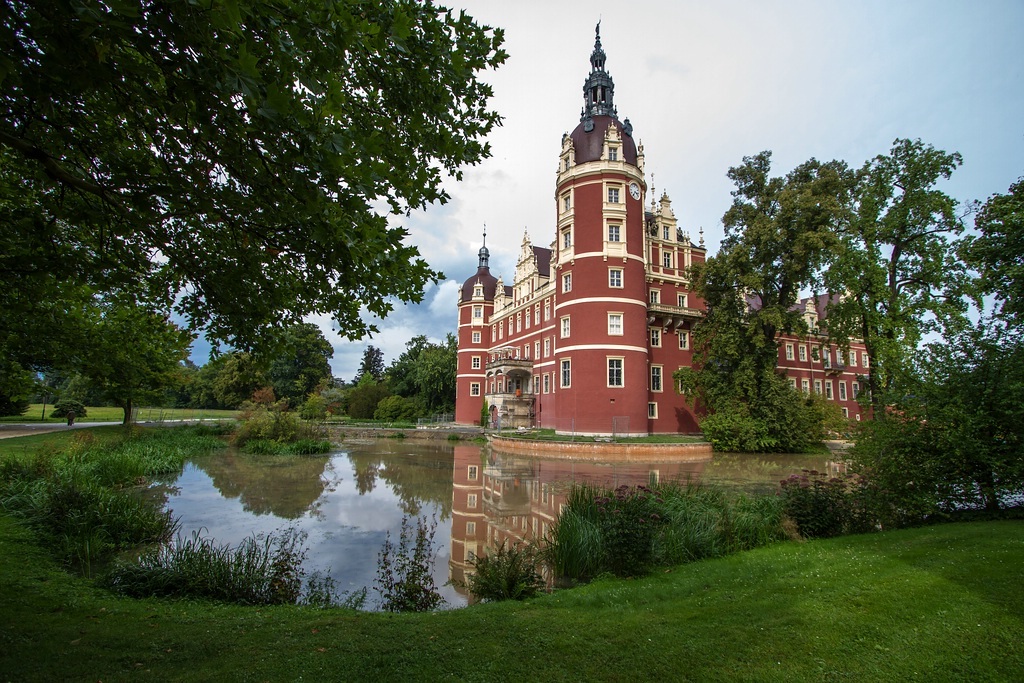
© Hedwig Storch, CC BY-SA 3.0 Resized from original. (This derivative is under the same CC BY-SA license.)
World Heritage Research
Discover scientific research and academic studies that deepen our understanding of Muskauer Park / Park Mużakowski from its history and significance to its conservation, management, and contemporary challenges.
-
Das kulinarische Vermächtnis des Fürsten Pückler-Muskau
Forst Pückler-Muskau's kulinarische Vermächtnis reveals the forgotten culinary innovations of 19th-century aristocracy, showcasing how his meticulous documentation of travel and dining experiences laid the foundation for modern gastronomy. The study analyzes his extensive diaries, letters, and albums (1806–1833), which captured not only landscapes but also culinary encounters, from regional specialties to innovative techniques. Pückler's emphasis on perfectionism—exemplified in his 1848 Branitz Park project—extended to gastronomy, blending artistic sensibility with practical experimentation. This research reconstructs his culinary contributions, demonstrating their influence on European dining culture, while highlighting the intersection of horticulture and cuisine in his legacy.
Heilmeyer, M. (2025). Das kulinarische Vermächtnis des Fürsten Pückler-Muskau. Der Beginn Der Kulinarischen Moderne, 91–98. https://doi.org/10.14361/9783839453674-005
View Publication Record | Read Publication -
Intergenerational Aspects of Marketing Communication on the Example of Muskau Park
Marketing communication for UNESCO World Heritage Sites can be significantly enhanced by tailoring strategies to the distinct needs and preferences of different generations. A study focusing on Muskauer Park reveals that dividing the tourism market based on age—specifically targeting Generations X, Y, and Z—leads to more effective engagement and satisfaction among tourists. This approach benefits both tourism providers and visitors by offering a diversified experience aligned with their lifestyles and expectations. The research leverages tools like HubSpot, generational studies, and literature reviews to develop innovative marketing strategies that resonate across diverse age groups, ultimately enriching the visitor experience in Lubusz Voivodeship.
Gandecka, A., & Charowska, N. (2024). Intergenerational Aspects of Marketing Communication on the Example of Muskau Park. Annales Universitatis Mariae Curie-Sklodowska, Sectio B – Geographia, Geologia, Mineralogia et Petrographia, 79, 1–15. https://doi.org/10.17951/b.2024.79.0.1-15
View Publication Record | Read Publication -
E 6 – Der historische Bergbau auf Alaun- und Braunkohleflözen im Muskauer Berg-und Badepark – eine unterschätzte Lokalität?
Historical mining activities in the Muskauer Park, particularly the early extraction of alum and brown coal dating back to the 16th century, have been significantly underappreciated despite their foundational role in shaping regional geology and industry. This study reveals that the park's geological significance, once documented by notable geologists like Leske, Werner, and Glocker, has been obscured by 19th-century landscaping efforts. Through a guided excursion, researchers uncovered remnants of mining operations—including shafts, waste heaps, coal seams, and tunnels—that illustrate the intertwined history of spa culture and mining in Bad Muskau. The findings highlight the park's dual heritage as both a natural landscape and an industrial site, challenging conventional perceptions of its geological and historical importance.
Bartholomäus, U. (2024). E 6 – Der historische Bergbau auf Alaun- und Braunkohleflözen im Muskauer Berg-und Badepark – eine unterschätzte Lokalität? FID GEO. https://doi.org/10.23689/FIDGEO-11165
View Publication Record | Read Publication -
Application of the Takaga-Sugeno neuro-fuzzy model for determining of engineering structures
Geodetic monitoring combined with neuro-fuzzy systems, such as the Takaga-Sugeno model, can effectively predict and assess horizontal and vertical displacements of engineering structures. This approach is particularly useful for rapidly changing phenomena like deformations in buildings or natural disasters. The study demonstrates its application on a historical footbridge in Muskauer Park, highlighting the potential of integrating artificial intelligence with geodetic technologies to improve the qualitative assessment of structural conditions.
Mrówczyńska, M. (2019). Application of the Takaga-Sugeno neuro-fuzzy model for determining of engineering structures. MATEC Web of Conferences, 284, 8006. https://doi.org/10.1051/matecconf/201928408006
View Publication Record | Read Publication -
Ueber den Park in Muskau in der Königlich Preussischen Ober Lausitz
The Muskauer Park, designed by Prince Pückler-Muskau and executed with the help of gardener Reder, stands as a masterful fusion of poetry and painting, transforming an ordinary landscape into a sublime natural artwork. This 19th-century creation exemplifies how poetic and pictorial arts can collaborate to shape nature into a harmonious composition, requiring not only imaginative genius but also a deep understanding of landscape painting principles. The park's design involved strategic removal of excess elements, integration of found features, and coaxing nature to fulfill missing components, all while balancing light, shadow, and perspective. Such an approach underscores the interplay between human creativity and natural beauty, setting a precedent for landscape architecture that blends artistic vision with environmental harmony.
Von Üchtritz, F. J. P. (2018). Ueber den Park in Muskau in der Königlich Preussischen Ober Lausitz. Neues Lausitzisches Magazin, 140, 147–152. https://doi.org/10.63045/nlm.bd.140.2018.s.147-152
View Publication Record | Read Publication -
A Mutually Gratifying Relationship: Goethe and Hermann von Pückler-Muskau
A mutual admiration and intellectual influence between Johann Wolfgang von Goethe and Prince Hermann von Pückler-Muskau, a renowned landscape gardener and travel writer, is revealed through their correspondence and unpublished accounts. Goethe's laudatory review of Pückler's 'Briefe eines Verstorbenen' significantly boosted the prince's literary fame, particularly in Britain, while also inspiring scenes in Goethe's 'Faust II.' Conversely, Pückler's park design philosophy was deeply rooted in Goethean principles, demonstrating a lasting and reciprocal impact. The study analyzes their interactions, correspondence, and the cultural significance of their relationship, offering new insights into the influence of 'Briefe eines Verstorbenen' on Goethe's work.
Bowman, P. J. (2017). A Mutually Gratifying Relationship: Goethe and Hermann von Pückler-Muskau. Publications of the English Goethe Society, 86(1), 1–28. https://doi.org/10.1080/09593683.2017.1281999
View Publication Record | Read Publication -
Krajobraz Kulturowy na Liście Światowego Dziedzictwa – Polskie Doświadczenia
Poland's collaboration with UNESCO on the World Heritage Convention, particularly concerning cultural landscapes, has been significantly driven by the Polish National Committee ICOMOS and its associated institutions. A key outcome of this cooperation is the successful inscription of Park Muskau (Muskauer Park) on the UNESCO World Heritage List, achieved through interdisciplinary efforts involving art historians, landscape architects, architects, and gardeners. The Centre for the Protection of Historic Landscape in Warsaw played a pivotal role by valuating cultural landscapes, organizing international conferences, and collaborating with the Fürst-Pückler-Park Bad Muskau Foundation to prepare the application. These activities highlight Poland's structured approach to preserving historic gardens and cultural landscapes, demonstrating effective interdisciplinary collaboration and international engagement.
Michałowski, A. (2017). KRAJOBRAZ KULTUROWY NA LIŚCIE ŚWIATOWEGO DZIEDZICTWA – POLSKIE DOŚWIADCZENIA. Protection of Cultural Heritage, (4), 21–30. https://doi.org/10.24358/odk_2017_04_03
View Publication Record | Read Publication