World Heritage Identification Number: 288
World Heritage since: 1984
Category: Cultural Heritage
WHE Type: Buildings & Architectural Ensembles
Transboundary Heritage: No
Endangered Heritage: No
Country: 🇩🇪 Germany
Continent: Europe
UNESCO World Region: Europe and North America
Map
Masterpieces of Early Rococo Architecture: The Castles of Augustusburg and Falkenlust at Brühl
The Castles of Augustusburg and Falkenlust at Brühl, located in the picturesque town of Brühl, North Rhine-Westphalia, Germany, are renowned for their exceptional contributions to early Rococo architecture. Inscribed as a UNESCO World Heritage Site in 1984, these two architectural marvels stand as testaments to the artistic and cultural achievements of the 18th century.
Augustusburg Palace, the principal structure of the complex, was built for Clemens August I of Bavaria, Prince-Archbishop of Cologne. Construction began in 1725 on the foundations of a medieval castle, with the main body largely completed by 1768, after the Elector's death. The initial architect was Johann Conrad Schlaun, and the project was taken over and completed by the Bavarian court architect François de Cuvilliés the Elder from 1728. Balthasar Neumann was responsible for designing the magnificent grand staircase.
The palace is a stunning example of Rococo style, characterized by its intricate ornamentation, delicate curves, and lightness. The palace's exterior features a harmonious blend of white stucco, red sandstone, and blue slate, while the interior boasts opulent frescoes (including the ceiling fresco by Carlo Carlone), gilded woodwork, and lavish furnishings.
Adjacent to Augustusburg Palace lies Falkenlust, a smaller hunting lodge built between 1729 and 1737. While less grandiose than its counterpart, Falkenlust showcases the same Rococo aesthetic, albeit in a more rustic setting. The lodge, designed by François de Cuvilliés, was designed as a retreat for Prince-Archbishop Clemens August I, who could indulge his passion for falconry amidst the tranquil surroundings of the Schlosspark.
The Schlosspark, which connects the two structures, is a verdant oasis that offers visitors a serene escape from the hustle and bustle of modern life. Dominique Girard, a student of the famous Versailles landscape architect André Le Nôtre, designed the gardens in the early 18th century in the formal French Baroque style. Starting in 1842, the renowned Prussian landscape architect Peter Joseph Lenné converted large sections of the park into an English landscape garden style. The Baroque appearance visible today is the result of a careful reconstruction undertaken in the 1930s under the direction of Georg Potente, the former director of the Sanssouci Gardens.
Today, the Castles of Augustusburg and Falkenlust at Brühl continue to captivate visitors with their breathtaking beauty and historical significance. They serve not only as a reminder of the artistic prowess of the past but also as a living testament to the enduring appeal of Rococo architecture. Furthermore, Augustusburg Palace and its parks host the annual Brühl Palace Concerts, providing a unique opportunity to experience the splendor of these historic sites through music.
Altogether, the Castles of Augustusburg and Falkenlust at Brühl represent a pinnacle of early Rococo architecture and offer a glimpse into the lives of the princes and archbishops who once resided there. Their inclusion on the UNESCO World Heritage List acknowledges their outstanding universal value and ensures their preservation for future generations to appreciate and enjoy.
UNESCO Description of the World Heritage Site
Set in an idyllic garden landscape, Augustusburg Castle (the sumptuous residence of the prince-archbishops of Cologne) and the Falkenlust hunting lodge (a small rural folly) are among the earliest examples of Rococo architecture in 18th-century Germany.
UNESCO Justification of the World Heritage Site
Criterion (ii): Augustusburg and Falkenlust represent the first important creations of Rococo style in Germany. For more than a century, they were a model in the majority of the princely courts.
Criterion (iv): The castles and gardens of Augustusburg and Falkenlust are the eminent example of the large princely residence of the 18th century.
Encyclopedia Record: Augustusburg and Falkenlust Palaces, Brühl
The Augustusburg and Falkenlust Palaces form a historical building complex in Brühl, North Rhine-Westphalia, Germany. The buildings are connected by the spacious gardens and trees of the Schlosspark. Built in the early 18th century, the palaces and adjoining gardens are considered masterpieces of early rococo architecture and have been listed as a UNESCO cultural World Heritage Site since 1984. Augustusburg Palace and its parks also serve as a venue for the Brühl Palace Concerts.Additional Site Details
Area: 89 hectares
Number of Components: 1
(iv) — Outstanding example of a type of building or landscape
Coordinates: 50.82502778 , 6.909777778
Image
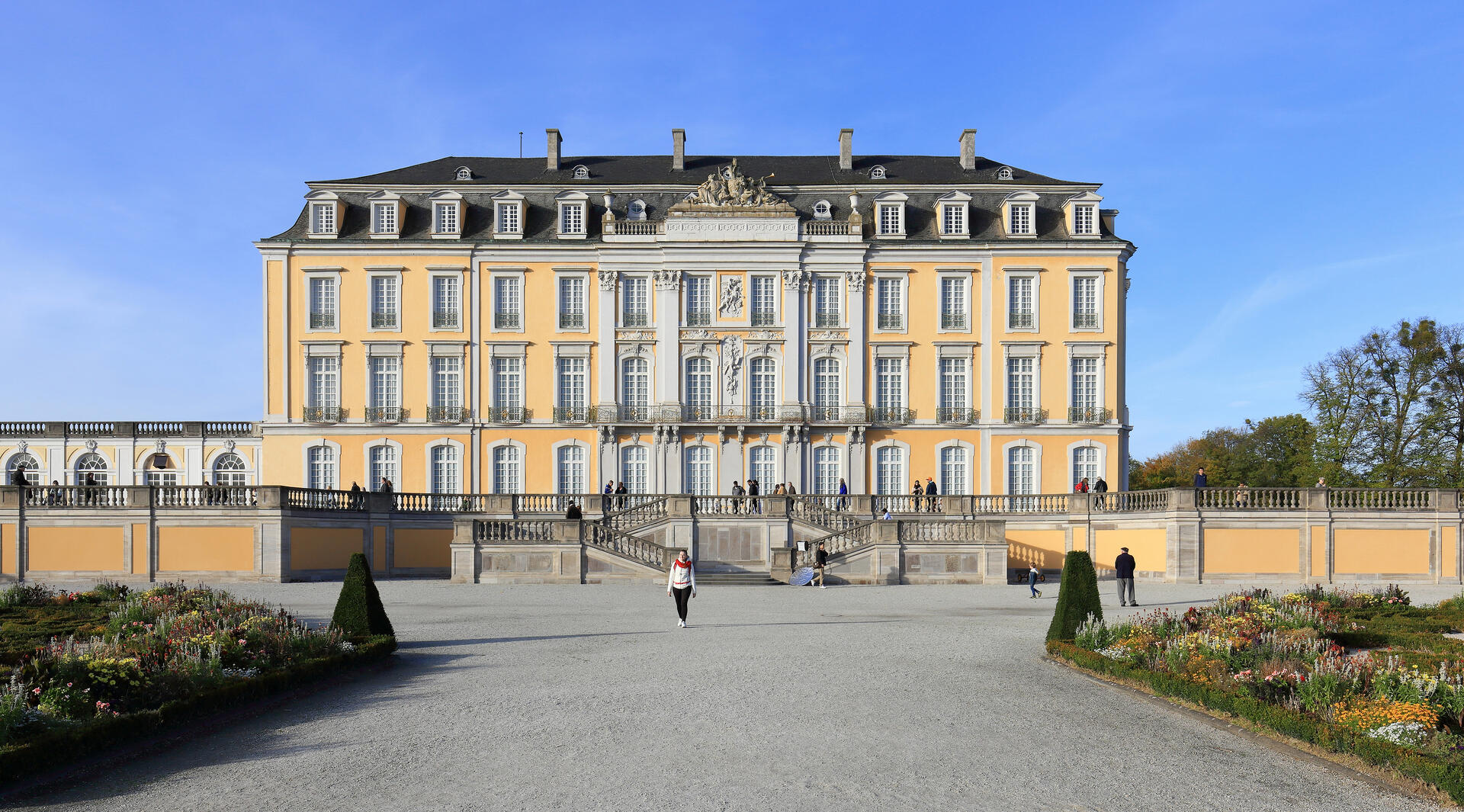
© Martin Falbisoner, CC BY-SA 4.0 Resized from original. (This derivative is under the same CC BY-SA license.)