World Heritage Identification Number: 988
World Heritage since: 2000
Category: Cultural Heritage
WHE Type: Religious Sites & Sacred Architecture
Transboundary Heritage: No
Endangered Heritage: No
Country: 🇪🇸 Spain
Continent: Europe
UNESCO World Region: Europe and North America
Map
The Catalan Romanesque Churches of the Vall de Boí: A Testament to Medieval Architecture
The Catalan Romanesque Churches of the Vall de Boí, nestled within the picturesque high Pyrenees, offer a captivating glimpse into the rich architectural heritage of medieval Europe. Inscribed as a UNESCO World Heritage Site in 2000, this collection of nine Early Romanesque churches stands as a testament to the artistic prowess and religious devotion that characterized the region during the Middle Ages.
More to come…UNESCO Description of the World Heritage Site
The narrow Vall de Boí is situated in the high Pyrénées, in the Alta Ribagorça region and is surrounded by steep mountains. Each village in the valley contains a Romanesque church, and is surrounded by a pattern of enclosed fields. There are extensive seasonally-used grazing lands on the higher slopes.
UNESCO Justification of the World Heritage Site
Criterion (ii): The significant developments in Romanesque art and architecture in the churches of the Vall de Boí testify to profound cultural interchange across medieval Europe and in particular across the mountain barrier of the Pyrenees.
Criterion (iv): The Churches of the Vall de Boí are an especially pure and consistent example of Romanesque art in a virtually untouched rural setting.
Encyclopedia Record: Catalan Romanesque Churches of the Vall de Boí
The Churches of the Vall de Boí are a set of nine Early Romanesque churches declared World Heritage Site by UNESCO and located in the Vall de Boí, in the Catalan comarca of Alta Ribagorça.Additional Site Details
Area: 7.98 hectares
Number of Components: 9
(iv) — Outstanding example of a type of building or landscape
Coordinates: 42.50472222 , 0.803611111
Image
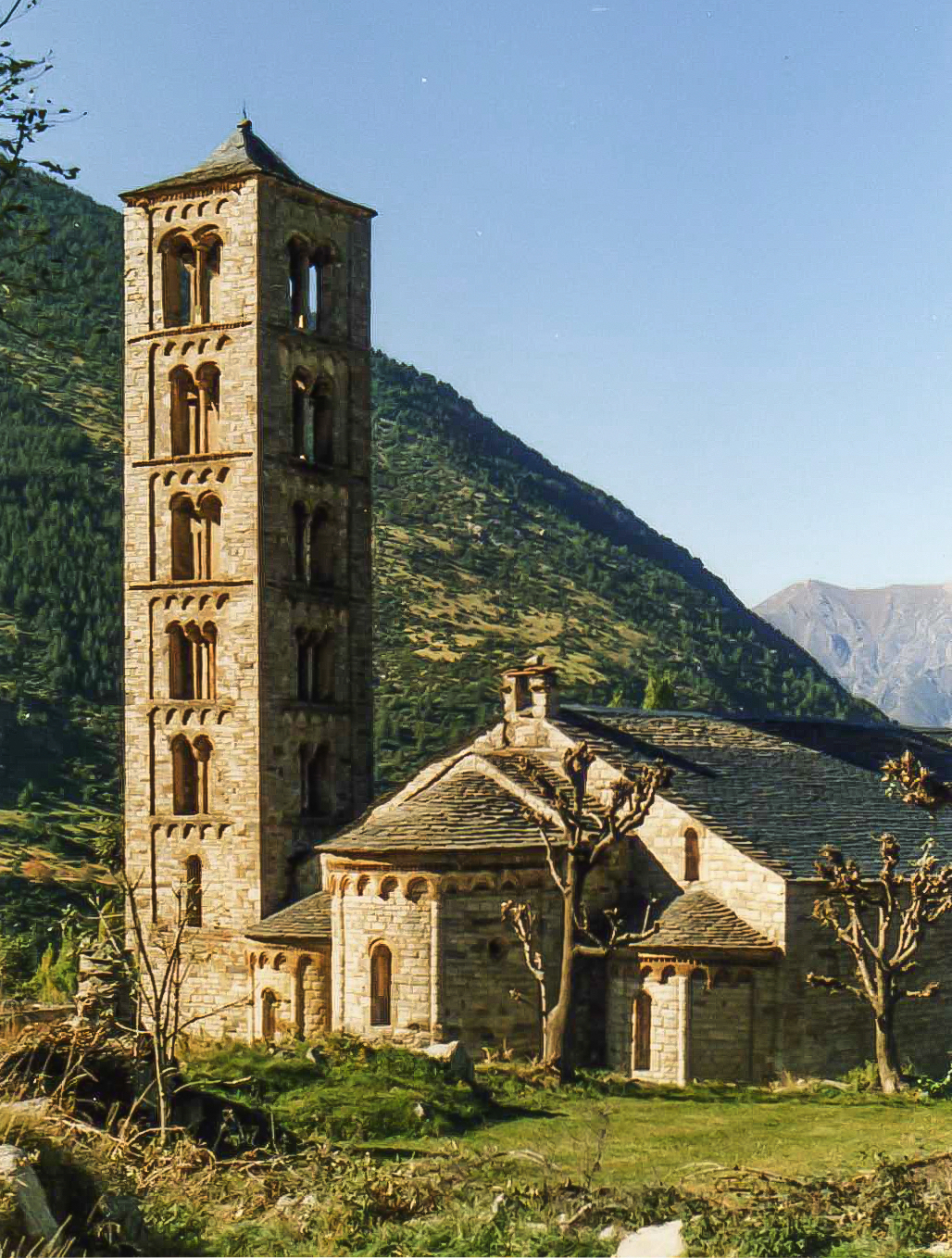
© Núria Pueyo, CC BY-SA 2.5 Resized from original. (This derivative is under the same CC BY-SA license.)
World Heritage Research
Discover scientific research and academic studies that deepen our understanding of Catalan Romanesque Churches of the Vall de Boí from its history and significance to its conservation, management, and contemporary challenges.
-
Iconografia bíblica a la pintura mural romànica de la Vall de Boí: el cel dins de l’eglésia
Romanesque mural paintings from three churches in Vall de Boí—Sant Climent of Taüll, Santa Maria of Taüll, and Sant Joan of Boí—reveal a sophisticated system of biblical iconography designed to convey religious messages to illiterate medieval believers. These paintings, now housed in the National Museum of Catalan Art in Barcelona, depict celestial themes within ecclesiastical contexts, serving as a visual means of education and spiritual instruction. The study analyzes how these murals integrate complex biblical narratives while maintaining accessibility through symbolic representation. This approach highlights the cultural significance of Romanesque art in religious communication during the medieval period.
Sesar, D. (2019). Iconografia bíblica a la pintura mural romànica de la Vall de Boí: el cel dins de l’eglésia. Beoiberística : Revista de Estudios Ibéricos, Latinoamericanos Y Comparativos, 3(1), 81–99. https://doi.org/10.18485/beoiber.2019.3.1.6
View Publication Record | Read Publication -
Mapping heritage digitally for tourism: an example of Vall de Boí, Catalonia, Spain
Digital preservation techniques, such as video mapping, have successfully restored and showcased medieval Romanesque paintings in the Catalan Pyrenees, revitalizing tourism in the Vall de Boí region. The study highlights how digital architectural design can enhance heritage experiences, particularly in lesser-visited destinations like this UNESCO World Heritage Site. A project called Taüll 1123, launched in 2013, demonstrated that technology-driven interventions can significantly boost local tourism while preserving cultural heritage. Using a qualitative approach, the research underscores the potential of digital tools to reinterpret and promote understudied historical sites.
Fusté-Forné, F. (2019). Mapping heritage digitally for tourism: an example of Vall de Boí, Catalonia, Spain. Journal of Heritage Tourism, 15(5), 580–590. https://doi.org/10.1080/1743873x.2019.1700264
View Publication Record | Read Publication