World Heritage Identification Number: 598
World Heritage since: 1993
Category: Cultural Heritage
WHE Type: Religious Sites & Sacred Architecture
Transboundary Heritage: No
Endangered Heritage: No
Country: 🇷🇴 Romania
Continent: Europe
UNESCO World Region: Europe and North America
Map
The Churches of Moldavia: A Testament to Byzantine Art and Moldavian Architecture
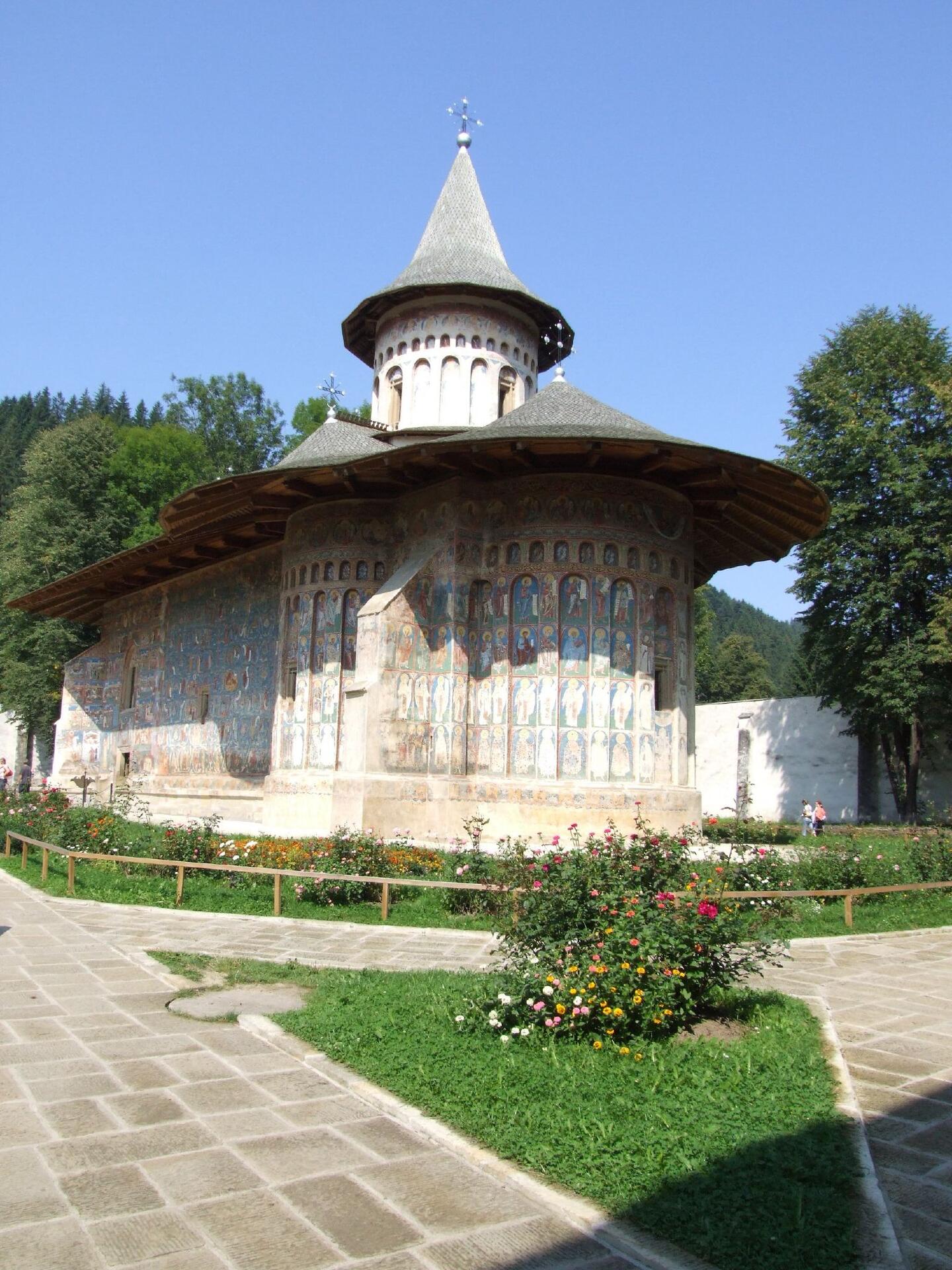
The Churches of Moldavia, inscribed as a UNESCO World Heritage Site in 1993, offer a captivating glimpse into the rich cultural heritage of the Moldavian region in Romania. This collection of eight churches, dating from the late 15th to the late 16th centuries, stands as a testament to the fusion of Byzantine art and Moldavian architecture that flourished during the Principality of Moldavia.
More to come…UNESCO Description of the World Heritage Site
These eight churches of northern Moldavia, built from the late 15th century to the late 16th century, their external walls covered in fresco paintings, are masterpieces inspired by Byzantine art. They are authentic and particularly well preserved. Far from being mere wall decorations, the paintings form a systematic covering on all the facades and represent complete cycles of religious themes.Their exceptional composition, the elegance of the characters, and the harmony of the colors blend perfectly with the surrounding countryside. The interior and exterior walls of the Church of the Suceviţa Monastery are entirely decorated with mural paintings of the 16th century, and this church is the only one to show a representation of the ladder of St John Climacus.
UNESCO Justification of the World Heritage Site
Criterion (i): The external paintings of the churches of Northern Moldavia cover all the facades. They embody a unique and homogeneous artistic phenomenon, directly inspired by Byzantine art. They are masterpieces of mural painting, and are of outstanding aesthetic value in view of their consummate chromatism and the remarkable elegance of the figures. They present cycles of events taken from the Bible and the Holy Scriptures, in the Orthodox Christian tradition.
Criterion (iv): The idea of completely covering the external facades of churches by paintings is an eminent example of a type of church construction and decoration adopted in Moldavia, which illustrates the cultural and religious context of the Balkans from the late 15th century to the late 16th century.
Encyclopedia Record: Churches of Moldavia
The north of the Moldavia region in Romania preserves numerous religious buildings as a testimony of the Moldavian architectural style developed in the Principality of Moldavia starting from the 14th century.Additional Site Details
Area: Not available
Number of Components: 8
(iv) — Outstanding example of a type of building or landscape
Coordinates: 47.7783333333 , 25.7127777778
World Heritage Research
Discover scientific research and academic studies that deepen our understanding of Churches of Moldavia from its history and significance to its conservation, management, and contemporary challenges.
-
Mysteries of Vasilkov on the Dniester: history, geography, toponymy, architecture
A rare medieval religious and defensive architecture complex, the Church of the Assumption of the Virgin in Vasilkov on the Dniester, has been revealed through a comprehensive multiscale historic-cartographical analysis. This study demonstrates that the church, located at the border of Moldavia and Ukraine, served as an Eastern outpost for the Principality of Moldavia and part of the Soroka castle's fortified system. The research employs modern geographic information methods, including high-precision digital elevation models and chronological cartographic comparisons, to unravel the historic-geographical evolution of the area. Additionally, it explores toponymic processes that shaped the region's geographical names, providing insights into ancient trade routes and settlements. This study highlights the significance of Vasilkov as a united natural and historic-cultural complex, offering new perspectives on medieval border dynamics and architectural traditions.
Herzen, A., Kostovska, S., & Nesterova, T. (2021). Mysteries of Vasilkov on the Dniester: history, geography, toponymy, architecture. InterCarto. InterGIS, 27(4), 495–519. https://doi.org/10.35595/2414-9179-2021-4-27-495-519
View Publication Record | Read Publication -
Space, Image, Light: Toward an Understanding of Moldavian Architecture in the Fifteenth Century
A fifteenth-century church in Moldavia, part of the UNESCO-listed Churches of Moldavia, demonstrates sophisticated architectural design that harnesses sunlight to create dynamic light effects aligned with key liturgical dates. This finding reveals a rare coordination of architecture, decoration, and ritual, showcasing advanced knowledge of cosmic phenomena and natural light manipulation. The study, focusing on the Holy Cross church at Pătrăuţi Monastery, highlights its historical significance as one of Moldavia's earliest preserved examples of such design, suggesting broader implications for understanding medieval and early modern Christian architecture in Byzantine and Slavic traditions.
Sullivan, A. I., Herea, G.-D., & Ivanovici, V. (2021). Space, Image, Light: Toward an Understanding of Moldavian Architecture in the Fifteenth Century. Gesta, 60(1), 81–100. https://doi.org/10.1086/712643
View Publication Record | Read Publication -
Land use changes and dynamics over the last century around churches of Moldavia, Bukovina, Northern Romania – Challenges and future perspectives
Significant land use changes over the past century have been identified around several UNESCO World Heritage Sites in Northern Romania, including Probota, Humor, Patrauti, and Arbore churches. These changes, analyzed through historical maps (1917) and modern orthophotos (2005, 2016), reveal deforestation and anthropogenic environmental alterations that threaten the integrity of these monuments. In contrast, Sucevita, Voronet, and Moldovita churches retain their natural Bukovina landscape, while Suceava church is embedded in a highly urbanized environment. The study highlights the vulnerability of these sites to human-induced changes, emphasizing the need for conservation efforts to preserve their cultural and ecological significance.
Nicu, I. C., & Stoleriu, C. C. (2019). Land use changes and dynamics over the last century around churches of Moldavia, Bukovina, Northern Romania – Challenges and future perspectives. Habitat International, 88, 101979. https://doi.org/10.1016/j.habitatint.2019.04.006
View Publication Record | Read Publication -
The Reformation in Eastern and Central Europe
The Reformation in Eastern and Central Europe significantly reshaped religious, social, and political landscapes. This volume reveals how Protestant movements interacted with local cultures, particularly in regions like Bohemia, Hungary, Transylvania, and Moldavia, where Calvinism became intertwined with estate liberation movements. It highlights the role of private libraries in spreading Protestant literature, the influence of mural painting on religious identity, and the complex negotiations between Protestant theologians and Eastern Orthodox Churches. The study also explores the impact of patronage and recatholicization efforts by nobility, contrasting with the confessionalization of urban centers in royal Prussia. By analyzing church building practices, morals courts, and national historical writing, it provides a nuanced understanding of how Reformation dynamics varied across regions.
Maag, K. (2016). The Reformation in Eastern and Central Europe. https://doi.org/10.4324/9781315237442
View Publication Record | Read Publication