World Heritage Identification Number: 971
World Heritage since: 2000
Category: Cultural Heritage
WHE Type: Religious Sites & Sacred Architecture
Transboundary Heritage: No
Endangered Heritage: No
Country: 🇨🇱 Chile
Continent: Americas
UNESCO World Region: Latin America and the Caribbean
Map
Unique Architectural Gems: The Churches of Chiloé
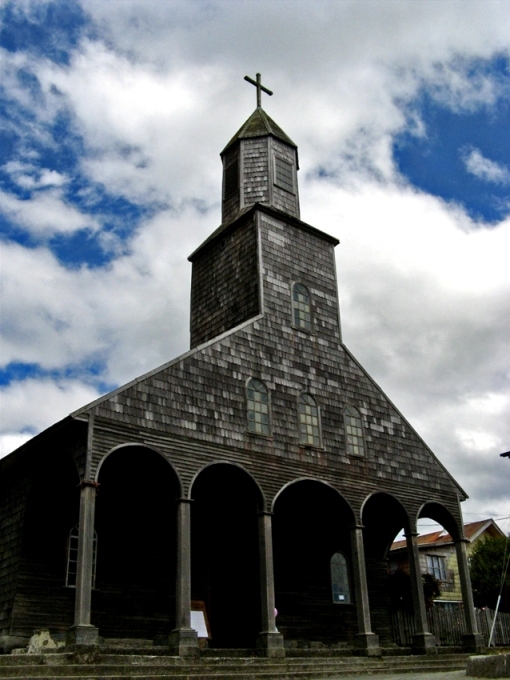
The Churches of Chiloé, located in the Chiloé Archipelago off the coast of southwestern Chile, stand as a testament to the harmonious blend of indigenous and European cultures. Inscribed as a UNESCO World Heritage Site in 2000, these wooden structures represent a distinctive architectural style that has persisted for over four centuries.
More to come…UNESCO Description of the World Heritage Site
The Churches of Chiloé represent a unique example in Latin America of an outstanding form of ecclesiastical wooden architecture. They represent a tradition initiated by the Jesuit Peripatetic Mission in the 17th and 18th centuries, continued and enriched by the Franciscans during the 19th century and still prevailing today. These churches embody the intangible richness of the Chiloé Archipelago, and bear witness to a successful fusion of indigenous and European culture, the full integration of its architecture in the landscape and environment, as well as to the spiritual values of the communities.
UNESCO Justification of the World Heritage Site
Criterion (ii): The Churches of Chiloé are outstanding examples of the successful fusion of European and indigenous cultural traditions to produce a unique form of wooden architecture.
Criterion (iii): The mestizo culture resulting from Jesuit missionary activities in the 17th and 18th centuries has survived intact in the Chiloé archipelago, and achieves its highest expression in the outstanding wooden churches.
Encyclopedia Record: Churches of Chiloé
The Churches of Chiloé in Chile's Chiloé Archipelago are a unique architectural phenomenon in the Americas and one of the most prominent styles of Chilotan architecture. Unlike classical Spanish colonial architecture, the churches of Chiloé are made entirely in native timber with extensive use of wood shingles. The churches were built from materials to resist the Chiloé Archipelago's humid and rainy oceanic climate.Additional Site Details
Area: 13.8977 hectares
Number of Components: 16
(iii) — Unique or exceptional testimony to a cultural tradition
Coordinates: -42.5 , -73.76666667
World Heritage Research
Discover scientific research and academic studies that deepen our understanding of Churches of Chiloé from its history and significance to its conservation, management, and contemporary challenges.
-
Ancestral and vernacular architecture as contemporary heritage, tourist and cultural resource. The case of the “palafitos” and the route of the 16 UNESCO heritage churches of Chiloé, Chile
Vernacular architecture in Chile's Chiloé, including stilt houses ('palafitos') and 16 UNESCO-listed churches, serves as a valuable contemporary heritage resource that balances cultural preservation with tourism. This study highlights how these unique structures—rooted in ancestral traditions—maintain their authenticity while attracting visitors without succumbing to gentrification. The research analyzes a complete palafito and a church from both architectural and constructive perspectives, alongside media coverage and interviews, to assess their role as tourist and cultural assets. Findings underscore the need for balanced conservation strategies that protect these sites' identity while leveraging their global significance.
Pareti, S., Rudolph, L., Flores, D., & Valdebenito, V. (2022). Ancestral and vernacular architecture as contemporary heritage, tourist and cultural resource. The case of the “palafitos” and the route of the 16 UNESCO heritage churches of Chiloé, Chile. IOP Conference Series: Earth and Environmental Science, 1026(1), 12051. https://doi.org/10.1088/1755-1315/1026/1/012051
View Publication Record | Read Publication -
The ruin(s) of Chiloé?: An ethnography of buildings de/reterritorializing
Rapid neoliberal transformation in Chile’s Chiloé archipelago has created a dynamic architectural landscape where competing forces of de- and re-territorialization shape cultural geographies. This study reveals how industrial aquaculture-driven urbanization clashes with heritage sites, particularly colonial-era churches, while new corporate retailers and shopping malls reshape consumer lifestyles. Using ethnographic methods, the research highlights the tension between commodification and preservation in a region transitioning from rural communalism to modern urban landscapes.
Miller, J. C. (2021). The ruin(s) of Chiloé?: An ethnography of buildings de/reterritorializing. Cultural Geographies, 29(3), 435–452. https://doi.org/10.1177/14744740211029280
View Publication Record | Read Publication -
The Restorers of Chiloé by Rosabetty Muñoz
The restoration of religious statues in the Churches of Chiloé reveals a unique blend of artistry and cultural reverence. Over centuries, wooden carvings of Jesus, Mary, and saints in 21 islands off southern Chile succumbed to weathering. A team of non-religious restorers, collaborating with local fiscal officials and villagers, meticulously repaired these artifacts, demonstrating profound respect for both the objects and their devotees. The process highlights the enduring cultural significance of these statues, even among those not directly involved in religious practices. Photographic documentation by Chilean photographer Mariana Mathews further captures the silent sanctity of Chiloé's saintly imagery, preserved in a digital museum.
Steele, C. (2020). The Restorers of Chiloé by Rosabetty Muñoz. Latin American Literary Review, 47(93). https://doi.org/10.26824/lalr.146
View Publication Record | Read Publication -
Memória de Compu - Análise crítica do património chilote
A critical analysis of the rural village of Compu on Chiloé Island, Chile, reveals its unique cultural and spatial identity shaped by maritime influences, historical development, and community dynamics. The study highlights the significance of the church as a defining element in both landscape and cultural terms, while also emphasizing the active role of residents in the village's progress. Through fieldwork and social analysis, the research explores Compu's territorial organization, its connection to the sea, and its potential future development, offering insights into the broader context of Chile's coastal heritage.
Miranda, M. M. e V. de. (2017). Memória de Compu - Análise crítica do património chilote [Universidade do Porto]. https://doi.org/10.34626/ZX85-2N02
View Publication Record | Read Publication -
Las unidades espaciales asociadas a la religiosidad chilota: Evolución de las entidades pobladas
Research on the Churches of Chiloé reveals that churches, both architecturally and symbolically, historically served as central points around which urban settlements in the archipelago developed. However, contemporary globalization and urban expansion threaten this cultural pattern by encroaching upon spaces integral to religious expressions, transcending the traditional boundaries of church properties. The study employs a spatial analysis approach to trace the evolution of populated entities linked to Chilote religiosity, highlighting the tension between historical urban development and modern cultural shifts.
Sahady Villanueva, A., Gallardo Gastelo, F. E., Bravo Sánchez, J., & Ibáñez Browne, M. D. l. Á. (2010). Las unidades espaciales asociadas a la religiosidad chilota: Evolución de las entidades pobladas. Revista de Urbanismo, 0(16). https://doi.org/10.5354/0717-5051.2007.299
View Publication Record | Read Publication