World Heritage Identification Number: 1730
World Heritage since: 2025
Category: Cultural Heritage
WHE Type: Archaeological Sites
Transboundary Heritage: No
Endangered Heritage: No
Country: 🇮🇹 Italy
Continent: Europe
UNESCO World Region: Europe and North America
Map
The Domus de Janas: A Window into Prehistoric Sardinian Culture
The Domus de Janas, or "Fairy Houses," offer a unique glimpse into the funerary traditions and cultural evolution of prehistoric Sardinia. Inscribed as a UNESCO World Heritage Site in 2025, this serial property encompasses a vast collection of hypogean burials and necropolises dating back to the 5th and 3rd millennia BCE.
More to come…UNESCO Description of the World Heritage Site
This serial property is an ensemble of hypogean burials and necropolises located in Sardinia, created between the 5th and 3rd millennia BCE. These sites reflect the daily life and funerary practices of prehistoric Sardinian communities. The domus de janas, locally known as “fairy houses,” are rock-cut tombs that reflect the funerary practices, spiritual beliefs, and social evolution of Sardinia’s prehistoric communities. These structures feature complex layouts, symbolic decorations, and figurative motifs that testify to the transformation of the relationship between the living and the dead in a society transitioning toward more complex forms of social organization. They represent the most extensive and rich manifestation of hypogean funerary architecture in the western Mediterranean, exemplifying a phenomenon attested by approximately 3,500 hypogea spread across the entire island.
UNESCO Justification of the World Heritage Site
Criterion (iii): Funerary Tradition in the Prehistory of Sardinia – The domus de janas represents an exceptional testimony to a distinctive funerary tradition, related to the beliefs about the afterlife and the cult of the dead, developed by Sardinian prehistoric communities between the 5th and the 3rd millennium BCE, and which disappeared with the arrival of the Nuragic civilisation to the island in the 17th century BCE. Showcasing a complete set of structural types, planimetric evolution, and extremely rich decorative art, the domus de janas included in the property document the burial customs and spiritual conceptions of the afterlife of the island’s earliest settled communities, and provide valuable insights into the societal transformations in Sardinia up to the beginning of the Bronze Age.
Encyclopedia Record: Domus de Janas
Domus de Janas are a type of pre-Nuragic rock-cut chamber tomb found in Sardinia. They consist of several chambers quarried out by the people of the San Ciriaco through Ozieri cultures and subsequent cultures, resembling houses in their layout.Additional Site Details
Area: Not available
Number of Components: 18
Coordinates: 40.0851388889 , 8.9513333333
Image
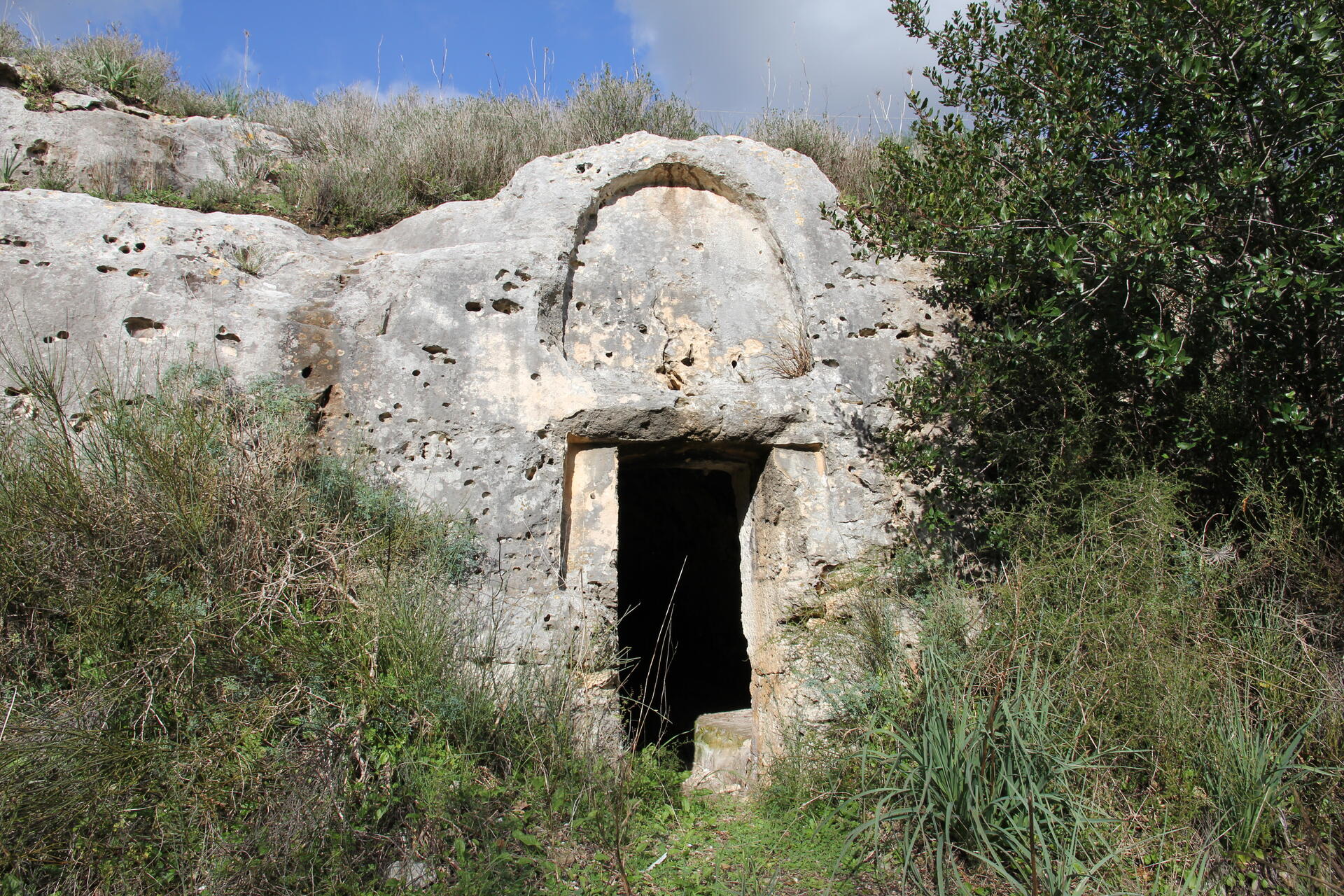
© Gianni Careddu, CC BY-SA 3.0 Resized from original. (This derivative is under the same CC BY-SA license.)
World Heritage Research
Discover scientific research and academic studies that deepen our understanding of Funerary Tradition in the Prehistory of Sardinia – The domus de janas from its history and significance to its conservation, management, and contemporary challenges.
-
Color reconstruction by photometric stereo with unknown lighting of rock art carvings found in two Sardinian Domus de Janas
A novel approach to photometric stereo imaging has successfully addressed computational challenges in reconstructing 3D color models of rock art carvings from Sardinian Domus de Janas tombs. The method introduces numerical indicators that assess dataset reliability, overcoming issues like non-Lambertian surface properties and insufficient light source distance. This advancement enables accurate digital documentation of fragile, immobile artifacts without altering their original location, preserving both cultural heritage and scientific analysis. By applying these techniques to two Sardinian sites, researchers demonstrate a robust solution for studying prehistoric engravings that were previously difficult to capture due to lighting and surface irregularities.
Crabu, E., Pes, F., Rodriguez, G., & Tanda, G. (2025). Color reconstruction by photometric stereo with unknown lighting of rock art carvings found in two Sardinian Domus de Janas. Journal of Cultural Heritage, 71, 320–327. https://doi.org/10.1016/j.culher.2024.12.019
View Publication Record | Read Publication -
Evaluation of a Subsequent Deposition of Human Bodies in a Funerary Site in Sardinia (Italy) Using Entomological Evidence
A rare entomological analysis of a Sardinian Neolithic tomb, the Domus de Janas at Filigosa, reveals new insights into prehistoric funerary practices. Mineralized remains of blow flies (Calliphora and Lucilia) and beetles (Necrobia) suggest that human bodies were exposed briefly before being deposited in the chamber, allowing initial colonization by flies. Subsequent primary burials occurred within the same space, with geological changes sealing the tomb shortly after use ceased. This study demonstrates how forensic entomology can reconstruct ancient burial sequences, bridging a gap in the application of this method to sites thousands of years old.
Tuccia, F., Rodriguez, C., Giordani, G., Subirà, M. E., Mazzarello, V., & Vanin, S. (2025). Evaluation of a Subsequent Deposition of Human Bodies in a Funerary Site in Sardinia (Italy) Using Entomological Evidence. Heritage, 8(2), 68. https://doi.org/10.3390/heritage8020068
View Publication Record | Read Publication -
Cross-border co-creation of conservation perspectives for the archaeological sites Domus de Janas , Sardinia–Italy
A collaborative approach to archaeological conservation, involving students and academics from the UK and Italy, along with local stakeholders, has yielded innovative strategies for preserving Sardinia's Domus de Janas sites. These rock-cut hypogeum tombs, significant yet under-preserved, were the focus of a co-creation workshop that addressed accessibility, material conservation, and interpretation. The process identified decay as an opportunity to enhance authenticity and leveraged landscape context for revitalization and musealization. Four conceptual proposals emerged, blending theoretical understanding with practical insights, demonstrating the potential of cross-border collaboration to enrich heritage conservation practices. This study underscores the value of inclusive, interdisciplinary methods in uncovering hidden narratives and promoting sustainable development.
Teba, T., Pilia, E., Fiorino, D. R., & Concu, G. (2025). Cross-border co-creation of conservation perspectives for the archaeological sites Domus de Janas , Sardinia–Italy. Journal of Cultural Heritage Management and Sustainable Development, 16(3), 505–523. https://doi.org/10.1108/jchmsd-04-2025-0090
View Publication Record | Read Publication -
Neural network for archaeological glyph detection
A novel approach leveraging convolutional neural networks (CNNs) significantly enhances the detection and classification of ancient glyphs in Sardinia's Neolithic Domus de Janas tombs, addressing challenges posed by environmental degradation. By preprocessing images to isolate glyphs from backgrounds, researchers mitigated distortions caused by lighting and wear, improving analysis accuracy. The study employed AlexNet, GoogLeNet, and EfficientNet models to categorize glyphs and identify geometric features, offering a more efficient method for preserving and studying these culturally significant artifacts.
Crisci, S., De Simone, V., Diana, A., & Zullo, F. (2025). Neural network for archaeological glyph detection. Intelligent Systems with Applications, 27, 200562. https://doi.org/10.1016/j.iswa.2025.200562
View Publication Record | Read Publication -
Guerra tra giganti. Il riconoscimento del patrimonio archeologico sardo tra conservazione e accessibilità
A recent analysis highlights the pressing need for balanced conservation and accessibility strategies to safeguard Sardinia's unique archaeological heritage, particularly its domus de janas and nuraghe sites. These structures, recognized for their distinctive decorative elements and cultural significance, face challenges in legal protection, maintenance, and public access. The study, conducted by the Superintendency of Culture, evaluates current conservation projects and proposes guidelines to enhance the recognition process while ensuring sustainable access. By examining the legal status, ongoing initiatives, and future plans, this research aims to provide a comprehensive framework for preserving Sardinia's archaeological assets without compromising their accessibility.
Billeci, B. (2023). Guerra tra giganti. Il riconoscimento del patrimonio archeologico sardo tra conservazione e accessibilità. Restauro Archeologico, 30(1). https://doi.org/10.36253/rar-14293
View Publication Record | Read Publication -
A spatial statistical study of the distribution of Sardinian nuraghes
A spatial statistical analysis of Sardinian nuraghes reveals significant clustering patterns and strong interactions with funerary structures, particularly domus de janas. The study found that nuraghe elevations are uniformly distributed between 0 and 400 meters, while their proximity to holy wells peaks at approximately 5 kilometers. Clustering is most pronounced in the mid-west, central, and south-west regions of Sardinia. Additionally, strong spatial interactions were observed with pre-Nuragic dolmens, menhirs, and collective funerary structures like 'Nuragic giants’ tombs' within a 1000-meter range. This research provides new insights into the spatial relationships between prehistoric sites, employing non-stationary G- and J-functions and Poisson models to quantify these patterns effectively.
Stein, A., Detotto, C., & Belgiu, M. (2022). A spatial statistical study of the distribution of Sardinian nuraghes. Annals of GIS, 28(3), 245–261. https://doi.org/10.1080/19475683.2022.2043937
View Publication Record | Read Publication -
First evidence of vivianite in human bones from a third millennium BC Domus de Janas: Filigosa tomb 1, Macomer (NU), Sardinia
Researchers have uncovered the first evidence of vivianite, a phosphate mineral, in human bones from a third millennium BC Domus de Janas tomb in Sardinia. This discovery, documented in Filigosa Tomb 1 near Macomer, represents one of the oldest occurrences of this mineral in Italy and predates the use of iron. Vivianite forms through the interaction of phosphate, iron, and water, suggesting unique environmental or burial conditions that facilitated its preservation. The study, conducted on osteological samples from a well-preserved tomb excavated in 1965, provides insights into prehistoric funerary practices and mineralization processes in Sardinian archaeological sites.
Rodriguez, C., Sanciu, L., Idini, A., Fancello, D., Murgia, C., Atzori, I., Mazzarello, V., & Subirà, M. E. (2021). First evidence of vivianite in human bones from a third millennium BC Domus de Janas: Filigosa tomb 1, Macomer (NU), Sardinia. Journal of Archaeological Science: Reports, 37, 102918. https://doi.org/10.1016/j.jasrep.2021.102918
View Publication Record | Read Publication