World Heritage Identification Number: 1
World Heritage since: 1978
Category: Natural Heritage
WHE Type: Natural Landscapes & Geographic Features
Transboundary Heritage: No
Endangered Heritage: No
Country: 🇪🇨 Ecuador
Continent: Americas
UNESCO World Region: Latin America and the Caribbean
Map
The Galápagos Islands: A Natural Laboratory of Evolution
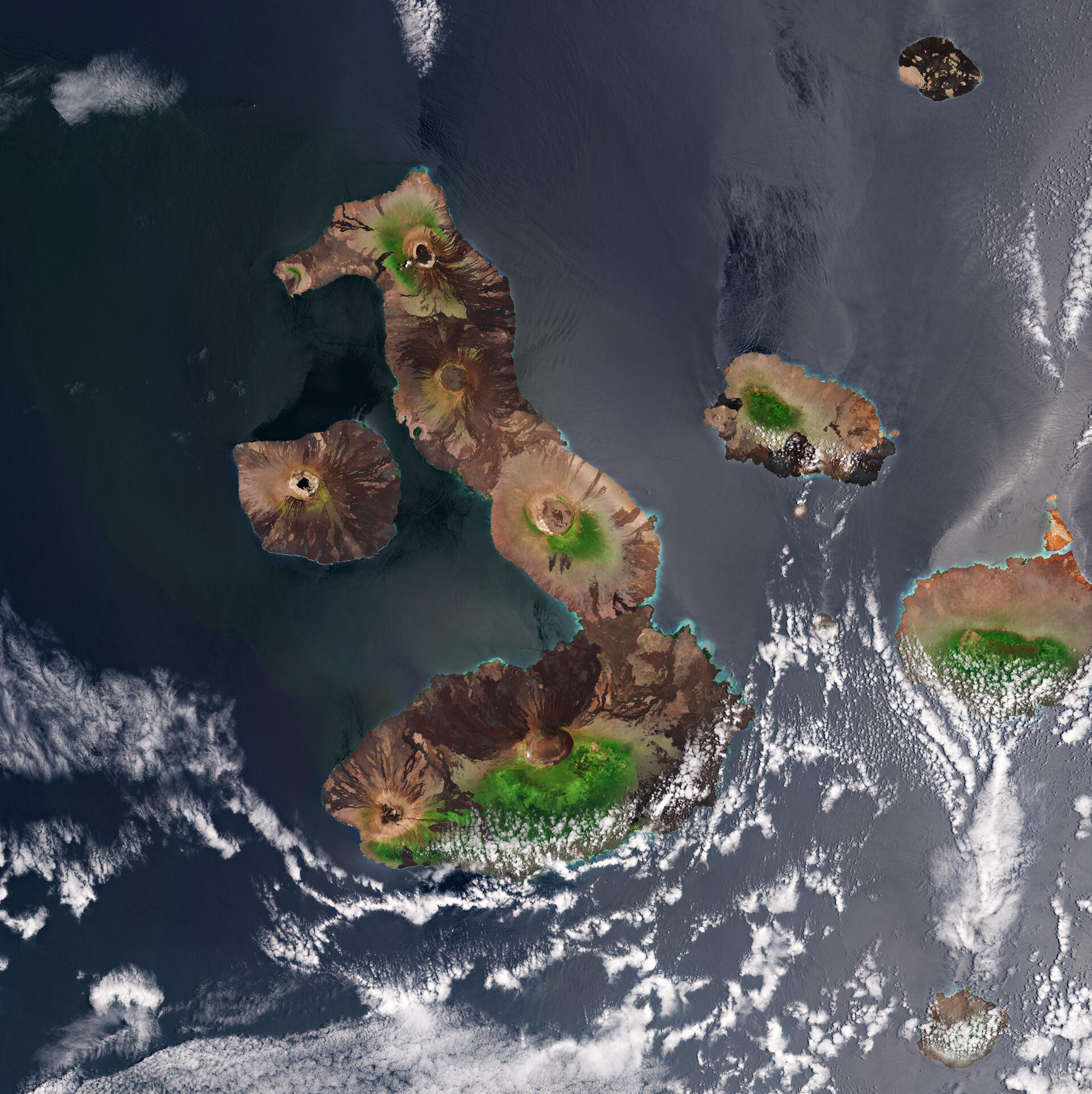
The Galápagos Islands, situated approximately 1,000 kilometers off the coast of Ecuador in the Pacific Ocean, represent a unique and captivating corner of the world. Inscribed as UNESCO World Heritage Site in 1978, this archipelago has been hailed as a 'living museum and showcase of evolution.' This designation acknowledges the islands' remarkable biodiversity, geological activity, and historical significance in shaping our understanding of evolutionary biology.
Comprising 19 islands and numerous smaller islets, the Galápagos Islands span a total land area of roughly 7,885 square kilometers. The islands are scattered across two tectonic plates—the Nazca Plate and the Cocos Plate—and their formation is attributed to ongoing volcanic activity. The oldest island, Española, was formed about three million years ago, while the youngest, Fernandina, is only about 700,000 years old. This youthfulness contributes to the islands' dynamic landscape, characterized by rugged volcanic terrain, lava fields, and dramatic cliffs.
The Galápagos Islands lie at the intersection of three major ocean currents - the confluence of the Cromwell, Humboldt, and Panama currents -, creating a rich and diverse marine ecosystem. This convergence fosters a 'melting pot' of marine species, resulting in a unique blend of flora and fauna found nowhere else on Earth. The islands' isolation, coupled with their volcanic origins, has led to the development of a plethora of endemic species. Among these are the iconic Galápagos penguin, the flightless cormorant, and the marine iguana, which can be seen basking in the sun along the rocky coastlines.
One of the most significant figures associated with the Galápagos Islands is Charles Darwin, who visited the archipelago during his voyage aboard the HMS Beagle in 1835. His observations of the islands' unique wildlife, particularly the finches, giant tortoises, and land iguanas, played a crucial role in the development of his groundbreaking theory of evolution by natural selection. Today, the Galápagos Islands continue to serve as a natural laboratory for scientists studying evolution, ecology, and conservation biology.
In recognition of its exceptional value, the Galápagos Islands are protected as part of Ecuador's Galápagos National Park, established in 1959. In addition to the park, the Galápagos Marine Reserve was later created to safeguard the surrounding ocean waters, which are home to an extraordinary diversity of marine life.
Together, the park and reserve form one of the most extensive and effective conservation areas in the world. This comprehensive protection encompasses nearly 97 percent of the territory of the Galápagos Province, ensuring the preservation of the islands' delicate ecosystems for future generations. Tourism plays a vital role in the local economy, providing income for residents, while also contributing to conservation efforts through park fees and ecotourism initiatives.
To wrap it up, the Galápagos Islands stand as a testament to the wonders of nature and the power of evolution. Their unique biodiversity, geological activity, and historical significance make them an unparalleled destination for scientific research, environmental education, and responsible tourism. As we continue to learn from the lessons offered by these extraordinary islands, it is essential that we work diligently to preserve and protect this living laboratory of evolution for future generations to enjoy and appreciate.
UNESCO Description of the World Heritage Site
Situated in the Pacific Ocean some 1,000 km from the South American continent, these 19 islands and the surrounding marine reserve have been called a unique ‘living museum and showcase of evolution’. Located at the confluence of three ocean currents, the Galápagos are a ‘melting pot’ of marine species. Ongoing seismic and volcanic activity reflects the processes that formed the islands. These processes, together with the extreme isolation of the islands, led to the development of unusual animal life – such as the land iguana, the giant tortoise and the many types of finch – that inspired Charles Darwin’s theory of evolution by natural selection following his visit in 1835.
UNESCO Justification of the World Heritage Site
Criterion vii: The Galapagos Marine Reserve is an underwater wildlife spectacle with abundant life ranging from corals to sharks to penguins to marine mammals. No other site in the world can offer the experience of diving with such a diversity of marine life forms that are so familiar with human beings, that they accompany divers. The diversity of underwater geomorphological forms is an added value to the site producing a unique display, which cannot be found anywhere else in the world.
Criterion viii: The archipelago´s geology begins at the sea floor and emerges above sea level where biological processes continue.. Three major tectonic plates—Nazca, Cocos and Pacific— meet at the basis of the ocean, which is of significant geological interest. In comparison with most oceanic archipelagos, the Galapagos are very young with the largest and youngest islands, Isabela and Fernandina, with less than one million years of existence, and the oldest islands, Española and San Cristóbal, somewhere between three to five million years. The site demonstrates the evolution of the younger volcanic areas in the west and the older islands in the east. On-going geological and geomorphological processes, including recent volcanic eruptions, small seismic movements, and erosion provide key insights to the puzzle of the origin of the Galapagos Islands. Almost no other site in the world offers protection of such a complete continuum of geological and geomorphological features.
Criterion ix: The origin of the flora and fauna of the Galapagos has been of great interest to people ever since the publication of the “Voyage of the Beagle” by Charles Darwin in 1839. The islands constitute an almost unique example of how ecological, evolutionary and biogeographic processes influence the flora and fauna on both specific islands as well as the entire archipelago. Darwin’s finches, mockingbirds, land snails, giant tortoises and a number of plant and insect groups represent some of the best examples of adaptive radiation which still continues today. Likewise, the Marine Reserve, situated at the confluence of 3 major eastern Pacific currents and influenced by climatic phenomena such as El Niño, has had major evolutionary consequences and provides important clues about species evolution under changing conditions. The direct dependence on the sea for much of the island’s wildlife (e.g. seabirds, marine iguanas, sea lions) is abundantly evident and provides an inseparable link between the terrestrial and marine worlds.
Criterion x: The islands have relatively high species diversity for such young oceanic islands, and contain emblematic taxa such as giant tortoises and land iguanas, the most northerly species of penguin in the world, flightless cormorants as well as the historically important Darwin’s finches and Galapagos mockingbirds. Endemic flora such as the giant daisy trees Scalesia spp. and many other genera have also radiated on the islands, part of a native flora including about 500 vascular plant species of which about 180 are endemic. Examples of endemic and threatened species include 12 native terrestrial mammal species (11 endemic, with 10 threatened or extinct) and 36 reptile species (all endemic and most considered threatened or extinct), including the only marine iguana in the world. Likewise the marine fauna has an unusually high level of diversity and endemism, with 2,909 marine species identified with 18.2% endemism. High profile marine species include sharks, whale sharks, rays and cetaceans. The interactions between the marine and terrestrial biotas (e.g. sea lions, marine and terrestrial iguanas, and seabirds) are also exceptional. Recent exploration of deep sea communities continues to produce new additions to science.
Encyclopedia Record: Galápagos Islands
The Galápagos Islands are an archipelago of volcanic islands in the Eastern Pacific, located around the equator, 900 km (560 mi) west of the mainland of South America. They form the Galápagos Province of the Republic of Ecuador, with a population of slightly over 33,000 (2020). The province is divided into the cantons of San Cristóbal, Santa Cruz, and Isabela, the three most populated islands in the chain. The Galápagos are famous for their large number of endemic species, which were studied by Charles Darwin in the 1830s and inspired his theory of evolution by means of natural selection. All of these islands are protected as part of Ecuador's Galápagos National Park and Marine Reserve.Additional Site Details
Area: 14,066,514 hectares
Number of Components: 1
(viii) — Outstanding example representing major earth stages
(ix) — Outstanding example representing ecological and biological processes
(x) — Contains most important habitats for biodiversity
Coordinates: -0.68986 , -90.501319
IUCN World Heritage Outlook
The 2025 Conservation Outlook on Galápagos Islands reports the following assessment:
Source: International Union for Conservation of Nature (IUCN) · View assessment
World Heritage Research
Discover scientific research and academic studies that deepen our understanding of Galápagos Islands from its history and significance to its conservation, management, and contemporary challenges.
-
Understanding the sources of marine litter in remote islands: The Galapagos islands as a case study
Marine litter, particularly plastic bottles, poses a significant threat to remote islands like the Galápagos. A study analyzing 60 beaches from 2018 to 2022 found that 76% were severely polluted with over 34 bottles per 100 meters. Most bottles (71%) originated from Peru, followed by China (17%) and Ecuador (9%), despite local products being predominantly Ecuadorian. Polyethylene terephthalate bottles with lids, which facilitate litter dispersal, accounted for 88% of the total, indicating that distant sources, mainly in South America, are the primary contributors. However, bottle ages suggest that a substantial portion—10% from Peru, 26% from Ecuador, and all from China—likely stems from ship dumping. The findings underscore the need to address land-based litter leakage in South America and enforce stricter regulations against ship waste dumping to mitigate marine pollution in the Galápagos.
Benito-Kaesbach, A., Suárez-Moncada, J., Velastegui, A., Moreno-Mendoza, J., Vera-Zambrano, M., Avendaño, U., Ryan, P. G., & Sanz-Lázaro, C. (2024). Understanding the sources of marine litter in remote islands: The Galapagos islands as a case study. Environmental Pollution, 347, 123772. https://doi.org/10.1016/j.envpol.2024.123772
View Publication Record | Read Publication -
Priorities for ecological research on cetaceans in the Galápagos Islands
Research on cetaceans in the Galápagos Islands highlights critical knowledge gaps that hinder conservation efforts. The study identifies five key research priorities—spatiotemporal occurrence, population assessment, health assessment, social ecology, and trophic ecology—to better understand and protect the 23 cetacean species present, including nine dolphins, one sperm whale, and three baleen whales. While coastal and oceanic habitats support these species year-round or seasonally, research remains sporadic and underfunded. The study recommends integrated sampling protocols, open data repositories, and citizen science initiatives (e.g., cruise ships and whale-watching tours) to optimize data collection despite logistical challenges. These efforts aim to advance ecological understanding of marine megafauna, their role in connectivity, and climate change mitigation, while informing conservation strategies for the UNESCO World Heritage Site.
Palacios, D. M., & Cantor, M. (2023). Priorities for ecological research on cetaceans in the Galápagos Islands. Frontiers in Marine Science, 10. https://doi.org/10.3389/fmars.2023.1084057
View Publication Record | Read Publication -
Decarbonization of the Galapagos Islands. Proposal to transform the energy system into 100% renewable by 2050
A fully decarbonized energy system for the Galápagos Islands, leveraging 100% renewable sources by 2050, is feasible through strategic legal frameworks and economic investments. This proposal addresses the archipelago's reliance on fossil fuels, which threatens its UNESCO World Heritage status due to environmental and sensory impacts. The study identifies significant potential in photovoltaic and wind solar energy, aligning with Ecuador’s National Plan All a Life. Transition strategies include electrifying transportation and household appliances while scaling renewable energy infrastructure to meet growing demand. By phasing out fossil fuels, the plan aims to preserve the Galápagos' ecological integrity while supporting its tourism-driven economy.
Icaza-Alvarez, D., Jurado, F., Tostado-Véliz, M., & Arevalo, P. (2022). Decarbonization of the Galapagos Islands. Proposal to transform the energy system into 100% renewable by 2050. Renewable Energy, 189, 199–220. https://doi.org/10.1016/j.renene.2022.03.008
View Publication Record | Read Publication -
“Rethink and reset” tourism in the Galapagos Islands: Stakeholders' views on the sustainability of tourism development
Sustainable tourism in the Galápagos Islands hinges on rethinking and resetting its development model, with stakeholders emphasizing the need for inclusive vision-setting, addressing community needs like basic services, health, and education, and balancing regulated high-end tourism with informal low-cost options. A decade after implementing the Ecotourism Model, this study highlights critical challenges and opportunities, offering insights applicable beyond the Galápagos. Researchers engaged tourism service providers and regulators in Puerto Ayora to explore how sustainability has been integrated into tourism-conservation links post-pandemic.
Burbano, D. V., Valdivieso, J. C., Izurieta, J. C., Meredith, T. C., & Ferri, D. Q. (2022). “Rethink and reset” tourism in the Galapagos Islands: Stakeholders’ views on the sustainability of tourism development. Annals of Tourism Research Empirical Insights, 3(2), 100057. https://doi.org/10.1016/j.annale.2022.100057
View Publication Record | Read Publication -
Multiple anthropogenic stressors in the Galápagos Islands' complex social–ecological system: Interactions of marine pollution, fishing pressure, and climate change with management recommendations
Anthropogenic stressors, including marine pollution, illegal fishing, and climate change, are threatening the ecological integrity of the Galápagos Islands. A recent review highlights how pollutants like oil spills, persistent organic compounds, metals, and ocean plastics are compromising the health and survival of endemic species, such as marine iguanas and Galápagos sea lions. Climate change exacerbates these impacts during El Niño events, pushing species toward population tipping points. The study emphasizes the need for multidisciplinary management strategies to mitigate these interconnected threats and preserve the Galápagos' unique biodiversity.
Alava, J. J., McMullen, K., Jones, J., Barragán-Paladines, M. J., Hobbs, C., Tirapé, A., Calle, P., Alarcón, D., Muñoz-Pérez, J. P., Muñoz-Abril, L., Townsend, K. A., Denkinger, J., Uyaguari, M., Domínguez, G. A., Espinoza, E., Reyes, H., Piedrahita, P., Fair, P., Galloway, T., et al. (2022). Multiple anthropogenic stressors in the Galápagos Islands’ complex social–ecological system: Interactions of marine pollution, fishing pressure, and climate change with management recommendations. Integrated Environmental Assessment and Management, 19(4), 870–895. https://doi.org/10.1002/ieam.4661
View Publication Record | Read Publication -
Microplastic distribution and composition on two Galápagos island beaches, Ecuador: Verifying the use of citizen science derived data in long-term monitoring
A study on two Galápagos beaches reveals that citizen science can effectively monitor microplastic contamination, with 93% of visually identified particles confirmed as microplastics or rubber. The research, conducted by students from high schools and universities, found plastic abundances ranging from 0 to 2524 particles per square meter—among the highest reported in the Galápagos. Significant accumulation gradients were observed near waterlines, with one beach showing four-fold higher concentrations at a sea turtle nesting site. No seasonal trends were detected over a year. This approach offers a cost-effective method for long-term monitoring and conservation efforts.
Jones, J. S., Guézou, A., Medor, S., Nickson, C., Savage, G., Alarcón-Ruales, D., Galloway, T. S., Muñoz-Pérez, J. P., Nelms, S. E., Porter, A., Thiel, M., & Lewis, C. (2022). Microplastic distribution and composition on two Galápagos island beaches, Ecuador: Verifying the use of citizen science derived data in long-term monitoring. Environmental Pollution, 311, 120011. https://doi.org/10.1016/j.envpol.2022.120011
View Publication Record | Read Publication -
Multicriteria Decision Analysis of Suitable Location for Wind and Photovoltaic Power Plants on the Galápagos Islands
A study identifies the Galápagos Islands as highly suitable for wind and photovoltaic power plants, with potential for 10 MW solar capacity on each island. Using Geographical Information Systems (GIS) combined with Multicriteria Decision Methods like Analytical Hierarchical Processes and Ordered Weighted Average, researchers assessed optimal locations to minimize environmental impact while fulfilling energy needs. The analysis revealed that Baltra Island is particularly promising for wind power, though other islands also show potential. This approach offers a sustainable solution to reduce reliance on fossil fuels, which have been degrading air quality and affecting the island's unique biodiversity.
Villacreses, G., Jijón, D., Nicolalde, J. F., Martínez-Gómez, J., & Betancourt, F. (2022). Multicriteria Decision Analysis of Suitable Location for Wind and Photovoltaic Power Plants on the Galápagos Islands. Energies, 16(1), 29. https://doi.org/10.3390/en16010029
View Publication Record | Read Publication