World Heritage Identification Number: 1398
World Heritage since: 2012
Category: Cultural Heritage
WHE Type: Buildings & Architectural Ensembles
Transboundary Heritage: No
Endangered Heritage: No
Country: 🇮🇷 Iran (Islamic Republic of)
Continent: Asia
UNESCO World Region: Asia and the Pacific
Map
Gonbad-e Qābus: A Unique Tomb Tower in North-East Iran
The Gonbad-e Qābus, located in the small town of Gonbad-e Qabus in the northeastern part of Iran, stands as a testament to the rich cultural heritage of the region. This remarkable structure, inscribed as a UNESCO World Heritage Site in 2012, is a unique example of Islamic architecture that showcases the interplay between Central Asian nomadic cultures and the ancient civilization of Iran.
More to come…UNESCO Description of the World Heritage Site
The 53 m high tomb built in ad 1006 for Qābus Ibn Voshmgir, Ziyarid ruler and literati, near the ruins of the ancient city of Jorjan in north-east Iran, bears testimony to the cultural exchange between Central Asian nomads and the ancient civilization of Iran. The tower is the only remaining evidence of Jorjan, a former centre of arts and science that was destroyed during the Mongols’ invasion in the 14th and 15th centuries. It is an outstanding and technologically innovative example of Islamic architecture that influenced sacral building in Iran, Anatolia and Central Asia. Built of unglazed fired bricks, the monument’s intricate geometric forms constitute a tapering cylinder with a diameter of 17–15.5 m, topped by a conical brick roof. It illustrates the development of mathematics and science in the Muslim world at the turn of the first millennium AD.
UNESCO Justification of the World Heritage Site
Criterion (i): Gonbad-e Qābus is a masterpiece and outstanding achievement in early Islamic brick architecture due to the structural and aesthetic qualities of its specific geometry.
Criterion (ii): The conically roofed form of Gonbad-e Qābus is significant as a prototype for the development of tomb towers in Iran, Anatolia and Central Asia, representing architectural cultural exchange between the Central Asian nomads and ancient Iranian civilisation.
Criterion (iii): Gonbad-e Qābus is exceptional evidence of the power and quality of the Ziyarid civilisation which dominated a major part of the region during the 10th and 11th centuries. Having been built for an emir who was also a writer, it marked the beginning of a regional cultural tradition of monumental tomb building including for the literati.
Criterion (iv): The monument is an outstanding example of an Islamic commemorative tower whose innovative structural design illustrates the exceptional development of mathematics and science in the Muslim world at the turn of the first millennium AD.
Encyclopedia Record: Gonbad-e Qabus (tower)
Gonbad-e Qabus or Gonbad-e Qabus Tower is a monument in Gonbad-e Qabus, Iran, and a UNESCO World Heritage Site since 2012. It marks the grave of Ziyarid ruler Qabus, and was built during his lifetime in 1006/7. It is a cylindrical tomb tower that reaches c. 61 metres and can be seen from some 30 kilometres away. The eponymous city is named after the monument.Additional Site Details
Area: 1.4754 hectares
Number of Components: 1
(ii) — Significant interchange of human values
(iii) — Unique or exceptional testimony to a cultural tradition
(iv) — Outstanding example of a type of building or landscape
Coordinates: 37.2580277778 , 55.169
Image
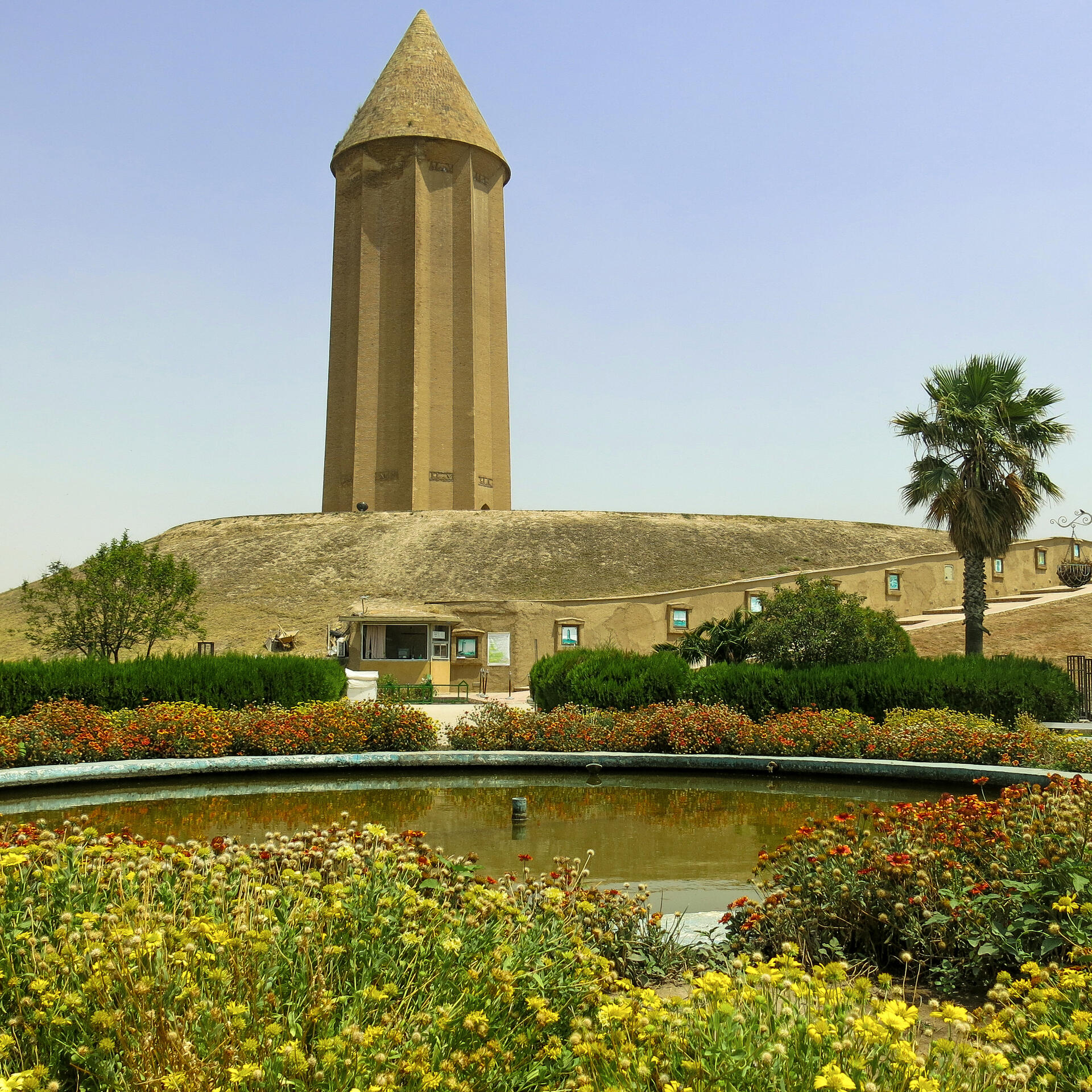
© Hadi Karimi, CC BY-SA 4.0 Resized from original. (This derivative is under the same CC BY-SA license.)
World Heritage Research
Discover scientific research and academic studies that deepen our understanding of Gonbad-e Qābus from its history and significance to its conservation, management, and contemporary challenges.
-
Lichen colonization and associated biodeterioration processes on ancient bricks of the Gonbad-e Qābus tower, UNESCO World Heritage Site, Iran
Lichen colonization on the ancient bricks of Gonbad-e Qābus, a UNESCO World Heritage Site in Iran, varies significantly with architectural features and microclimatic conditions such as wall geometry, wind direction, rainfall, and sunlight exposure. This study reveals that lichens contribute to biodeterioration by penetrating brick pores with hyphae, secreting acids, and chemically altering mineral constituents. The research characterizes lichen diversity and distribution across different parts of the tower, highlighting how these factors influence conservation efforts. Understanding these relationships is crucial for preventive measures aimed at preserving cultural heritage structures.
Zabihi, M., Sohrabi, M., Favero-Longo, S. E., & Nortaghani, A. (2024). Lichen colonization and associated biodeterioration processes on ancient bricks of the Gonbad-e Qābus tower, UNESCO World Heritage Site, Iran. https://doi.org/10.21203/rs.3.rs-5390357/v1
View Publication Record | Read Publication -
Field Observation and Vulnerability Assessment of Gonbad-e Qābus
Gonbad-e Qābus, the world's tallest pure-brick tower at 52.8 meters, stands as a testament to early Islamic architecture amidst urban development. A study reveals that the structure is vulnerable to seismic demands with a return period of 475 years, necessitating retrofit strategies for enhanced stability. The research employs nonlinear finite-element simulations and equivalent lateral static force methods to assess potential structural and architectural damages, providing detailed classifications and proposed solutions. Key findings underscore the urgent need for conservation efforts to preserve this monumental heritage site from seismic risks.
Ebrahimiyan, M., Golabchi, M., & Yekrangnia, M. (2017). Field Observation and Vulnerability Assessment of Gonbad-e Qābus. Journal of Architectural Engineering, 23(4). https://doi.org/10.1061/(asce)ae.1943-5568.0000266
View Publication Record | Read Publication