World Heritage Identification Number: 274
World Heritage since: 1983
Category: Mixed Cultural Heritage and Natural Heritage
WHE Type: Religious Sites & Sacred Architecture
Transboundary Heritage: No
Endangered Heritage: No
Country: 🇵🇪 Peru
Continent: Americas
UNESCO World Region: Latin America and the Caribbean
Map
The Historic Sanctuary of Machu Picchu: A Unique Blend of Nature and Culture
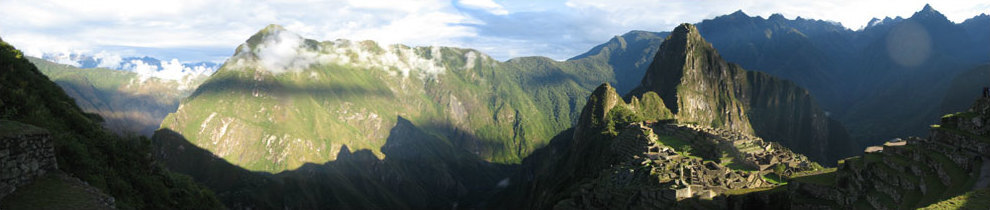
The Historic Sanctuary of Machu Picchu, inscribed as a UNESCO World Heritage Site in 1983, offers a remarkable fusion of cultural and natural heritage. Situated in the highlands of Peru, it stands at an elevation of approximately 2,430 meters (7,972 feet) above sea level, nestled within a lush tropical mountain forest. This breathtaking location provides a picturesque backdrop for one of the most significant urban creations of the Inca Empire during its zenith.
The sanctuary spans over 35,000 hectares, encompassing not only the renowned Machu Picchu archaeological site but also the surrounding natural environment. The Machu Picchu site itself is perched upon the rugged cliffs of the Yungas, a region characterized by its dense cloud forests that blanket the eastern slopes of the Andes. The sanctuary's boundaries extend along both banks of the Urubamba River, which meanders northwestward through this section of the Andean landscape.
The Machu Picchu archaeological site is distinguished by its grandiose architecture, featuring massive stone walls, intricate terraces, and expansive ramps. These architectural marvels appear as if they were seamlessly carved into the continuous rock escarpments, showcasing the exceptional craftsmanship of the Inca builders. The site's layout suggests that it served as a religious, astronomical, and administrative center for the Inca civilization.
Beyond the architectural wonders, the Historic Sanctuary of Machu Picchu boasts an extraordinary biodiversity. The sanctuary lies within the upper Amazon basin, home to an abundance of plant and animal species. The region's rich flora includes orchids, ferns, and bamboo, while its diverse fauna comprises monkeys, jaguars, and various bird species such as the cock-of-the-rock and the Andean condor. The sanctuary's unique blend of culture and nature makes it a must-visit destination for travelers seeking to immerse themselves in the history and beauty of the Andean highlands.
In addition to its cultural and natural significance, the Historic Sanctuary of Machu Picchu faces challenges related to conservation and sustainable tourism. To address these issues, the Peruvian government has implemented measures aimed at preserving the site's integrity while promoting responsible tourism practices. These efforts include limiting visitor numbers, establishing infrastructure for waste management, and implementing educational programs to raise awareness about the importance of protecting this precious World Heritage Site.
To bring it all together, the Historic Sanctuary of Machu Picchu, recognized as one of the New Seven Wonders of the World in 2007, represents a remarkable testament to the ingenuity and artistic prowess of the Inca civilization. Its stunning natural surroundings, teeming with biodiversity, further enhance its allure. As a UNESCO World Heritage Site, the sanctuary serves as a reminder of our shared human heritage and the importance of preserving these treasures for future generations to appreciate and learn from.
UNESCO Description of the World Heritage Site
Machu Picchu stands 2,430 m above sea-level, in the middle of a tropical mountain forest, in an extraordinarily beautiful setting. It was probably the most amazing urban creation of the Inca Empire at its height; its giant walls, terraces and ramps seem as if they have been cut naturally in the continuous rock escarpments. The natural setting, on the eastern slopes of the Andes, encompasses the upper Amazon basin with its rich diversity of flora and fauna.
UNESCO Justification of the World Heritage Site
Criterion (i): The Inca City of the Historic Sanctuary of Machu Picchu is the articulating centre of its surroundings, a masterpiece of art, urbanism, architecture and engineering of the Inca Civilization. The working of the mountain, at the foot of the Huaya Picchu, is the exceptional result of integration with its environment, the result from a gigantic effort as if it were an extension of nature.
Criterion (iii): The Historic Sanctuary of Machu Picchu is a unique testimony of the Inca Civilization and shows a well-planned distribution of functions within space, territory control, and social, productive, religious and administrative organization.
Criterion (vii): The historic monuments and features in the Historic Sanctuary of Machu Picchu are embedded within a dramatic mountain landscape of exceptional scenic and geomorphological beauty thereby providing an outstanding example of a longstanding harmonious and aesthetically stunning relationship between human culture and nature.
Criterion (ix): Covering part of the transition between the High Andes and the Amazon Basin the Historic Sanctuary of Machu Picchu shelters a remarkably diverse array of microclimates, habitats and species of flora and fauna with a high degree of endemism. The property is part of a larger area unanimously considered of global significance for biodiversity conservation.
Encyclopedia Record: Historic Sanctuary of Machu Picchu
The Historic Sanctuary of Machu Picchu is a protected area in Peru covering over 35,000 hectares. It includes the natural environment surrounding the Machu Picchu archaeological site, located in the rugged cloud forest of the Yungas on the eastern slope of the Peruvian Andes and along both banks of the Urubamba River, which flows northwest in this section.Additional Site Details
Area: 38,160.87 hectares
Number of Components: 1
(iii) — Unique or exceptional testimony to a cultural tradition
(vii) — Contains superlative natural phenomena or beauty
(ix) — Outstanding example representing ecological and biological processes
Coordinates: -13.184934 , -72.533443
IUCN World Heritage Outlook
The 2025 Conservation Outlook on Historic Sanctuary of Machu Picchu reports the following assessment:
Source: International Union for Conservation of Nature (IUCN) · View assessment
World Heritage Research
Discover scientific research and academic studies that deepen our understanding of Historic Sanctuary of Machu Picchu from its history and significance to its conservation, management, and contemporary challenges.
-
Destination Regeneration: Transforming Overtourism Hotspots into Smart Eco-Regions
A transformative approach to combating overtourism, the excessive and often detrimental influx of tourists, is proposed through the concept of 'Smart Eco-Regions.' This model integrates advanced digital infrastructure, sustainable tourism practices, community engagement, and adaptive governance to regenerate overburdened destinations like Venice, Barcelona, Machu Picchu, and Santorini. The study highlights that proactive destination regeneration—rather than reactive crisis management—can preserve cultural heritage, enhance environmental resilience, and foster long-term socio-economic benefits. By balancing visitor experiences with ecological and social sustainability, this framework offers a blueprint for transforming overtourism hotspots into thriving, sustainable eco-regions.
Sirivadhanawaravachara, A. (2026). Destination Regeneration: Transforming Overtourism Hotspots into Smart Eco-Regions. Zenodo. https://doi.org/10.5281/ZENODO.18846003
View Publication Record | Read Publication -
Hidden Gems to Sinking Cities: The Local Consequences of UNESCO World Heritage Site Management
Research reveals that UNESCO World Heritage Site (WHS) designation, while beneficial globally, often leads to the exclusion of local communities from economic participation due to tourism management policies. A longitudinal case study comparing Angkor Archaeological Park in Cambodia and Machu Picchu in Peru over 20 years found that as tourism intensifies, local management practices actively marginalize communities, contributing to issues like overtourism and 'UNESCO-cide.' The study maps the evolution of site management phases and UNESCO's prioritized concerns, highlighting the unintended consequences of heritage designation on local economies.
Nunez Ludeiro, Flavia. (2026). HIDDEN GEMS TO SINKING CITIES: THE LOCAL CONSEQUENCES OF UNESCO WORLD HERITAGE SITE MANAGEMENT. The University of North Carolina at Chapel Hill University Libraries. https://doi.org/10.17615/1C8M-3Q21
View Publication Record | Read Publication -
Legal Mechanisms of Cultural Property Restitution in Peru: National and International Levels
Peru's shift from judicial to diplomatic-administrative mechanisms for cultural property restitution, exemplified by the Machu Picchu collection dispute with Yale University, highlights that international protective status alone does not ensure effective safeguarding without robust national frameworks. The study analyzes Peru's legal evolution, tracing key legislation from 1929 to 2004 and applying Massimo Severo Giannini's theory of split ownership to demonstrate the separation between physical possession and cultural value title. Using Chan Chan, a UNESCO World Heritage site, as a case study, it underscores the necessity for differentiated national mechanisms to complement international conventions like the 1970 UNESCO and 1995 UNIDROIT agreements.
Cherkashina, A. V. (2026). Legal Mechanisms of Cultural Property Restitution in Peru: National and International Levels. Теория И Практика Общественного Развития, (7), 203–208. https://doi.org/10.24158/tipor.2026.7.21
View Publication Record | Read Publication -
Cultural Heritage Preservation and Revitalization in Peru: An Analytical Study of Machu Picchu and Cuzco
Peru's approach to preserving and revitalizing its cultural heritage, exemplified by the UNESCO World Heritage Site Machu Picchu and the city of Cuzco, offers a global model for sustainable heritage management. The study highlights Peru's systematic regulatory framework, international cooperation efforts, and innovative strategies such as characteristic tourism routes, cultural experience activities, and integration with education and community life. These measures effectively balance preservation with revitalization, providing valuable lessons in legislation, sustainable tourism, protection concepts, and collaborative governance. This analytical study underscores the importance of multi-faceted strategies in ensuring the long-term conservation and innovative development of cultural heritage worldwide.
Wu, Y., & Kong, F. (2025). Cultural Heritage Preservation and Revitalization in Peru: An Analytical Study of Machu Picchu and Cuzco. Journal of Humanities, Arts and Social Science, 9(4), 718–722. https://doi.org/10.26855/jhass.2025.04.009
View Publication Record | Read Publication -
Peruvian Gastronomy, Cultural Heritage, and Tourist Attraction of the Destination Peru
Peruvian gastronomy has emerged as a significant cultural heritage and tourist attraction, complementing traditional material sites like Machu Picchu to drive tourism in Peru. This study demonstrates that food culture, an immaterial expression of Peruvian identity, not only holds global recognition but also motivates international travel, positioning it as both a heritage asset and an engine for social change. The research employs a mixed-method approach, combining documentary review, data registration, and indirect observation to analyze three key aspects: the evolution of Peruvian gastronomy from local tradition to worldwide acclaim; its status as a cultural heritage; and its role in tourism. Findings highlight its dual capacity to preserve heritage while fostering economic and social transformation.
Zapata Mendoza, M. E. (2025). Peruvian Gastronomy, Cultural Heritage, and Tourist Attraction of the Destination Peru. Purpose-Driven Tourism, 83–101. https://doi.org/10.1201/9781003637844-5
View Publication Record | Read Publication -
Human presence in the Salapunku area (Machu Picchu, Cusco, Peru) based on recent radiocarbon evidence
Recent radiocarbon analysis at Salapunku, the gateway to Machu Picchu's Cordillera of Vilcabamba, reveals a layered cultural history spanning from early human presence to complex pre-Hispanic societies and the colonial period. Unlike previous chronological studies relying on artifact typology, this first-ever radiocarbon dating for the site provides precise temporal markers, clarifying the sequence of occupations and their transitions. The findings challenge assumptions about the site's sole association with Inca settlements, underscoring its significance as a crossroads of diverse cultural periods in the Cusco region.
Sieczkowska-Jacyna, D., Bastante, J., Rakowski, A., Pawlyta, J., & Condori Castillo, I. F. (2025). Human presence in the Salapunku area (Machu Picchu, Cusco, Peru) based on recent radiocarbon evidence. Radiocarbon, 68(1), 139–154. https://doi.org/10.1017/rdc.2025.10153
View Publication Record | Read Publication -
ResNet50V2 for Global Landmark Categorization: A Deep Transfer Learning and Residual Mapping Approach
A deep learning model, ResNet50V2, demonstrates high accuracy in classifying 12 globally significant landmarks, including the Historic Sanctuary of Machu Picchu. This advancement leverages transfer learning and residual mapping to handle complex variations in form, history, and location, addressing challenges posed by diverse cultural heritage sites. The model's ability to generalize and extract relevant features supports applications in tourism marketing, heritage conservation, digital preservation, and educational resources. By automating landmark recognition, the approach promotes sustainable management of cultural heritage and enhances global learning initiatives.
Dey, R., Banerjee, D., Sharma, J., Singla, M. K., Singh, A. K., Chitre, A., & Mahajan, R. A. (2025). ResNet50V2 for Global Landmark Categorization: A Deep Transfer Learning and Residual Mapping Approach. 2025 IEEE 5th International Conference on ICT in Business Industry &Amp; Government (ICTBIG), 1–5. https://doi.org/10.1109/ictbig68706.2025.11323705
View Publication Record | Read Publication