World Heritage Identification Number: 700
World Heritage since: 1994
Category: Cultural Heritage
WHE Type: Archaeological Sites
Transboundary Heritage: No
Endangered Heritage: No
Country: 🇵🇪 Peru
Continent: Americas
UNESCO World Region: Latin America and the Caribbean
Map
Deciphering the Enigma: The Lines and Geoglyphs of Nasca and Palpa
The Lines and Geoglyphs of Nasca and Palpa, inscribed on the UNESCO World Heritage List in 1994, constitute one of the most intriguing archaeological mysteries in the world. Situated on the arid coastal plain of Peru, approximately 400 kilometers south of Lima, the geoglyphs of Nasca and the Pampas de Jumana cover about 450 square kilometers.
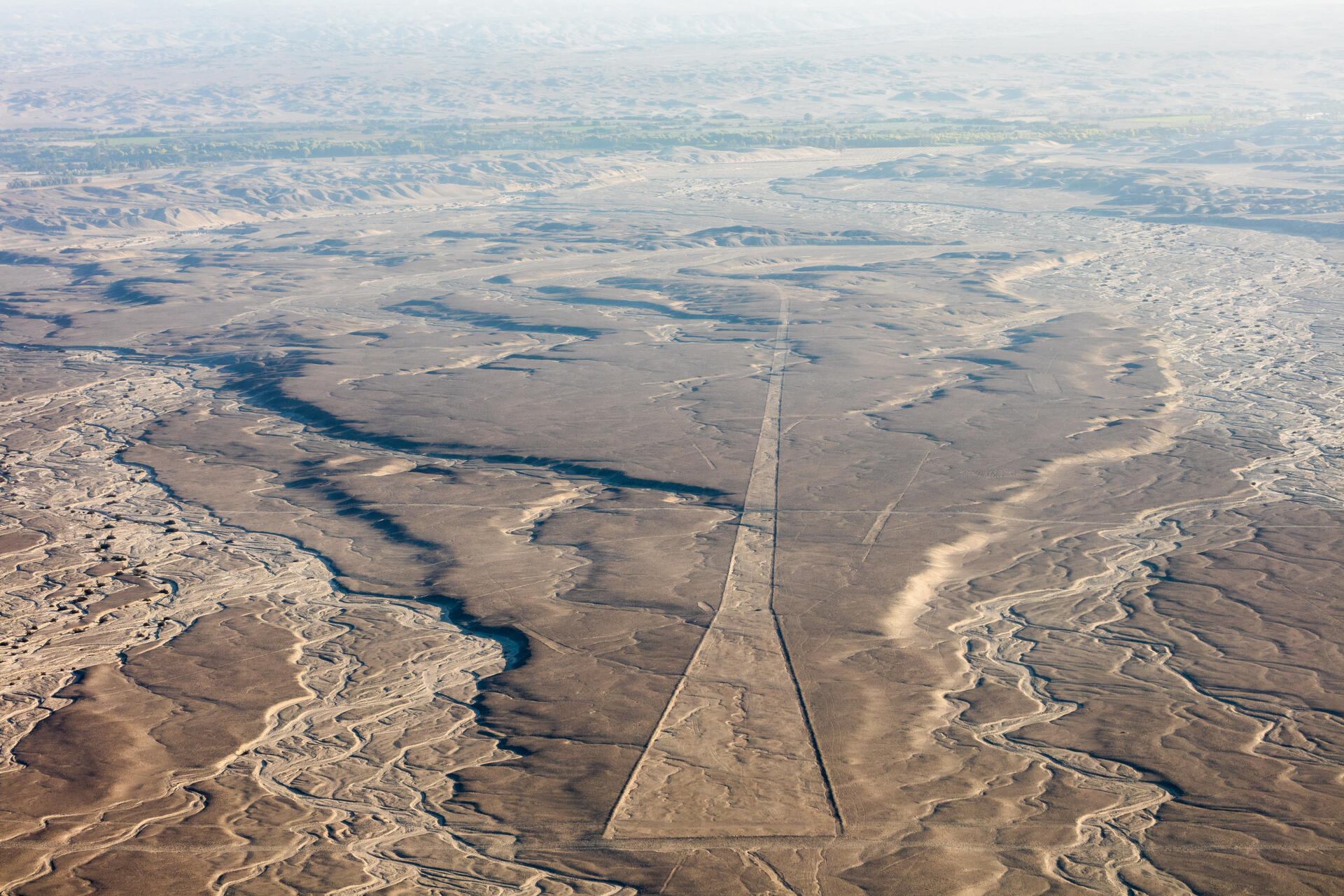
The geoglyphs date primarily from approximately 500 B.C. to A.D. 500 and consist of lines, geometric shapes, and figurative designs. These include representations of animals, plants, birds, insects, and other living creatures, as well as fantastic or imaginary beings and geometric patterns extending for several kilometers. Although their exact purpose remains uncertain, scholars have proposed that some of the geoglyphs were associated with ritual and ceremonial activities, including possible astronomical functions.
The Nasca and Palpa regions contain a remarkable variety of geoglyphs. In 2024, researchers reported 303 previously unknown figurative geoglyphs identified with the assistance of artificial intelligence and high-resolution aerial imagery. Combined with the approximately 430 figurative geoglyphs already known, this brought the documented total to more than 700 figurative geoglyphs. These discoveries demonstrate that additional geoglyphs may still await identification and study.
The geoglyphs were created over several centuries by ancient communities associated with the Paracas and Nasca cultural traditions. Their development reflects a long period of cultural continuity and change rather than the work of a single group at a single moment in time. The earlier Paracas tradition is associated with some of the earlier figurative geoglyphs, while the later Nasca period saw the creation and expansion of many of the enormous lines and geometric designs for which the region is famous.
Although the Nasca Lines are the most widely known, the archaeological landscape also extends into the Palpa region, which contains numerous geoglyphs and related archaeological remains. The figures and lines of Palpa are particularly important because they provide evidence for traditions that predate or overlap with the better-known Nasca geoglyphs. Studying Nasca and Palpa together therefore allows archaeologists to investigate how the practice of creating geoglyphs developed and changed over time, rather than treating the famous Nasca figures as an isolated phenomenon.
The extraordinary preservation of the geoglyphs is largely due to the region's exceptionally dry climate, limited rainfall, and stable desert surface. Nevertheless, the site remains vulnerable to human activity and environmental pressures, making careful monitoring and conservation essential. Modern understanding of the geoglyphs was also shaped by the work of researchers such as Maria Reiche, whose decades of research and advocacy helped bring international attention to the Nasca Lines and contributed greatly to their study and preservation.
The broader archaeological landscape also contains numerous lines, geometric forms, and other features that collectively make up what is commonly known as the Nasca Lines. The geoglyphs were created primarily by removing the dark, weathered surface stones and pebbles to expose the lighter-colored ground beneath. This relatively simple technique enabled the ancient inhabitants of the region to create remarkably large and precise designs. Archaeologists identify different cultural and chronological phases in their development, including the Paracas and Nasca phases.
One of the most captivating aspects of the Nasca geoglyphs is their scale and complexity. Some of the larger designs extend across vast areas of the desert and are particularly difficult to appreciate from ground level. Their creation required careful planning and a detailed understanding of the landscape, yet it did not necessarily depend on sophisticated technology. Simple tools and surveying techniques could have enabled the ancient inhabitants to establish straight lines, geometric forms, and large-scale figures with remarkable accuracy.
Despite decades of archaeological research, the exact purpose and meaning of the Nasca geoglyphs remain unresolved. Astronomical interpretations have long been proposed, but the evidence does not support a single explanation for all of the geoglyphs. Researchers have also suggested religious, ceremonial, social, and communicative functions. Recent studies indicate that different types of geoglyphs may have served different purposes, with some associated with communal ceremonial activities and others potentially communicating information about people, animals, or activities across the landscape.
The Lines and Geoglyphs of Nasca and Palpa therefore stand as a remarkable testament to the ingenuity, organization, and artistic traditions of the ancient peoples of the region. Their extraordinary preservation in one of the world's most arid environments has allowed these enigmatic designs to survive for centuries. As archaeological research and new technologies continue to reveal previously unknown geoglyphs, they may provide further insights into the societies, beliefs, and practices of pre-Columbian Peru.
UNESCO Description of the World Heritage Site
Located in the arid Peruvian coastal plain, some 400 km south of Lima, the geoglyphs of Nasca and the pampas of Jumana cover about 450 km2 . These lines, which were scratched on the surface of the ground between 500 B.C. and A.D. 500, are among archaeology's greatest enigmas because of their quantity, nature, size and continuity. The geoglyphs depict living creatures, stylized plants and imaginary beings, as well as geometric figures several kilometres long. They are believed to have had ritual astronomical functions.
UNESCO Justification of the World Heritage Site
Criterion (i): The Nasca Lines and Geoglyphs form a unique and magnificent artistic achievement of the Andean culture that is unrivalled in its extension, dimensions and diversity and long existence anywhere in the prehistoric world.
Criterion (iii): The Nasca and Pampas de Jumana Lines and Geoglyphs, through its unique form of land use, are an exceptional testimony of the culture and magical-religious tradition and beliefs of the societies that developed in Pre-Columbian South America between the 8th BC and 8th AD centuries.
Criterion (iv): The system of lines and geoglyphs, which has survived intact for more than two millennia, evidences an unusual way of using the land and the natural environment that represent a highly symbolic cultural landscape, using a construction technology that allowed them to design large-scale figures with outstanding geometric precision.
Encyclopedia Record: Nazca lines
The Nazca lines are a group of over 700 geoglyphs made in the soil of the Nazca Desert in southern Peru. They were created between 500 BC and 500 AD by people making depressions or shallow incisions in the desert floor, removing pebbles and leaving different-colored dirt exposed. There are two major phases of the Nazca lines, Paracas phase, from 400 to 200 BC, and Nazca phase, from 200 BC to 500 AD. In the 21st century, several hundred new figures had been found with the use of drones, and archaeologists believe that there are more to be found.Additional Site Details
Area: 75,358.47 hectares
Number of Components: 1
(iii) — Unique or exceptional testimony to a cultural tradition
(iv) — Outstanding example of a type of building or landscape
Coordinates: -14.72583 , -75.14861
Image
© Diego Delso, CC BY-SA 4.0 Resized from original. (This derivative is under the same CC BY-SA license.)
World Heritage Research
Discover scientific research and academic studies that deepen our understanding of Lines and Geoglyphs of Nasca and Palpa from its history and significance to its conservation, management, and contemporary challenges.
-
The Chincha lines
A newly documented set of linear geoglyphs and structures, dubbed the 'Chincha lines,' has been identified in Carmen Pampa within the upper Chincha valley of southern Peru. These geoglyphs, similar to those found in nearby Nasca and Palpa valleys, date back to the Paracas period (400–200 BCE) with potential use extending into AD 100. The complex comprises linear geoglyphs, small mounded structures, and larger platform mounds, offering significant insights into ancient Peruvian cultural practices and regional interactions. This discovery expands our understanding of pre-Columbian art and architecture in the region.
Stanish, C., & Tantaleán, H. (2018). The Chincha lines. Ñawpa Pacha, 38(1), 77–107. https://doi.org/10.1080/00776297.2018.1444949
View Publication Record | Read Publication -
Tracking Human-Induced Landscape Disturbance at the Nasca Lines UNESCO World Heritage Site in Peru with COSMO-SkyMed InSAR
A groundbreaking study leverages high-resolution COSMO-SkyMed satellite imagery to document human-induced disturbances at the UNESCO World Heritage Site 'Lines and Geoglyphs of Nasca and Palpa' in Peru. The research identifies two significant events—December 2014 and January 2018—using interferometric SAR (InSAR) techniques, which detect temporal decorrelation linked to landscape changes. These findings align with photographic evidence, published reports, and official records from Peruvian authorities. Additionally, Sentinel-2B data reveal surface reflectance changes in the Pampa de Jumana, exposing underlying clay layers beneath darker pebble surfaces. This study underscores the value of SAR imagery archives for retrospective analysis and digital preservation, offering critical geospatial insights into heritage conservation.
Cigna, F., & Tapete, D. (2018). Tracking Human-Induced Landscape Disturbance at the Nasca Lines UNESCO World Heritage Site in Peru with COSMO-SkyMed InSAR. Remote Sensing, 10(4), 572. https://doi.org/10.3390/rs10040572
View Publication Record | Read Publication -
Detecting Landscape Disturbance at the Nasca Lines Using SAR Data Collected from Airborne and Satellite Platforms
A groundbreaking study leverages synthetic aperture radar (SAR) data from both airborne and satellite platforms to detect and measure landscape disturbances threatening the UNESCO World Heritage Site of Nasca and Palpa, home to the iconic Nasca Lines. The research demonstrates that even pedestrian-scale disturbances are discernible using L-band SAR correlation images, while C-band SAR data from ESA’s Sentinel-1 satellites offers high-resolution insights into landscape changes with a repeat pass interval as short as six days. This allows for precise identification of disturbance time windows (1–3 weeks) without compromising spatial coverage. The study also introduces pixel value stretching techniques and statistical methods to quantify and validate landscape changes, providing a robust framework for monitoring archaeological sites and ecosystems under threat.
Comer, D., Chapman, B., & Comer, J. (2017). Detecting Landscape Disturbance at the Nasca Lines Using SAR Data Collected from Airborne and Satellite Platforms. Geosciences, 7(4), 106. https://doi.org/10.3390/geosciences7040106
View Publication Record | Read Publication -
Von Bildern zu Bühnen: Die Geoglyphen von Palpa und Nasca (Süd-Peru) in ihrem räumlichen und sozialen Kontext
The geoglyphs of Palpa and Nasca, Southern Peru, transitioned from symbolic depictions to functional ritual stages over time. Initially, during the Paracas Period, these geoglyphs were primarily located on slopes and featured anthropomorphic motifs borrowed from other media, likely serving as distant focal points for unspecified activities. However, during the subsequent Nasca Period, geoglyphs evolved into vast geometric patterns on desert plains, becoming central to elaborate ritual practices. These rituals, marked by offering deposits, are believed to have been linked to prayers for water and fertility amid increasing aridity. The study suggests that the significance of these geoglyphs shifted from their visual representation to the activities performed upon them, with other media taking on a more prominent role in image-bearing.
Lambers, K. Von Bildern zu Bühnen: Die Geoglyphen von Palpa und Nasca (Süd-Peru) in ihrem räumlichen und sozialen Kontext. Bild - Raum - Handlung. https://doi.org/10.1515/9783110266344.47
View Publication Record | Read Publication