World Heritage Identification Number: 1236
World Heritage since: 2011
Category: Cultural Heritage
WHE Type: Religious Sites & Sacred Architecture
Transboundary Heritage: No
Endangered Heritage: No
Country: 🇳🇮 Nicaragua
Continent: Americas
UNESCO World Region: Latin America and the Caribbean
Map
The León Cathedral: A Testament to Transitional Architecture and Artistic Elegance
The León Cathedral, officially known as the Cathedral of the Assumption of Mary, stands as a testament to the harmonious blend of Baroque and Neoclassical architecture in León, Nicaragua. This significant historical landmark, awarded World Heritage Site status by the United Nations Educational, Scientific and Cultural Organization (UNESCO) in 2011, is the third cultural landmark in Nicaragua, following the ruins of León Viejo and El Güegüense.
More to come…UNESCO Description of the World Heritage Site
Built between 1747 and the early 19th century to the design of Guatemalan architect Diego José de Porres Esquivel, the monument expresses the transition from Baroque to Neoclassical architecture and its style can be considered to be eclectic. The Cathedral is characterized by the sobriety of its interior decoration and the abundance of natural light. The vault of the Sanctuary, however, presents rich ornamentation. The Cathedral houses important works of art including a wooden Flemish altarpiece, and paintings of the 14 stations of the Way of the Cross by Nicaraguan artist Antonio Sarria (late 19th and early 20th centuries).
UNESCO Justification of the World Heritage Site
Criterion (ii): León Cathedral is an outstanding example of an exchange of human values demonstrated by the different architectural influences from Spanish Art that merge in the monument, shaped by the local workmanship and the geographical and social environment. León Cathedral materially encapsulates the social, religious and artistic syncretism of the new Latin American society appearing during the 18th century.
Criterion (iv): León Cathedral constitutes an outstanding example of a regional Central American interpretation of a typology of religious building merging several architectural and stylistic sources in an ensemble featured by its unity and architectural and social significance.
Encyclopedia Record: León Cathedral, Nicaragua
The Cathedral of the Assumption of Mary, also known as the "Royal and Renowned Basilica Cathedral of the Assumption of the Blessed Virgin Mary", is a significantly important and historic landmark in León, Nicaragua. The cathedral was awarded World Heritage Site status with the United Nations Educational, Scientific and Cultural Organization (UNESCO). The site's nomination is Nicaragua's third cultural landmark, following the ruins of León Viejo and El Güegüense.Additional Site Details
Area: 0.77 hectares
Number of Components: 1
(iv) — Outstanding example of a type of building or landscape
Coordinates: 12.435 , -86.8780555556
Image
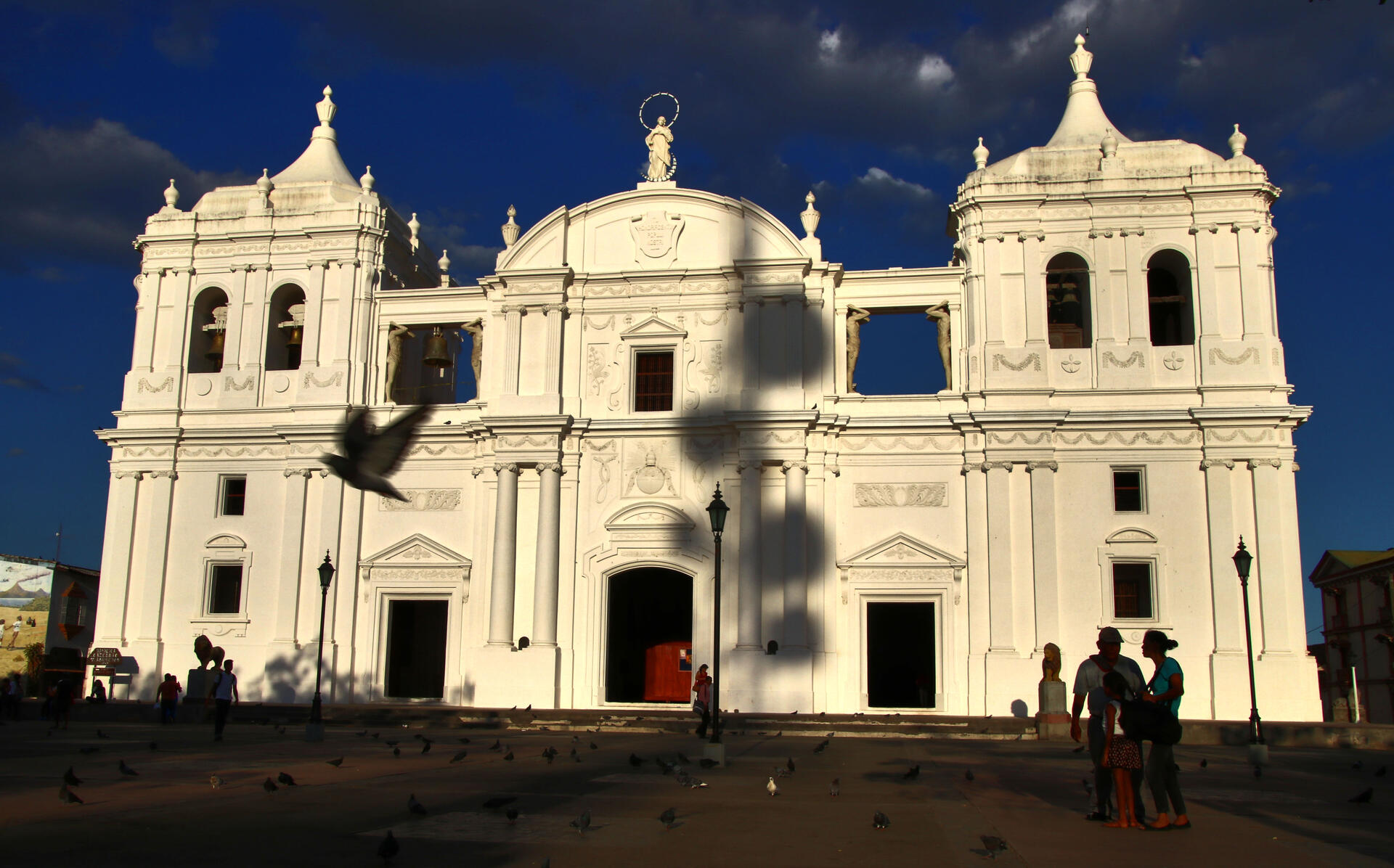
© Guillaume Baviere from Uppsala, Sweden, CC BY-SA 2.0 Resized from original. (This derivative is under the same CC BY-SA license.)
World Heritage Research
Discover scientific research and academic studies that deepen our understanding of León Cathedral from its history and significance to its conservation, management, and contemporary challenges.
-
Chemical composition of Medieval stained glasses from the Cathedral of León (Spain)
Medieval stained glass windows from León Cathedral, Spain, are primarily composed of potash-lime glass with notably low alumina content. This unique chemical composition has contributed to their significant deterioration over centuries due to environmental exposure. The study employed advanced techniques such as X-ray diffraction, inductively coupled plasma, X-ray fluorescence, and flame photometry to analyze a selection of glass samples dating from the Medieval and Renaissance periods. These findings provide critical insights into the material properties and preservation challenges of historical stained glass, offering valuable data for conservation efforts.
Valle, F. J., Ortega, P., Pascual, L., Carmona, N., & Fernández Navarro, J. M. (2002). Chemical composition of Medieval stained glasses from the Cathedral of León (Spain). Offenbach : Verlag Der Deutschen Glastechnischen Gesellschaft. https://doi.org/10.34657/13014
View Publication Record | Read Publication -
Monumenta et memoriae:the thirteenth-century episcopal pantheon of León Cathedral
The thirteenth-century episcopal pantheon of León Cathedral exemplifies the fusion of commemoration and propaganda, serving as a tool to manipulate collective memory and reinforce episcopal authority. This study identifies key devices within the pantheon that evoke bishops' achievements, personal devotion, rituals, dogmas, and the history of the See. It highlights the expressive mourning traditions of Leonese citizens, rooted in Iberian practices, while analyzing the aesthetic compliance with Lucas of Tuy's ideals. Notably, Bishop Rodrigo's sepulchral monument is recognized as a foundational work in Castilian-Leonese tomb design, with its complex interplay between imagery and audience influencing subsequent designs, such as that of Bishop Martin.
Ameijeiras, R. S. (2019). Monumenta et memoriae:the thirteenth-century episcopal pantheon of León Cathedral. Memory and the Medieval Tomb, 269–299. https://doi.org/10.4324/9781315193427-12
View Publication Record | Read Publication -
Musical Cryptography and the Early History of the ‘León Antiphoner’
A groundbreaking analysis of the León Antiphoner, a 10th-century manuscript containing Old Hispanic chant, reveals that it was commissioned by San Froilán, Bishop of León, between 900 and 905. The study deciphers cryptographic inscriptions on the manuscript, providing definitive evidence for its dating and patronage, which had previously been debated. The research suggests that the manuscript was likely produced in the scriptorium of the monastery of SS Cosmas and Damian in Abellar, offering new insights into the early history of this significant cultural artifact.
De Luca, E. (2017). MUSICAL CRYPTOGRAPHY AND THE EARLY HISTORY OF THE ‘LEÓN ANTIPHONER’. Early Music History, 36, 105–158. https://doi.org/10.1017/s0261127917000018
View Publication Record | Read Publication -
Royal misattribution: monograms in the León Antiphoner
A new terminus ante quem date of approximately 960 for the León Antiphoner (León, Cathedral Library, MS 8), the most complete manuscript of Old Hispanic chant, has been established through a reassessment of royal monograms on fol. 4v. This challenges previous hypotheses that placed its compilation between the first third of the tenth century and the eleventh century. The study examines the use of monograms and signa in the Visigothic written world, particularly focusing on royal insignia, to support this revised dating. It also proposes a new hypothesis regarding the role of the León Antiphoner as a potential royal insignia, shedding light on its historical significance.
De Luca, E. (2015). Royal misattribution: monograms in the León Antiphoner. Journal of Medieval Iberian Studies, 9(1), 25–51. https://doi.org/10.1080/17546559.2015.1101521
View Publication Record | Read Publication