World Heritage Identification Number: 613
World Heritage since: 2000
Category: Cultural Heritage
WHE Type: Archaeological Sites
Transboundary Heritage: No
Endangered Heritage: No
Country: 🇳🇮 Nicaragua
Continent: Americas
UNESCO World Region: Latin America and the Caribbean
Map
The Ruins of León Viejo: A Window into the Past of Colonial Nicaragua
The Ruins of León Viejo, inscribed as a UNESCO World Heritage Site in 2000, offer a unique glimpse into the history and development of colonial Nicaragua. Situated in the municipality of La Paz Centro, within the department of León, these ancient ruins serve as a testament to the social and economic structures that defined the Spanish Empire during the 16th century.
More to come…UNESCO Description of the World Heritage Site
León Viejo is one of the oldest Spanish colonial settlements in the Americas. It did not develop and so its ruins are outstanding testimony to the social and economic structures of the Spanish Empire in the 16th century. Moreover, the site has immense archaeological potential.
UNESCO Justification of the World Heritage Site
Criterion (iii): The ruined town of León Viejo provides exceptional testimony to the material culture of one of the earliest Spanish colonial settlements.
Criterion (iv): The form and nature of early Spanish settlements in the New World, adapting European architectural and planning concepts to the material potential of another region, are uniquely preserved in the archaeological site of León Viejo.
Encyclopedia Record: León Viejo
Ruins of León Viejo is a World Heritage Site in Nicaragua. It was the original location of León. It is the present location of the town of Puerto Momotombo in the Municipality of La Paz Centro of the Department of León. It is administered by the Instituto Nicaragüense de Cultura.Additional Site Details
Area: 31.87 hectares
Number of Components: 1
(iv) — Outstanding example of a type of building or landscape
Coordinates: 12.40047 , -86.616336
Image
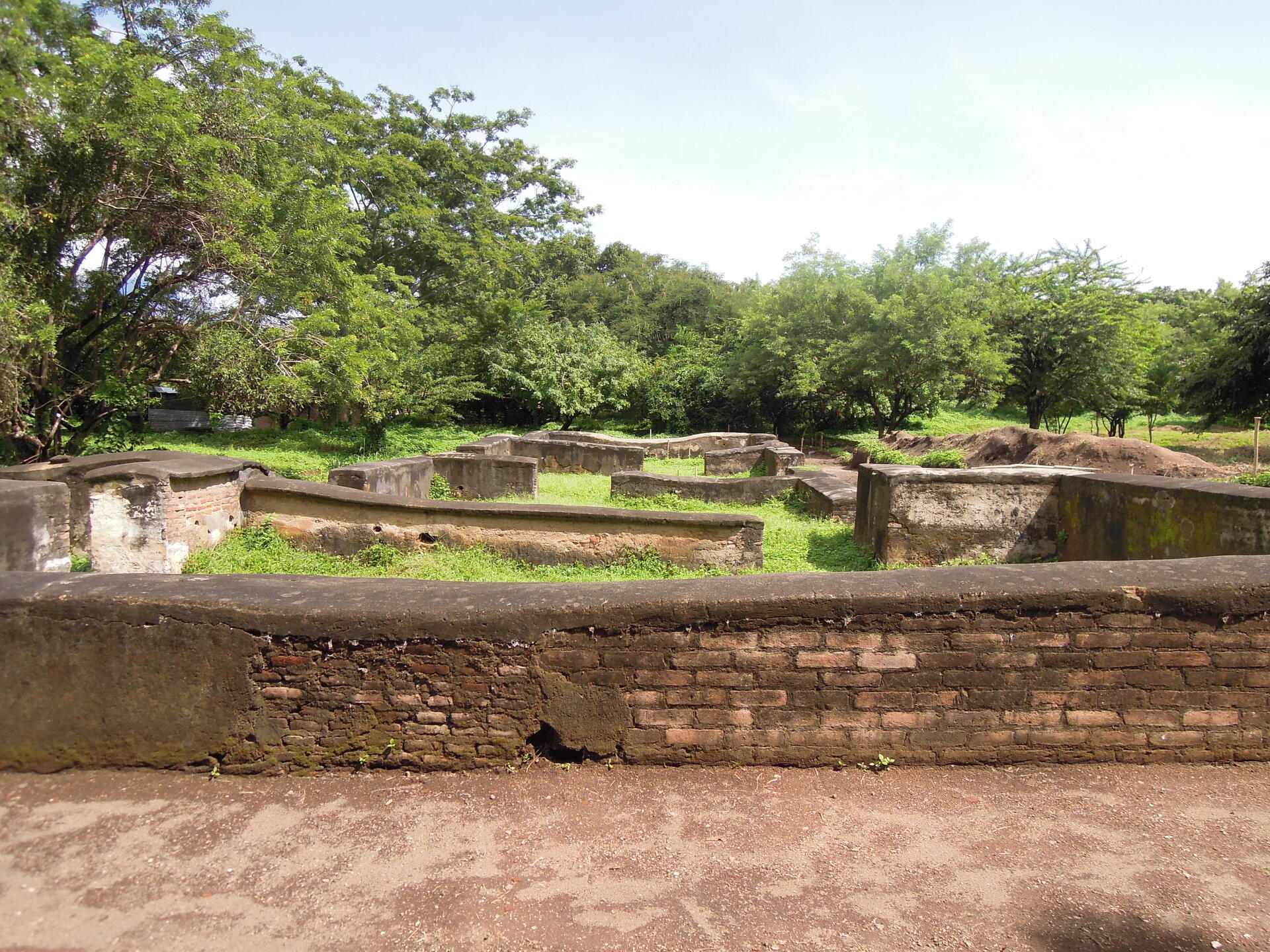
© pr47, CC BY-SA 3.0 Resized from original. (This derivative is under the same CC BY-SA license.)
World Heritage Research
Discover scientific research and academic studies that deepen our understanding of Ruins of León Viejo from its history and significance to its conservation, management, and contemporary challenges.
-
León Viejo de Nicaragua: Arquitectura colonial española en el siglo XVI
Colonial architecture in León Viejo, Nicaragua's first city (founded 1524, abandoned 1610), established foundational stylistic and design patterns that shaped the future of architectural heritage in the region. This study identifies key characteristics of Spanish colonial architecture during its implantation phase in the 16th century, revealing how settlers adapted European techniques to local constraints—limited resources, high seismicity, and a skilled but under-equipped workforce. The research highlights the prevalence of the 'casapatio' design with porticoed corridors and the 'par y nudillo' roof structure, influenced by Nasrid architecture. Unlike previous studies, this analysis combines historiography and site-specific data to contextualize León Viejo's unaltered ruins within broader historical, cultural, socio-economic, and natural frameworks. It underscores the need for continued conservation and study of this significant, yet under-researched, architectural heritage.
Guillén Valenzuela, D. M. (2020). León Viejo of Nicaragua: Spanish colonial architecture in the XVI century. Gremium, 7(E2), 38–49. https://doi.org/10.56039/rgne2a05
View Publication Record | Read Publication