
World Heritage Identification Number: 1149
World Heritage since: 2004
Category: Natural Heritage
WHE Type: Natural Landscapes & Geographic Features
Transboundary Heritage: No
Endangered Heritage: No
Country: 🇩🇰 Denmark
Continent: Europe
UNESCO World Region: Europe and North America
Map
A Journey Through Time and Ice: The Ilulissat Icefjord
The Ilulissat Icefjord, located on the west coast of Greenland approximately 250 kilometers north of the Arctic Circle, stands as a testament to the enduring power of nature and the ever-evolving relationship between humanity and its environment. This breathtaking natural wonder, a UNESCO World Heritage Site since 2004, offers visitors a unique opportunity to witness firsthand the intricate dance between a massive ice sheet and the relentless forces of the ocean.
More to come…UNESCO Description of the World Heritage Site
Located on the west coast of Greenland, 250 km north of the Arctic Circle, Greenland’s Ilulissat Icefjord is the sea mouth of Sermeq Kujalleq, one of the few glaciers through which the Greenland ice cap reaches the sea. Sermeq Kujalleq is one of the fastest and most active glaciers in the world. It annually calves over 35 km3 of ice, i.e. 10% of the production of all Greenland calf ice and more than any other glacier outside Antarctica. Studied for over 250 years, it has helped to develop our understanding of climate change and icecap glaciology. The combination of a huge ice-sheet and the dramatic sounds of a fast-moving glacial ice-stream calving into a fjord covered by icebergs makes for a dramatic and awe-inspiring natural phenomenon.
UNESCO Justification of the World Heritage Site
Criterion (vii): The combination of a huge ice sheet and a fast moving glacial ice-stream calving into a fjord covered by icebergs is a phenomenon only seen in Greenland and Antarctica. Ilulissat offers both scientists and visitors easy access for a close view of the calving glacier front as it cascades down from the ice sheet and into the ice-choked fjord. The wild and highly scenic combination of rock, ice and sea, along with the dramatic sounds produced by the moving ice, combine to present a memorable natural spectacle.
Criterion (viii): The Ilulissat Icefjord is an outstanding example of a stage in the Earth’s history: the last ice age of the Quaternary Period. The ice-stream is one of the fastest (40 m per day) and most active in the world. Its annual calving of over 46 km3 of ice accounts for 10% of the production of all Greenland calf ice, more than any other glacier outside Antarctica. The glacier has been the object of scientific attention for 250 years and, along with its relative ease of accessibility, has significantly added to the understanding of ice-cap glaciology, climate change and related geomorphic processes.
Encyclopedia Record: Ilulissat Icefjord
Ilulissat Icefjord is a fjord in western Greenland. Located 250 km north of the Arctic Circle, the Ilulissat Icefjord runs west 40 km (25 mi) from the Greenland ice sheet to Disko Bay just south of the town of Ilulissat. Ilulissat Icefjord was declared a UNESCO World Heritage Site in 2004 because of its natural beauty and the importance of the fast-moving Jacobshavn Glacier in developing the current scientific understanding of anthropogenic climate change.Additional Site Details
Area: 399,800 hectares
Number of Components: 1
(viii) — Outstanding example representing major earth stages
Coordinates: 69.13333333 , -49.5
IUCN World Heritage Outlook
The 2025 Conservation Outlook on Ilulissat Icefjord reports the following assessment:
Source: International Union for Conservation of Nature (IUCN) · View assessment
Image
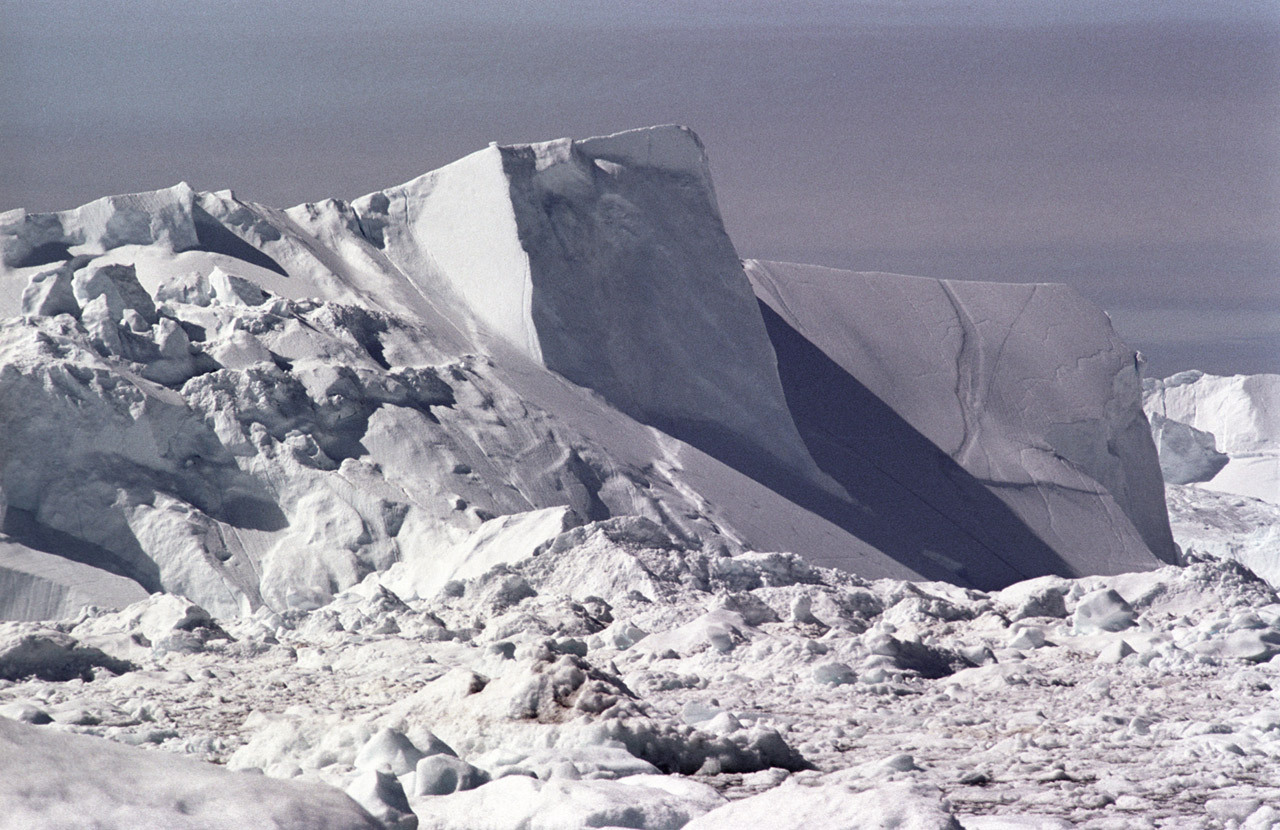
© Unknown, CC BY-SA 3.0 Resized from original. (This derivative is under the same CC BY-SA license.)
World Heritage Research
Discover scientific research and academic studies that deepen our understanding of Ilulissat Icefjord from its history and significance to its conservation, management, and contemporary challenges.
-
A Reassessment of the Role of Atmospheric and Oceanic Forcing on Ice Dynamics at Jakobshavn Isbræ (Sermeq Kujalleq), Ilulissat Icefjord
Jakobshavn Isbræ, the largest contributor to Greenland Ice Sheet mass loss over the past three decades, has shown complex ice dynamics influenced by both atmospheric and oceanic factors. Recent research indicates that the glacier began re-accelerating in 2018, with near-terminus velocity increasing by 49% between 2018 and 2021, prior to significant ocean warming. This acceleration was likely driven by reductions in effective pressure due to ice surface lowering, caused by negative surface mass balance and dynamic thinning. Additionally, sustained thinning and iceberg calving during winter 2020/2021 corresponded with a decrease in rigid mélange extent, linked to increased ocean temperatures in Disko Bay and Ilulissat Icefjord. The study underscores the need to consider both atmospheric and oceanic forcing when projecting the future behavior of marine-terminating outlet glaciers like Jakobshavn Isbræ.
Picton, H. J., Nienow, P. W., Slater, D. A., & Chudley, T. R. (2025). A Reassessment of the Role of Atmospheric and Oceanic Forcing on Ice Dynamics at Jakobshavn Isbræ (Sermeq Kujalleq), Ilulissat Icefjord. Journal of Geophysical Research: Earth Surface, 130(4). Portico. https://doi.org/10.1029/2024jf008104
View Publication Record | Read Publication -
The Ilulissat Icefjord: Local Stewardship and Global Responsibility in a Changing Climate
Climate change and oceanic forces are destabilizing the Sermermiut archaeological site at Ilulissat Icefjord, threatening 4000 years of Inuit cultural heritage. A 2024 fieldwork initiative, involving Greenland’s cultural institutions and international partnerships, employed advanced monitoring techniques and community engagement to study these impacts. The research underscores the need for adaptive management strategies that align with the UN 2030 Agenda to safeguard this UNESCO World Heritage Site. By integrating scientific research, responsible site management, and local knowledge, the Ilulissat Icefjord can remain a globally significant natural site while supporting resilient Arctic communities in a changing climate.
Albrechtsen, B. (2025). The Ilulissat Icefjord: Local Stewardship and Global Responsibility in a Changing Climate. Blue Papers, 4(2). https://doi.org/10.58981/bluepapers.2025.2.01
View Publication Record | Read Publication -
Ilulissat Icefjord Upper‐Layer Circulation Patterns Revealed Through GPS‐Tracked Icebergs
A novel approach using GPS-tracked icebergs reveals that upper-layer circulation in Ilulissat Icefjord, Greenland, is significantly influenced by tributary meltwater runoff and glacier behavior. The study found that increased meltwater discharge can cause icebergs to deviate from their typical down-fjord trajectory, even reversing direction temporarily until the runoff subsides. This dynamic suggests a strong coupling between glacier activity and fjord circulation patterns, which are critical for understanding heat transport in these complex environments. By leveraging freely floating icebergs as natural drifters, researchers successfully quantified circulation over the upper 0–250 meters of the water column during summers 2014 and 2019, addressing long-standing data gaps in this iceberg-rich region. The findings underscore the importance of incorporating tributary fjord dynamics into predictive models of heat transport and glacier behavior.
Baratta, S. J. N., Schild, K. M., & Sutherland, D. A. (2024). Ilulissat Icefjord Upper‐Layer Circulation Patterns Revealed Through GPS‐Tracked Icebergs. Journal of Geophysical Research: Oceans, 129(1). Portico. https://doi.org/10.1029/2023jc020117
View Publication Record | Read Publication -
The diet and diving behaviour of the ringed seal (Pusa hispida) in Kangia (Ilulissat Icefjord), Greenland
Ringed seals (Pusa hispida) in Kangia, Ilulissat Icefjord, Greenland, exhibit unique diving behaviors and dietary preferences that highlight their ecological adaptability. Adult males frequently dive to depths of 400 meters, while subadults typically stay around 150 meters, with deeper dives observed more in winter. Stomach content analysis revealed that polar cod, capelin, mysids, and shrimps dominate their diet, with shrimp prevalence linked to the deeper diving behavior of adults. This niche overlap extends to harp seals and Greenland halibut, underscoring Kangia's critical role as a habitat for these genetically distinct seals.
Schiøtt, S., Holland, D. M., Holland, D., Rysgaard, S., & Rosing-Asvid, A. (2024). The diet and diving behaviour of the ringed seal (Pusa hispida) in Kangia (Ilulissat Icefjord), Greenland. Polar Biology, 47(12), 1409–1422. https://doi.org/10.1007/s00300-024-03310-4
View Publication Record | Read Publication -
An evolutionarily distinct ringed seal in the Ilulissat Icefjord
Researchers have identified a unique ringed seal ecotype, locally known as 'Kangia,' within the Ilulissat Icefjord. This distinct population, genetically divergent from other Arctic ringed seals for approximately 240,000 years, exhibits strong selection in genes linked to pelage coloration, growth, and osmoregulation, explaining its phenotypic and behavioral uniqueness. Despite ongoing gene flow, the study suggests secondary contact since the Last Glacial Maximum, challenging the traditional view of Arctic regions as evolutionary freezers. The findings underscore the value of indigenous knowledge in guiding scientific discovery and highlight the need to reassess how Arctic species may respond differently to environmental changes.
Rosing‐Asvid, A., Löytynoja, A., Momigliano, P., Hansen, R. G., Scharff‐Olsen, C. H., Valtonen, M., Kammonen, J., Dietz, R., Rigét, F. F., Ferguson, S. H., Lydersen, C., Kovacs, K. M., Holland, D. M., Jernvall, J., Auvinen, P., & Tange Olsen, M. (2023). An evolutionarily distinct ringed seal in the Ilulissat Icefjord. Molecular Ecology, 32(22), 5932–5943. Portico. https://doi.org/10.1111/mec.17163
View Publication Record | Read Publication -
Environmental DNA metabarcoding reveals seasonal and spatial variation in the vertebrate fauna of Ilulissat Icefjord, Greenland
A combination of environmental DNA (eDNA) metabarcoding, local ecological knowledge, and hydrographic data reveals significant seasonal and spatial variation in the vertebrate fauna of Ilulissat Icefjord, Greenland. The study finds that Arctic char migrate to the southern fjord during summer, while harp seals forage in large herds within the system. Polar cod emerges as the dominant prey fish, whereas Greenland shark is notably absent, likely contributing to larger ringed seal and Greenland halibut populations due to reduced predation pressure. Summer conditions show a more diverse vertebrate community and distinct water masses in the southern branch compared to the northern branch and main fjord, indicating a time lag in inflow dynamics. This research underscores the value of integrating local knowledge with scientific methods to monitor biological responses to climate-induced changes in this UNESCO World Heritage Site.
Schiøtt, S., Jensen, M., Sigsgaard, E., Møller, P., Avila, M., Thomsen, P., & Rysgaard, S. (2023). Environmental DNA metabarcoding reveals seasonal and spatial variation in the vertebrate fauna of Ilulissat Icefjord, Greenland. Marine Ecology Progress Series, 706, 91–108. https://doi.org/10.3354/meps14250
View Publication Record | Read Publication -
Ilulissat Icefjord Upper-Layer Circulation Patterns Revealed through GPS-Tracked Icebergs
GPS-tracked icebergs in Ilulissat Icefjord reveal that upper-layer circulation patterns (0–250 m depth) are directly influenced by tributary meltwater flux, with deviations in iceberg trajectories coinciding in both location and timing. The study also demonstrates that the speed of this circulation varies with glacier behavior, including changes in glacier velocity and meltwater runoff. Researchers deployed 13 GPS units on icebergs to track their movement, providing unprecedented insights into the dynamic interactions between glacial meltwater and ocean currents in this UNESCO World Heritage Site.
Baratta, S. J., Schild, K. M., & Sutherland, D. A. (2023). Ilulissat Icefjord Upper-Layer Circulation Patterns Revealed through GPS-Tracked Icebergs. https://doi.org/10.22541/essoar.170158349.95482362/v1
View Publication Record | Read Publication -
Subglacial discharge as a driver of fjord circulation in Ilulissat Icefjord
Subglacial discharge of surface meltwater significantly drives fjord circulation and enhances submarine melting at the terminus of Greenland's outlet glaciers, such as Sermeq Kujalleq (Jakobshavn Isbræ). This process, previously understudied, connects atmospheric forcing to marine glacier termini, influencing sea level rise projections. The research reveals that subglacial drainage networks evolve seasonally in response to meltwater volume changes, leading to varying discharge properties and plume dynamics throughout the runoff season. Using the GlaDS model within ISSM and MITgcm ocean modeling of Ilulissat Icefjord, scientists characterized these seasonal variations, demonstrating their impact on fjord circulation and glacier melt rates.
Kajanto, K., de Fleurian, B., Seroussi, H., Straneo, F., & Nisancioglu, K. (2023). Subglacial discharge as a driver of fjord circulation in Ilulissat Icefjord. https://doi.org/10.5194/egusphere-egu23-6444
View Publication Record | Read Publication -
Inuit and Local Knowledge on the Marine Ecosystem in Ilulissat Icefjord, Greenland
Local fishers in Ilulissat Icefjord, Greenland, are adapting their fishing strategies to rapid environmental changes driven by climate change. The study reveals that increased ice clearing events during winter have shifted traditional dogsled fishing to boat-based methods when the main fjord becomes navigable. However, deteriorating sea ice conditions and reduced accessibility in the southern branch of the fjord system have led fishers from Qasigiannguit to visit the area less frequently. Despite these challenges, Ilulissat Icefjord remains a critical fishing and hunting ground due to its larger Greenland halibut and ringed seal populations compared to Disco Bay. The research highlights the immediate impacts of climate change on local ecosystems, including altered ice conditions, fjord accessibility, and the emergence of Atlantic cod, which were previously absent in significant numbers. This study combines interview surveys with Inuit and local knowledge to document these changes.
Schiøtt, S., Tejsner, P., & Rysgaard, S. (2021). Inuit and Local Knowledge on the Marine Ecosystem in Ilulissat Icefjord, Greenland. Human Ecology, 50(1), 167–181. https://doi.org/10.1007/s10745-021-00277-2
View Publication Record | Read Publication -
Interannual summer mixing processes in the Ilulissat Icefjord, Greenland
Enhanced oceanic mixing at the deep sill of Ilulissat Icefjord, Greenland, promotes upward heat and salt transport from subsurface layers to the surface mixed layer. This process, quantified using Thorpe scale analysis of density inversions from summer research cruises (2009–2017), revealed diapycnal diffusivity reaching up to 1×10⁻³.⁵ m²/s⁻¹—significantly higher than global ocean averages. The strongest mixing occurred in 2013, while the weakest was observed in 2016, correlating with glacier melting conditions and ice melange dynamics. Low melange concentrations increased ventilation, facilitating intrusions of Polar and Irminger waters that disrupted water column stability, reducing diffusive convection. These findings suggest that water intrusions from Disko Bay may influence the stability of Jakobshavn Isbræ Glacier, offering critical insights into fjord-glacier interactions.
Mojica, J. F., Djoumna, G., Holland, D. M., & Holland, D. (2021). Interannual summer mixing processes in the Ilulissat Icefjord, Greenland. Journal of Marine Systems, 214, 103476. https://doi.org/10.1016/j.jmarsys.2020.103476
View Publication Record | Read Publication -
Characteristics of meltwater export from Jakobshavn Isbræ and Ilulissat Icefjord
A study of Jakobshavn Isbræ, the fastest retreating glacier in Greenland and a significant contributor to ice-sheet mass loss, reveals that its meltwater export forms a buoyant coastal gravity current extending 10 km offshore and reaching depths of 100 meters. The research, conducted using hydrographic observations and inert geochemical tracers, provides the first quantitative description of glacially-modified waters exported from the Jakobshavn/Ilulissat Icefjord system. These waters contain submarine meltwater (up to 2.5 ± 0.12%) and subglacial discharge (up to 6 ± 0.37%), along with entrained ocean waters, suggesting a deep-reaching overturning cell driven by glacial buoyancy forcing. The findings highlight the potential impacts of increased freshwater discharge on ice melt feedbacks, marine ecosystems, and regional ocean circulation.
Beaird, N., Straneo, F., & Jenkins, W. (2017). Characteristics of meltwater export from Jakobshavn Isbræ and Ilulissat Icefjord. Annals of Glaciology, 58(74), 107–117. https://doi.org/10.1017/aog.2017.19
View Publication Record | Read Publication -
Freshwater Flux and Spatiotemporal Simulated Runoff Variability into Ilulissat Icefjord, West Greenland, Linked to Salinity and Temperature Observations near Tidewater Glacier Margins Obtained Using Instrumented Ringed Seals
A study of Ilulissat Icefjord, West Greenland, reveals that freshwater flux into the fjord is dominated by ice discharge from Jakobshavn Isbrae (85%), with runoff contributing 14% and other sources accounting for the remaining 1%. The research, spanning 2009–2013, used instrumented ringed seals to collect salinity and temperature data near tidewater glacier margins, providing unprecedented access to otherwise inaccessible waters. Simulated runoff showed significant spatiotemporal variability, correlating with observed hydrographic conditions in the upper fjord and southern arm. Notably, runoff spikes during late summer significantly altered salinity in the upper water column (0–50 m), while smaller variations had minimal impact. The study highlights the complex interplay between terrestrial runoff and glacial dynamics in shaping fjord conditions.
Mernild, S. H., Holland, D. M., Holland, D., Rosing-Asvid, A., Yde, J. C., Liston, G. E., & Steffen, K. (2015). Freshwater Flux and Spatiotemporal Simulated Runoff Variability into Ilulissat Icefjord, West Greenland, Linked to Salinity and Temperature Observations near Tidewater Glacier Margins Obtained Using Instrumented Ringed Seals. Journal of Physical Oceanography, 45(5), 1426–1445. https://doi.org/10.1175/jpo-d-14-0217.1
View Publication Record | Read Publication -
Oceanic Boundary Conditions for Jakobshavn Glacier. Part I: Variability and Renewal of Ilulissat Icefjord Waters, 2001–14
Jakobshavn Glacier's retreat in Ilulissat Icefjord, Greenland, is linked to the variability of fjord waters. A 13-year study (2001–2014) found that while summer basin temperatures averaged 2.8°C from 2009 to 2013, excluding a cooler anomaly in 2010, potential densities remained consistent (27.20 ≤ σθ ≤ 27.31 kg m⁻³), matching Disko Bay waters since at least 1980. The 2010 temperature dip was advected from Disko Bay, indicating annual or faster renewal of fjord basin waters. Velocity profiles suggested a renewal timescale of about one month, with subglacial discharge driving circulation, while external baroclinic forcing was ineffective due to the mouth sill. This suggests that oceanic conditions play a critical role in glacier dynamics.
Gladish, C. V., Holland, D. M., Rosing-Asvid, A., Behrens, J. W., & Boje, J. (2015). Oceanic Boundary Conditions for Jakobshavn Glacier. Part I: Variability and Renewal of Ilulissat Icefjord Waters, 2001–14. Journal of Physical Oceanography, 45(1), 3–32. https://doi.org/10.1175/jpo-d-14-0044.1
View Publication Record | Read Publication -
Oceanic Boundary Conditions for Jakobshavn Glacier. Part II: Provenance and Sources of Variability of Disko Bay and Ilulissat Icefjord Waters, 1990–2011
Jakobshavn Glacier's response to temperature changes in Ilulissat Icefjord is influenced by the exchange of basin waters with neighboring Disko Bay, which occurs at least annually. The study reveals that the warm Atlantic-origin core of the West Greenland Current does not penetrate deep into Disko Bay or the fjord due to bathymetric impediments on the west Greenland shelf. Instead, the fjord basin is filled by an equal mix of Atlantic water and less-saline polar water, with the latter often originating from the East/West Greenland Current but sometimes from the colder Baffin Current. The annual temperature cycle of the West Greenland Current does not propagate into deep Disko Bay or the fjord basin due to depressed isopycnals during warm autumn/winter phases. Anomalously cool conditions in Ilulissat Icefjord during summer 2010 were linked to high freshwater flux through the Canadian Arctic and a weak West Greenland Current, allowing cold Baffin Current water to flood the shelf. Conversely, record warm waters in Disko Bay and Ilulissat Icefjord in 2011/12 were attributed to subpolar gyre warming associated with a negative North Atlantic Oscillation (NAO) index during winter 2009/10.
Gladish, C. V., Holland, D. M., & Lee, C. M. (2015). Oceanic Boundary Conditions for Jakobshavn Glacier. Part II: Provenance and Sources of Variability of Disko Bay and Ilulissat Icefjord Waters, 1990–2011. Journal of Physical Oceanography, 45(1), 33–63. https://doi.org/10.1175/jpo-d-14-0045.1
View Publication Record | Read Publication -
Observing calving-generated ocean waves with coastal broadband seismometers, Jakobshavn Isbræ, Greenland
A groundbreaking study reveals that icebergs calving from Jakobshavn Isbræ, Greenland, generate ocean waves detectable up to 150 kilometers away, recorded via coastal broadband seismometers. These waves exhibit distinct spectral peaks, persist for hours without dispersion, and suggest the potential to stimulate seiches in both Ilulissat Icefjord and Disko Bay. The research integrates time-lapse photography, MODIS satellite imagery, ocean wave measurements, and seismic data, offering novel insights into the understudied oceanographic impacts of iceberg calving. This approach highlights the utility of land-based seismometers, such as those in the Greenland Ice Sheet Monitoring Network (GLISN), for advancing our understanding of glacial dynamics.
Amundson, J. M., Clinton, J. F., Fahnestock, M., Truffer, M., Lüthi, M. P., & Motyka, R. J. (2012). Observing calving-generated ocean waves with coastal broadband seismometers, Jakobshavn Isbræ, Greenland. Annals of Glaciology, 53(60), 79–84. https://doi.org/10.3189/2012/aog60a200
View Publication Record | Read Publication -
Meltwater flux and runoff modeling in the ablation area of Jakobshavn Isbræ, West Greenland
Surface runoff from the Jakobshavn Glacier contributes only about 7% of the total freshwater flux to Ilulissat Icefjord, with an average annual volume of approximately 3.4 km³. This finding emerges from a study that modeled meltwater flux and runoff in the glacier's ablation area using high-resolution meteorological data and the SnowModel system. The research, spanning 2000/01 to 2006/07, validated its simulations against winter snow depth observations and MODIS-derived summer melt data. While both runoff and ice discharge showed increasing trends during this period, the overall freshwater flux remained relatively stable. This study highlights the minor but significant role of surface runoff in the broader context of glacial freshwater input to Ilulissat Icefjord.
Mernild, S. H., Liston, G. E., Steffen, K., & Chylek, P. (2010). Meltwater flux and runoff modeling in the ablation area of Jakobshavn Isbræ, West Greenland. Journal of Glaciology, 56(195), 20–32. https://doi.org/10.3189/002214310791190794
View Publication Record | Read Publication
