World Heritage Identification Number: 901
World Heritage since: 1999
Category: Cultural Heritage
WHE Type: Buildings & Architectural Ensembles
Transboundary Heritage: No
Endangered Heritage: No
Country: 🇨🇿 Czechia
Continent: Europe
UNESCO World Region: Europe and North America
Map
Litomyšl Castle: A Renaissance Gem in the Heart of Bohemia
Litomyšl Castle, nestled in the picturesque town of Litomyšl in the Pardubice Region of the Czech Republic, stands as a testament to the harmonious fusion of Italian Renaissance architecture and Central European design. This architectural marvel, declared a UNESCO World Heritage Site in 1999, offers a unique blend of history, art, and culture that continues to captivate visitors from around the globe.
More to come…UNESCO Description of the World Heritage Site
Litomyšl Castle was originally a Renaissance arcade-castle of the type first developed in Italy and then adopted and greatly developed in central Europe in the 16th century. Its design and decoration are particularly fine, including the later High-Baroque features added in the 18th century. It preserves intact the range of ancillary buildings associated with an aristocratic residence of this type.
UNESCO Justification of the World Heritage Site
Criterion (ii): Litomyšl Castle is an outstanding and immaculately preserved example of the arcaded castle, a type of building first developed in Italy and modified in the Czech Lands to create an evolved form of special architectural quality.
Criterion (iv): Litomyšl Castle illustrates in an exceptional way the aristocratic residences of central Europe in the Renaissance and their subsequent development under the influence of new artistic movements.
Encyclopedia Record: Litomyšl Castle
Litomyšl Castle is one of the largest Renaissance castles in the Czech Republic. It is owned by the Czech state. It is located in the centre of the town of Litomyšl and was declared a UNESCO World Heritage Site in 1999. Litomyšl Castle is an outstanding example of the arcade castle, a type of building first developed in Italy and modified in the Czech lands to create an evolved form of special architectural quality. High-Baroque features were added to this castle in the 18th century.Additional Site Details
Area: 4.25 hectares
Number of Components: 1
(iv) — Outstanding example of a type of building or landscape
Coordinates: 49.87361 , 16.31444
Image
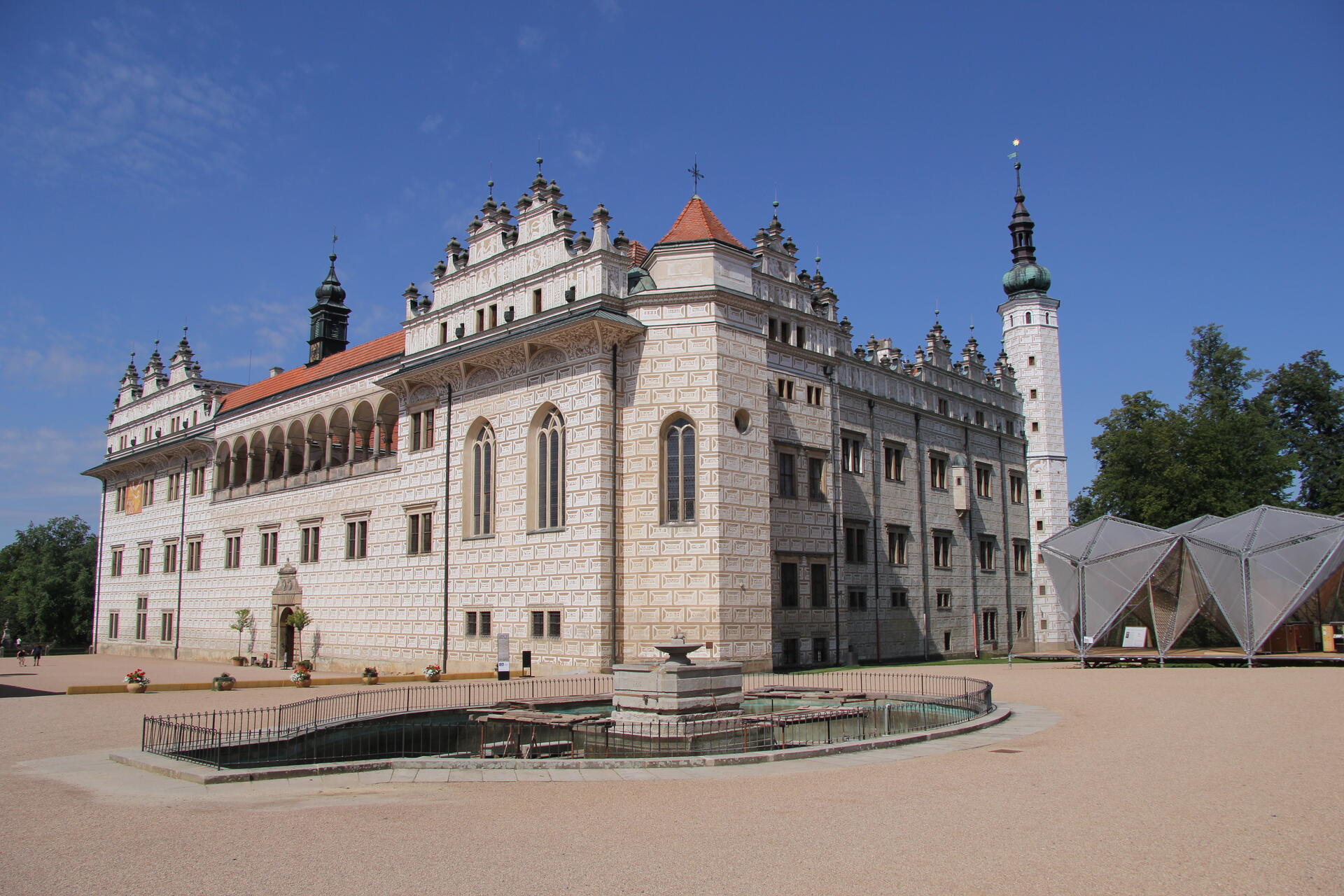
© Přemysl Otakar, CC BY-SA 4.0 Resized from original. (This derivative is under the same CC BY-SA license.)
World Heritage Research
Discover scientific research and academic studies that deepen our understanding of Litomyšl Castle from its history and significance to its conservation, management, and contemporary challenges.
-
Satisfaction and perception of visitors to selected UNESCO cultural and historical objects
Visitors to UNESCO World Heritage Sites, including Litomyšl Castle, exhibit above-average satisfaction with their experience. This finding emerges from an analysis of 1,500 Google reviews collected between January 2022 and June 2023 across three Czech castles. The study identified key themes in visitor feedback, such as 'beautiful,' 'nice,' and 'lock,' highlighting the positive perception of these cultural heritage sites. The research employed frequency analysis to map customer reviews, providing insights into the factors driving visitor satisfaction and the quality of service offered at these landmarks.
Botlíková, M., Palyzová, M., & Botlík, J. (2023). Satisfaction and perception of visitors to selected UNESCO cultural and historical objects. Acta Academica Karviniensia, 23(2), 44–58. https://doi.org/10.25142/aak.2023.014
View Publication Record | Read Publication -
The 1618 Reconstruction Plan of the Weimar Residenzschloss by Costantino de’ Servi
A ground plan for the 1618 reconstruction of Weimar Residenzschloss, previously attributed to Giovanni Bonalino, has been reattributed to Costantino de’ Servi, a Florentine polymath. This study identifies de’ Servi’s sources of inspiration, including Palazzo Marino in Milan, Litomyšl Castle in Bohemia, Richmond Palace in England, and local Saxon architectural traditions. By comparing archival records from Weimar and Florence, the research places the Residenzschloss reconstruction within a broader transnational European context, highlighting its Italianate style and cross-cultural influences.
Martino, D. (2020). The 1618 Reconstruction Plan of the Weimar Residenzschloss by Costantino de’ Servi. Zeitschrift Für Kunstgeschichte, 83(2), 213–235. https://doi.org/10.1515/zkg-2020-2003
View Publication Record | Read Publication