World Heritage Identification Number: 1237
World Heritage since: 2009
Category: Natural Heritage
WHE Type: Natural Landscapes & Geographic Features
Transboundary Heritage: No
Endangered Heritage: No
Country: 🇮🇹 Italy
Continent: Europe
UNESCO World Region: Europe and North America
Map
The Dolomites: A Geological Marvel in the Italian Alps
The Dolomites, officially recognized as a UNESCO World Heritage Site since 2009, stand as a testament to the breathtaking beauty and geological complexity of the Italian Alps. This mountain range, spanning across the regions of Veneto, Trentino-Alto Adige/Südtirol, and Friuli-Venezia Giulia, offers a unique blend of stunning landscapes, rich history, and scientific importance.
Covering an expansive area of approximately 141,903 hectares, the Dolomites encompass eighteen peaks that tower above 3,000 meters. Among them, Marmolada—frequently referred to as the “Queen of the Dolomites”—is the highest peak, reaching 3,343 meters at Punta Penìa. The region's topography is characterized by vertical walls, sheer cliffs, and a high density of narrow, deep, and long valleys, creating a dramatic and awe-inspiring visual spectacle.
One of the key attributes that led to the Dolomites’ designation as a World Heritage Site is their exceptional geomorphology. The area presents a variety of spectacular landscapes, including steeples, pinnacles, and extensive rock walls, all of which are significant on an international scale for their geological value. These landscapes are the result of dynamic natural processes, including erosion, landslides, floods, and avalanches, which continue to shape the Dolomites and contribute to their evolving character.
In addition to their geomorphological features, the Dolomites contain numerous glacial landforms and well-developed karst systems. Glaciers have played a crucial role in shaping the landscape over millennia, carving deep valleys and sculpting many of the landforms visible today. Karst systems, formed by the dissolution of soluble carbonate rocks such as limestone and dolomite, are widespread and include caves, sinkholes, fissures, and underground drainage networks, offering valuable insights into the region’s geological history.
Another significant aspect of the Dolomites is their exceptional preservation of Mesozoic carbonate platform systems, particularly those dating to the Triassic period - roughly 250 to 200 million years ago. These ancient reef structures and associated sedimentary layers contain rich fossil assemblages that document marine life and environmental conditions from over 200 million years ago, making the site essential for paleontological research. The fossil record preserved in the Dolomites has played a key role in advancing scientific understanding of reef evolution, plate tectonics, and mountain-building processes.
Beyond their geological and scientific significance, the Dolomites also hold cultural and historical importance. The region has been inhabited for thousands of years, with evidence of human activity dating back to the Bronze Age. Over time, diverse cultural influences—including Roman, Ladin, Venetian, and Austro-Hungarian—have left their marks on the Dolomites, resulting in a rich tapestry of architecture, art, and land-use practices.
Today, the Dolomites continue to captivate visitors from around the world. Whether hiking through the picturesque valleys, exploring ancient villages, or witnessing the dramatic play of light on the pale rock faces, the mountain range offers an unparalleled experience that transcends mere tourism. As a UNESCO World Heritage Site, the Dolomites stand as a powerful reminder of the Earth’s geological history, natural beauty, and the importance of safeguarding such extraordinary landscapes for future generations.
UNESCO Description of the World Heritage Site
The site of the Dolomites comprises a mountain range in the northern Italian Alps, numbering 18 peaks which rise to above 3,000 metres and cover 141,903 ha. It features some of the most beautiful mountain landscapes anywhere, with vertical walls, sheer cliffs and a high density of narrow, deep and long valleys. A serial property of nine areas that present a diversity of spectacular landscapes of international significance for geomorphology marked by steeples, pinnacles and rock walls, the site also contains glacial landforms and karst systems. It is characterized by dynamic processes with frequent landslides, floods and avalanches. The property also features one of the best examples of the preservation of Mesozoic carbonate platform systems, with fossil records.
UNESCO Justification of the World Heritage Site
Criterion (vii): The Dolomites are widely regarded as being among the most attractive mountain landscapes in the world. Their intrinsic beauty derives from a variety of spectacular vertical forms such as pinnacles, spires and towers, with contrasting horizontal surfaces including ledges, crags and plateaux, all of which rise abruptly above extensive talus deposits and more gentle foothills. A great diversity of colours is provided by the contrasts between the bare pale-coloured rock surfaces and the forests and meadows below. The mountains rise as peaks with intervening ravines, in some places standing isolated but in others forming sweeping panoramas. Some of the rock cliffs here rise more than 1,500 m and are among the highest limestone walls found anywhere in the world. The distinctive scenery of the Dolomites has become the archetype of a “dolomitic landscape”. Geologist pioneers were the first to be captured by the beauty of the mountains, and their writing and subsequent painting and photography further underline the aesthetic appeal of the property.
Criterion (viii): The Dolomites are of international significance for geomorphology, as the classic site for the development of mountains in dolomitic limestone. The area presents a wide range of landforms related to erosion, tectonism and glaciation. The quantity and concentration of extremely varied limestone formations is extraordinary in a global context, including peaks, towers, pinnacles and some of the highest vertical rock walls in the world. The geological values are also of international significance, notably the evidence of Mesozoic carbonate platforms, or “fossilized atolls”, particularly in terms of the evidence they provide of the evolution of the bio-constructors after the Permian/Triassic boundary, and the preservation of the relationships between the reefs they constructed and their surrounding basins. The Dolomites also include several internationally important type sections for the stratigraphy of the Triassic Period. The scientific values of the property are also supported by the evidence of a long history of study and recognition at the international level. Taken together, the combination of geomorphological and geological values creates a property of global significance.
Encyclopedia Record: Dolomites
The Dolomites or Pale Mountains are a mountain range in northeastern Italy. They form part of the Southern Limestone Alps and extend from the river Adige in the west to the Piave Valley in the east. The northern and southern borders are defined by the Puster Valley and the Sugana Valley. The Dolomites are in the regions of Veneto, Trentino-Alto Adige/Südtirol and Friuli-Venezia Giulia, covering an area shared between the provinces of Belluno, Vicenza, Verona, Trentino, South Tyrol, Udine and Pordenone.Additional Site Details
Area: 141,902.8 hectares
Number of Components: 9
(viii) — Outstanding example representing major earth stages
Coordinates: 46.6130555556 , 12.1630555556
IUCN World Heritage Outlook
The 2025 Conservation Outlook on The Dolomites reports the following assessment:
Source: International Union for Conservation of Nature (IUCN) · View assessment
Image
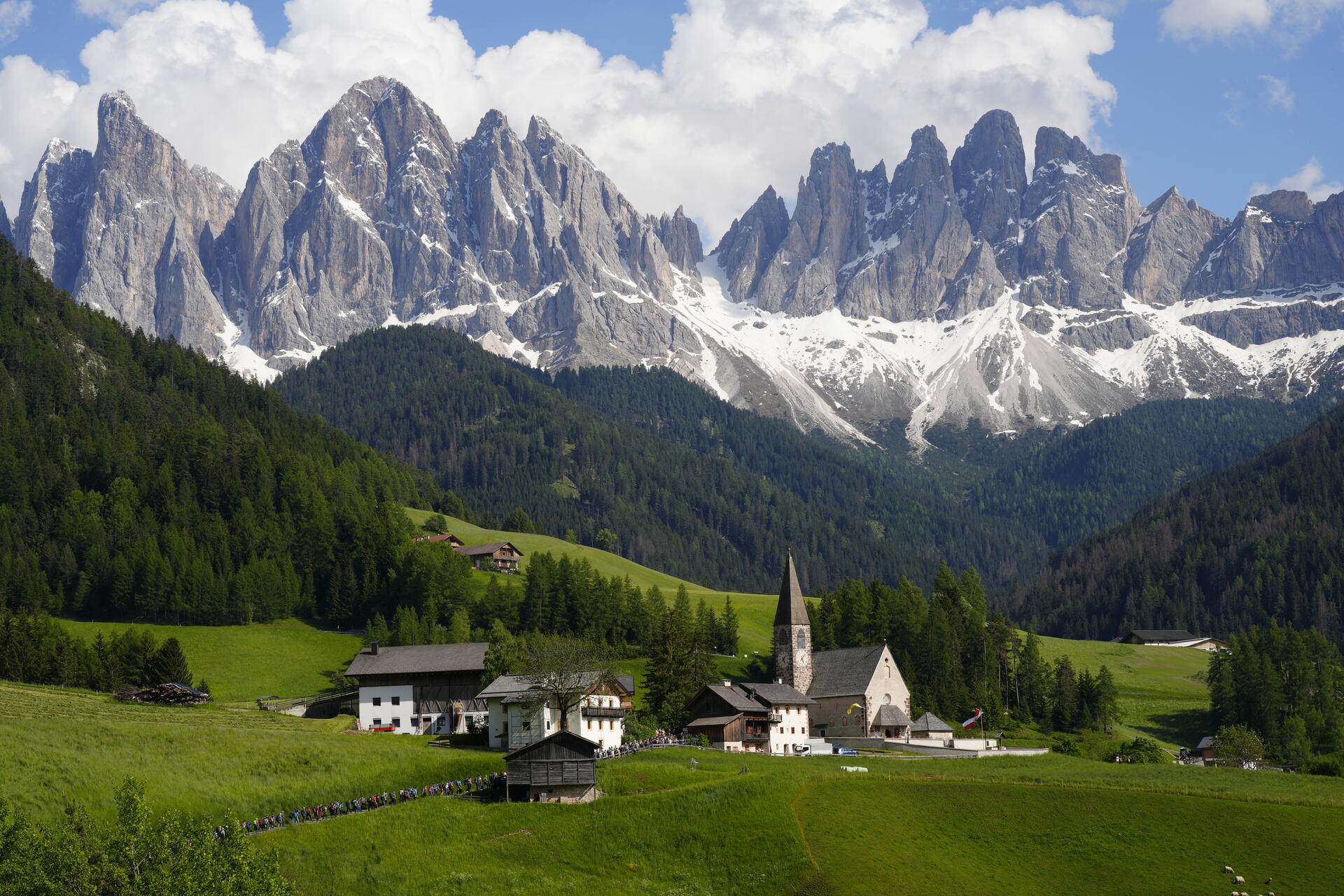
© Chensiyuan, CC BY-SA 4.0 Resized from original. (This derivative is under the same CC BY-SA license.)
World Heritage Research
Discover scientific research and academic studies that deepen our understanding of The Dolomites from its history and significance to its conservation, management, and contemporary challenges.
-
Cultural diplomacy as an emergent and uneven process: The cultural olympiad in the veneto dolomites ahead of Milano cortina 2026
Cultural diplomacy in the context of the Milano Cortina 2026 Winter Olympics emerges as an uneven and emergent process, shaped by local governance, grassroots capacity, and the ability to engage external audiences. While over half of initiatives are led by community-based organizations, only 35% of stakeholders plan new Olympiad-related activities due to fragmented coordination and limited funding. The study, conducted through territorial mapping, policy analysis, and stakeholder surveys in Belluno—a peripheral Alpine province and UNESCO World Heritage site—reveals that diplomatic functions remain indirect and weakly institutionalized, largely embedded in territorial promotion. This research contributes to debates on subnational cultural diplomacy by highlighting the conditions and limits of such efforts.
Peli, A., & Tonin, S. (2026). Cultural diplomacy as an emergent and uneven process: The cultural olympiad in the veneto dolomites ahead of Milano cortina 2026. Journal of Cultural Management and Cultural Policy, 12(1), 261–280. https://doi.org/10.1177/27018466261449823
View Publication Record | Read Publication -
Essere “World Heritage Site”. Rischi e opportunità del marchio UNESCO per le destinazioni alpine
The UNESCO World Heritage designation of the Dolomites, while highlighting its exceptional characteristics, has also triggered complex dynamics between conservation needs and increasing human activities. This study reveals that overtourism in natural sites can reduce landscapes to consumable and exhaustible global products, raising critical questions about the sustainability of such designations. It suggests that a radical rethinking is necessary to prevent these sites from becoming purely extractive locations. Conversely, it also explores opportunities presented by World Heritage status, including innovative governance models and integrated territorial management policies. The research adopts an interdisciplinary approach, integrating spatial practice, landscape ecology, and tourism studies, to critically interrogate the role of natural heritage in the 21st century amidst climate change and unsustainable tourism models.
Gigliotti, R., & Sarracino, E. (2026). Essere “World Heritage Site”. Rischi e opportunità del marchio UNESCO per le destinazioni alpine. Archalp, 16(2026). https://doi.org/10.30682/aa2616j
View Publication Record | Read Publication -
The regional effects of UNESCO heritage on property values: a synthetic control approach
UNESCO World Heritage Site designation significantly boosts residential property values, with the Dolomites seeing a 17.4% increase for ordinary dwellings and 13.4% for luxury properties after inscription in 2009—a persistent effect lasting over a decade. No such impact was observed for commercial properties. The study used a synthetic control approach on municipality–semester panel data from 2005 to 2022, comparing actual trends with counterfactual scenarios to isolate the heritage effect.
Andergassen, R., & Guerra, A. (2026). The regional effects of UNESCO heritage on property values: a synthetic control approach. Regional Studies, 60(1). https://doi.org/10.1080/00343404.2026.2691130
View Publication Record | Read Publication -
Assessing the Conservation Priority of Alpine Carabid Beetle Communities by Mapping the Index of Natural Value (INV) in Natura 2000 Habitats in the Brenta Dolomites (Italian Alps)
Alpine carabid beetle communities in the Brenta Dolomites exhibit heightened vulnerability to extinction at higher altitudes, particularly in limestone cliffs, screes, and alpine grasslands. This finding emerges from a study that mapped the Index of Natural Value (INV) across Natura 2000 habitats, revealing a positive correlation between vulnerability and altitude. The research used INV—a metric based on specialized species' frequencies—as a proxy for disturbance sensitivity. While alkaline fens hosted the least vulnerable communities, intermediate levels were observed in bush and forest habitats. This study underscores the critical conservation priority of high-altitude carabid beetle assemblages within UNESCO World Heritage Sites.
Peretti, E., Armanini, M., Chirichella, R., Mustoni, A., & Gobbi, M. (2025). Assessing the Conservation Priority of Alpine Carabid Beetle Communities by Mapping the Index of Natural Value (INV) in Natura 2000 Habitats in the Brenta Dolomites (Italian Alps). Insects, 16(6), 602. https://doi.org/10.3390/insects16060602
View Publication Record | Read Publication -
Dolichens: An Information System on the Lichens of the Dolomites
A comprehensive digital platform, Dolichens, has been developed to aggregate and centralize lichen diversity data from the UNESCO World Heritage site of the Dolomites. This innovative system addresses longstanding gaps in data accessibility by consolidating fragmented historical records into an interoperable format compatible with global repositories. By leveraging decades of lichenological research since the 19th century, Dolichens provides researchers, conservationists, and policymakers with a robust tool for monitoring and preserving lichen biodiversity. The platform's design prioritizes usability while ensuring seamless integration with international databases, marking a significant advancement in environmental data management.
Francesconi, L., Conti, M., Martellos, S., Di Nuzzo, L., Gheza, G., Nimis, P. L., Pistocchi, C., & Nascimbene, J. (2025). Dolichens: An Information System on the Lichens of the Dolomites. Journal of Fungi, 11(9), 624. https://doi.org/10.3390/jof11090624
View Publication Record | Read Publication -
A Sentinel-1 Based Hybrid Interferometric Approach to Complement EGMS for Landslides Identification
A novel Hybrid Interferometric Approach (HIA) using Sentinel-1 satellite data significantly enhances the detection of landslides, particularly those moving faster than current thresholds. This method outperforms the European Ground Motion Service (EGMS), providing a more comprehensive mapping of slope instabilities in the Dolomites. The HIA integrates multi-baseline interferometric analysis with radar signals from both point-like and distributed targets, reducing temporal decorrelation effects by limiting observation windows to six months. By analyzing ten datasets spanning 2017–2021, the study demonstrates that this approach broadens detectable landslide ranges, offering critical advancements for hazard assessment and risk reduction efforts.
Mantovani, M., Ceccotto, F., Ballaera, A., Bertorelle, E., Bossi, G., Marcato, G., & Pasuto, A. (2025). A Sentinel-1 Based Hybrid Interferometric Approach to Complement EGMS for Landslides Identification. Remote Sensing, 17(23), 3849. https://doi.org/10.3390/rs17233849
View Publication Record | Read Publication -
L'arte o la morte
Dolomiti Contemporanee (DC) revitalizes abandoned or underused sites within the UNESCO World Heritage Site of the Dolomites, transforming them into dynamic hubs for art, culture, and environmental research. These forgotten spaces—such as ex-factories, villages, or hilltop hamlets—are repurposed to foster innovation, challenging conventional tourist exploitation by creating 'mountains that think.' The initiative hosts hundreds of anti-mimetic artists, architects, designers, ecologists, scientists, astrophysicists, and mountaineers annually, prioritizing artistic practice. By merging aesthetics with environmental inquiry, DC projects these sites into a meaningful future, emphasizing depth over superficial engagement. This approach opposes the reductionist view of landscapes as mere recreational spaces, instead championing their potential for intellectual and creative resonance.
D’Inca Levis, G. (2025). L’arte o la morte. Archalp, 15(2025). https://doi.org/10.30682/aa2515c
View Publication Record | Read Publication