World Heritage Identification Number: 1720
World Heritage since: 2024
Category: Cultural Heritage
WHE Type: Archaeological Sites
Transboundary Heritage: No
Endangered Heritage: No
Country: 🇰🇪 Kenya
Continent: Africa
UNESCO World Region: Africa
Map
Exploring the Historic Town and Archaeological Site of Gedi: A Window into Swahili Civilization
The Historic Town and Archaeological Site of Gedi, situated along the Indian Ocean coast of eastern Kenya, offers a captivating glimpse into the rich history and culture of the Swahili civilization. Inscribed as a UNESCO World Heritage Site in 2024, this abandoned city stands as a testament to its former prominence as one of the most significant Swahili cities during the 10th to 17th centuries.
More to come…UNESCO Description of the World Heritage Site
Surrounded by a remnant coastal forest, away from the coastline, the abandoned city of Gedi was one of the most important Swahili cities on the East African coast from the 10th to 17th centuries. During this period, it was part of a complex and international network of trade and cultural exchanges that crossed the Indian Ocean, linking African coastal centres with Persia and other areas. The opulent settlement is clearly delineated by walls and features remains of domestic, religious, and civic architecture, and a sophisticated water management system. It strongly represents the characteristics of Swahili architecture and town planning, utilising materials such as coral rag, coral and earth mortar and wood.
UNESCO Justification of the World Heritage Site
Criterion (ii): The Historic Town and Archaeological Site of Gedi exhibits an important interchange of values on architecture, technology and town-planning as a result of its participation over several centuries in the Indian Ocean trading system between the East African coast, the Arabian Sea and Southern Asia. The fusion of African and Islamic beliefs can be seen in the layout of the city, in the distinctive architectural forms of its coral stone buildings, in the decorative details of its mosques and tombs, and in the technical know-how of the wells and hydraulic systems that sustained a large urban settlement over centuries of occupation.
Criterion (iii): The Historic Town and Archaeological Site of Gedi bears exceptional testimony to the strong Swahili cultural traditions that developed and flourished as a result of maritime trade between the East African coast and the Indian Ocean from the 10th to the 17th centuries. Gedi was a substantial urban settlement with outstanding features of town planning, architecture, and infrastructure. It is distinctive for the scale and density of its urban settlement, unusual and complex spatial layout, and intricate water engineering.
Criterion (iv): The Historic Town and Archaeological Site of Gedi is an outstanding example of a Swahili settlement from the 10th to the 17th centuries, that reflects a period when the East African coast became part of a global trading network linking Eastern Africa across the Arabian Sea and the Indian Ocean with India and Southern Asia. Gedi is one of the largest, most well-preserved and well-researched abandoned Swahili Islamic settlements on the East African coast. The architectural and archaeological elements of Gedi demonstrate its opulence, as well as its social stratification.
Encyclopedia Record: Ruins of Gedi
The ruins of Gedi are a UNESCO World Heritage site near the Indian Ocean coast of eastern Kenya. The site is adjacent to the town of Gedi in the Kilifi District and within the Arabuko-Sokoke Forest.Additional Site Details
Area: 20.81 hectares
Number of Components: 1
(iii) — Unique or exceptional testimony to a cultural tradition
(iv) — Outstanding example of a type of building or landscape
Coordinates: -3.3102638889 , 40.0172638889
Image
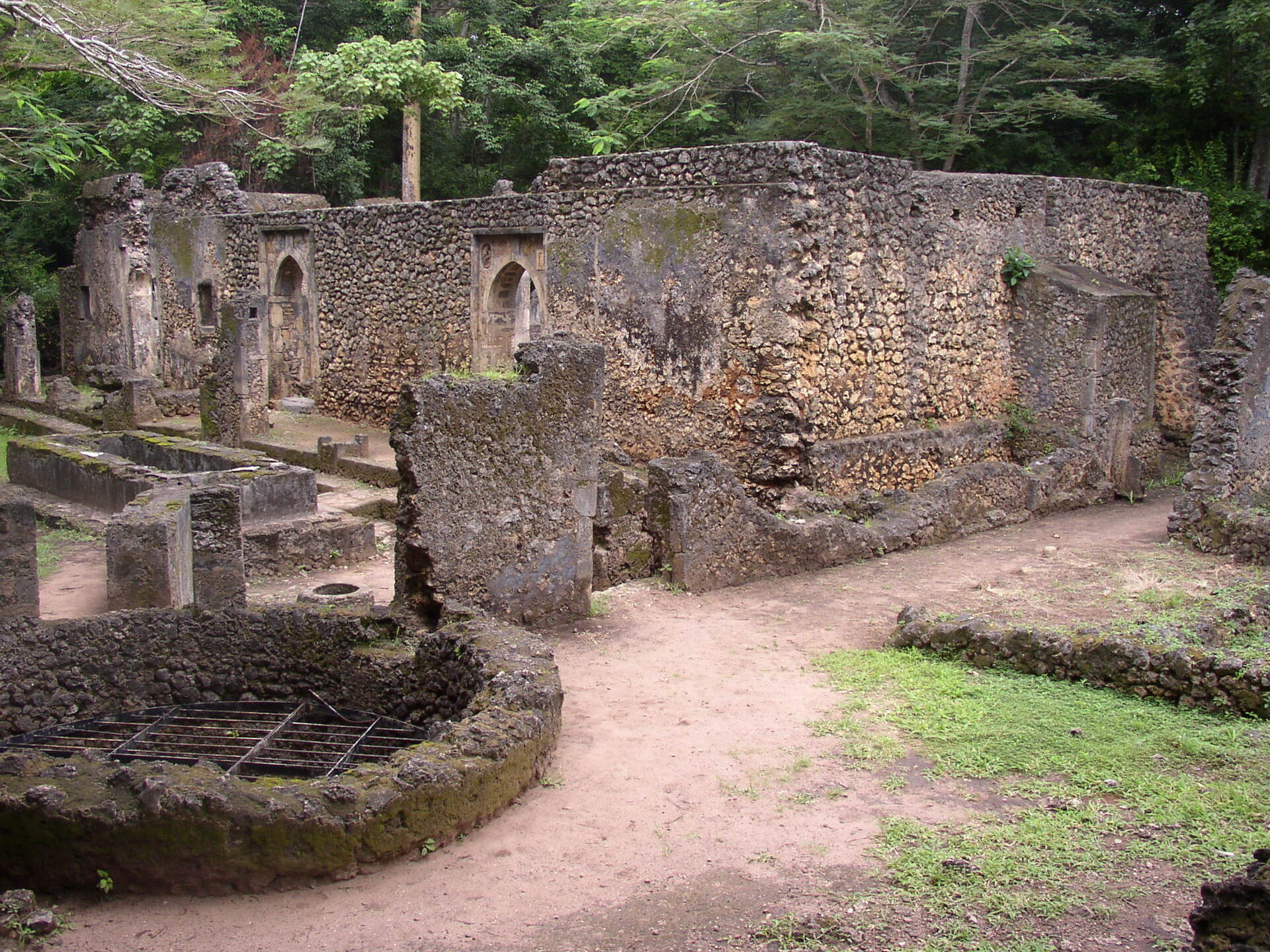
© Mgiganteus, CC BY-SA 3.0 Resized from original. (This derivative is under the same CC BY-SA license.)
World Heritage Research
Discover scientific research and academic studies that deepen our understanding of The Historic Town and Archaeological Site of Gedi from its history and significance to its conservation, management, and contemporary challenges.
-
Dwindling Vernacular Architecture of the Swahili Coast: A Cosmopolitan Enclave in East Africa
Swahili architecture, shaped by centuries of Indian Ocean trade and now at risk of disappearing, remains a dynamic cultural expression despite its dwindling vernacular knowledge. The study reveals that while skilled craftsmen still exist today, their expertise may vanish without intervention, threatening the preservation of this unique regional architectural language. Employing comparative analysis within a case study approach, researchers used qualitative methods—including observations, literature reviews, and focus group interviews—to highlight how Swahili culture has historically incorporated foreign influences while adapting to social, cultural, and aesthetic changes. The findings underscore the urgency of safeguarding traditional building techniques to maintain the authenticity of Swahili settlements, particularly in UNESCO World Heritage Sites like Gedi, where tourism presents both an opportunity for preservation and a risk of cultural erosion.
Sakr, M. (2025). Dwindling Vernacular Architecture of the Swahili Coast: A Cosmopolitan Enclave in East Africa. ISVS E-Journal, 12(1), 77–86. https://doi.org/10.61275/isvsej-2024-12-01-06
View Publication Record | Read Publication -
The Swahili Coast: Architectural Heritage of a Cosmopolitan East African Enclave
Swahili architecture, shaped by extensive Indian Ocean trade from the 8th century onward, reflects a cosmopolitan cultural heritage that has been underexplored by architectural scholars. This study highlights how maritime exchanges with Arabs, Persians, Indians, Chinese, and Malays influenced Swahili vernacular architecture, creating a unique regional idiom distinct from other Indian Ocean styles. By employing a comparative analytical approach using qualitative research tools, the paper emphasizes the significance of understanding this pre-modern globalization's impact on Swahili settlements before contemporary tourism alters their perception. The findings underscore the need to move beyond romanticized tourist presentations, preserving the architectural legacy as a testament to early global interactions.
Sakr, M., & Dabaieh, M. (2024). The Swahili Coast: Architectural Heritage of a Cosmopolitan East African Enclave. Proceedings Africa24 Conference. https://doi.org/10.4995/africa24.2024.19087
View Publication Record | Read Publication -
An Outport for Gedi?—Archaeological Survey in Mida Creek, Kenya
Archaeological survey in Mida Creek, Kenya, reveals potential evidence that Chafisi may have served as an outport for the ancient Swahili city of Gedi. The study, conducted by the 'MUCH to Discover in Mida Creek' project, identified a concentration of contemporary house sites near the creek's closest point to Gedi, suggesting possible maritime trade activity. This finding challenges previous assumptions about Gedi's limited seaward connectivity and offers new insights into its role within the Indian Ocean maritime trade networks from the 10th to 16th centuries CE.
Bita, C., & Forsythe, W. (2023). An Outport for Gedi?—Archaeological Survey in Mida Creek, Kenya. Heritage, 6(12), 7366–7380. https://doi.org/10.3390/heritage6120386
View Publication Record | Read Publication -
Teaching The Astronomical Visualization Used For The Explanation Of The Ancient Ein-Gedi Archaeological Zodiac And Its Related Inscription
Astronomical analysis reveals that the Septuagint version of the Bible, translated from Hebrew in the 3rd century BC, encodes precise observations of the sun's motion and zodiacal conjunctions at the Vernal Equinox. This finding positions the text as one of the oldest detailed scientific sources, challenging assumptions about ancient knowledge of precession and planetary orbits. The study supports this conclusion through calculations based on the Ein-Gedi synagogue inscription and zodiac mosaics from Middle Eastern synagogues, demonstrating a sophisticated understanding of celestial phenomena that predates modern astronomical models.
Cohen, A. (2022). Teaching The Astronomical Visualization Used For The Explanation Of The Ancient Ein-Gedi Archaeological Zodiac And Its Related Inscription. Journal of Astronomy & Earth Sciences Education (JAESE), 9(2), 25–38. https://doi.org/10.19030/jaese.v9i2.10415
View Publication Record | Read Publication