World Heritage Identification Number: 1703
World Heritage since: 2023
Category: Cultural Heritage
WHE Type: Historic Cities & Urban Areas
Transboundary Heritage: No
Endangered Heritage: Yes
Country: 🇺🇦 Ukraine
Continent: Europe
UNESCO World Region: Europe and North America
Map
The Historic Centre of Odesa: A Testament to Intercultural Exchange and Multicultural Cities of the 19th Century
The Historic Centre of Odesa, located in the heart of the Black Sea port city of Odesa, Ukraine, stands as a remarkable testament to the intercultural exchange and multicultural cities that flourished during the 19th century. Inscribed as a UNESCO World Heritage Site in 2023, this densely populated urban area is a unique blend of classical architecture, eclecticism, and cultural diversity. However, due to the ongoing Russian invasion of Ukraine, the site has been placed on the List of World Heritage in Danger.
More to come…UNESCO Description of the World Heritage Site
The Historic Center of Odesa, part of the Black Sea port city developed on the site of Khadzhybei, is a densely built-up area, planned according to classicism canons, characterized by two- to four-storey buildings and wide perpendicular streets lined with trees. Historic buildings reflect the rapid economic development of the city in the 19th and early 20th centuries. The site includes theatres, bridges, monuments, religious buildings, schools, private palaces and tenement houses, clubs, hotels, banks, shopping centres, warehouses, stock exchanges and other public and administrative buildings designed by architects and engineers, mostly from Italy in the early years, but also of other nationalities. Eclecticism is the dominant feature of the historic city centre’s architecture. The site bears witness to the city’s highly diverse ethnic and religious communities, representing an outstanding example of intercultural exchanges and the growth of multicultural and multi-ethnic Eastern European cities of the 19th century.
UNESCO Justification of the World Heritage Site
Criterion (ii): The historic centre of Odesa represents an important interchange of human values within Eastern Europe through its heterogeneous architectural styles, developed during its rapid growth in the 19th century, that reflect the coexistence of many cultures and the combination of influences characteristic of the border area of Europe and Asia.
Criterion (iv): The historic centre of Odesa is an outstanding “time capsule” of the 19th‑century urban planning, with heterogeneous buildings mostly from the second half of the 19th century and the early 20th century, which reflects both the exceptionally fast growth of the town, based on the prosperity generated by the Industrial Revolution, and its notable diversity.
Encyclopedia Record: Historic Centre of Odesa
The Historic Centre of Odesa, Historical City Centre of Odesa, or Centre of Odesa is a city centre and World Heritage Site in Odesa, Ukraine. It was listed in 2023, and currently, it is on the list of World Heritage Sites in Danger because of the Russian invasion of Ukraine.Additional Site Details
Area: 618.54 hectares
Number of Components: 1
(iv) — Outstanding example of a type of building or landscape
Coordinates: 46.48645 , 30.7416138889
Image
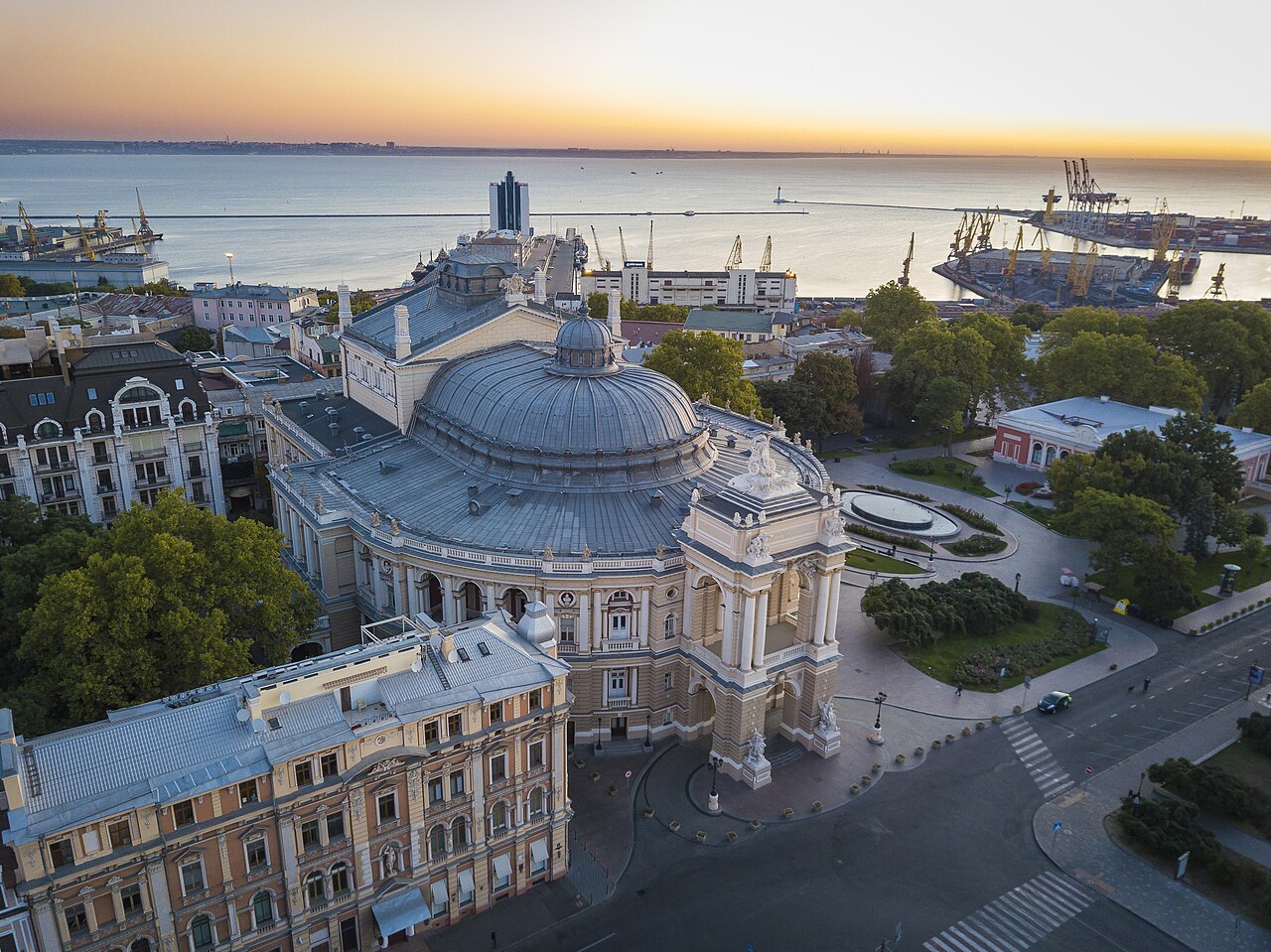
© Konstantin Brizhnichenko, CC BY-SA 4.0 Resized from original. (This derivative is under the same CC BY-SA license.)
World Heritage Research
Discover scientific research and academic studies that deepen our understanding of The Historic Centre of Odesa from its history and significance to its conservation, management, and contemporary challenges.
-
Integration of artificial intelligence into the restoration of architectural monuments: Methods and prospects
Artificial intelligence (AI) significantly enhances the restoration of architectural heritage, improving expertise, documentation, condition analysis, and decision-making. While AI offers substantial benefits, challenges such as incomplete automation, integration complexity, and the need for human oversight persist. The study highlights that AI applications must adhere to principles like authenticity, accountability, and reliable data use, with Ukrainian legislation currently lacking specific regulations on AI in restoration. Case studies from sites like the Dunhuang Mogao Grottoes and Odesa's Historic Centre demonstrate successful AI integration, while Ukrainian practices show readiness for future implementation. The research underscores the potential of comprehensive AI systems for analysis, modeling, and preservation planning, provided they uphold scientific verification and human oversight.
Nester, O. (2026). Integration of artificial intelligence into the restoration of architectural monuments: Methods and prospects. Architectural Studies, 12(1), 93–105. https://doi.org/10.56318/as/1.2026.93
View Publication Record | Read Publication -
Public Administration Mechanisms for Odesa’s Tourism Potential as a UNESCO Historical and Cultural Heritage Site
Odesa's tourism potential as a UNESCO World Heritage Site can be harnessed through targeted public administration mechanisms, despite challenges posed by war and cultural heritage destruction. A SWOT analysis identified key strengths—such as Odesa’s rich historical and architectural heritage—and weaknesses, including infrastructure damage and regulatory gaps. The study proposes integrated institutional, financial, technological, and environmental strategies to balance preservation with sustainable tourism development. Recommendations align with UNESCO standards, offering a roadmap for post-war recovery that prioritizes cultural integrity while fostering economic resilience.
Balan, O., Shepel, M.,. (2025). Public Administration Mechanisms for Odesa’s Tourism Potential as a UNESCO Historical and Cultural Heritage Site. Economic Journal Odessa Polytechnic University, 2(32), 14–23. https://doi.org/10.15276/ej.02.2025.2
View Publication Record | Read Publication -
Decolonisation Policy in Ukraine and Reflections of the Territorial Community (the Case of Odessa)
Post-2022 decolonization policies in Ukraine, analyzed through the case of Odesa, reveal a shift from hybrid historical memory to a dominant Ukrainian-centric narrative. The study demonstrates how the dismantling of imperial and Soviet symbols is being integrated into a mnemonic security strategy, reflecting the state's response to Russia's aggression. Using postcolonial theory, securitization theory, and discursive analysis, researchers highlight the tension between nationwide securitized logic and local cultural resistance in Odesa. The city serves as a 'mnemonic frond,' where hybrid identities clash with unifying state narratives, illustrating the complex interplay between anti-colonialism and regional identity.
Pakhomenko, S., Gridina, I., & Balabanov, K. (2025). DECOLONISATION POLICY IN UKRAINE AND REFLECTIONS OF THE TERRITORIAL COMMUNITY (THE CASE OF ODESSA). Bulletin of Mariupol State University Series History Political Studies, 15(41), 125. https://doi.org/10.34079/2518-1521-2025-15-41-125-141
View Publication Record | Read Publication -
Peculiarities of the “Provincial Secession” Style Development in Ukraine At the Beginning of the 20th Century and Modern Problems of Its Monuments Preservation In War Time
The study identifies the unique characteristics of 'Provincial Secession' style buildings in Ukraine's regional centers, distinct from both European Secession and major urban centers like Lviv, Kyiv, Kharkiv, and Odesa. These provincial structures, influenced by local cultural strata and imperial affiliations (Austro-Hungarian or Russian), face significant preservation challenges due to the ongoing Russian-Ukrainian war, which has led to widespread destruction of valuable background buildings. Despite this, planned repairs and restorations for even undamaged monuments remain neglected, highlighting urgent conservation needs.
IVASHKO, Y., SHCHEVIOVA, U., ZOLOTAR, L., IVASHKO, O., DMYTRENKO, A., URAKINA, A., POCZĄTKO, M., RUBTSOVA, S.,. (2024). Peculiarities of the “Provincial Secession” Style Development in Ukraine At the Beginning of the 20th Century and Modern Problems of Its Monuments Preservation In War Time. International Journal of Conservation Science, 15(SI), 321–334. https://doi.org/10.36868/ijcs.2024.si.24
View Publication Record | Read Publication -
Special status of cultural heritage objects during armed conflicts: a comparative analysis of Dubrovnik and Odesa experience
UNESCO World Heritage status significantly enhances the protection and restoration of cultural heritage during armed conflicts, as demonstrated by comparative analyses of Dubrovnik (Croatia) and Odesa (Ukraine). Both cities, though inscribed on the UNESCO list decades apart—Dubrovnik in 1979 and Odesa in 2023—their experiences highlight how international recognition mobilizes resources, fosters cooperation, and mitigates risks to architectural and historical values. While Dubrovnik's post-war recovery symbolized resilience after Croatia’s War of Independence, Odesa faces ongoing challenges during the Russo-Ukrainian conflict, including threats to museums, libraries, and civil society-led preservation efforts. The study underscores that UNESCO designation serves as a critical tool for safeguarding heritage, emphasizing the role of local engagement and global support in mitigating destruction and looting.
Halushko, K., Lobanova, M.,. (2024). Special status of cultural heritage objects during armed conflicts: a comparative analysis of Dubrovnik and Odesa experience. Vita Antiqua, 15, 33–43. https://doi.org/10.37098/va-2024-15-33-43
View Publication Record | Read Publication -
Italian Culture and Art Representations in Odesa under the Policy of Romanization Conditions (1941–1944)
During the Romanian occupation of Odesa (1941–1944), Italian culture and art played a significant role in revitalizing European traditions, particularly in music and theatre, under the fascist ideological framework. This brief but unique period saw the implementation of a Romanization policy aimed at integrating the city's population into a 'Roman world' system, promoting Italian language, cinema, visual arts, and music. The study identifies key figures such as tenor Tito Schipa, singer Katerina Boratto, and conductor Francesco Pradelli, whose performances and pedagogical efforts shaped Odesa's cultural landscape. Through interdisciplinary methods—including source studies, biographical analysis, and historical comparison—the research reveals how the Italian Royal Bureau and later the Italian Institute of Culture in Odesa drove this policy, targeting local intelligentsia, including ethnic Italians who survived Stalinist repression. The findings highlight the policy's role as a component of Romanianization, emphasizing its cultural propaganda aspects.
Batsak, K. (2024). Italian Culture and Art Representations in Odesa under the Policy of Romanization Conditions (1941–1944). Scientific Herald of Tchaikovsky National Music Academy of Ukraine, (139), 92–111. https://doi.org/10.31318/2522-4190.2024.139.301123
View Publication Record | Read Publication -
The Cabaret in Ukraine as a Phenomenon of the Age of Modernism
Ukrainian cabaret emerged as a distinct cultural phenomenon during the modernist era, blending European avant-garde traditions with local folklore and political satire. This study reveals that Ukrainian cabarets, particularly in cities like Odesa, Kyiv, and Lviv, served dual roles: entertainment hubs and platforms for social critique, often navigating censorship challenges. The research contextualizes cabaret within Europe's broader modernist movement, highlighting its roots in French and German venues such as Le Chat Noir and Überbrettl, while emphasizing Ukraine's unique contributions through figures like Mykola Sadovskyi and Les Kurbas. It also explores the socio-political factors leading to its decline under Soviet rule but notes its enduring legacy in contemporary Ukrainian arts.
Oleynikov, S. (2024). THE CABARET IN UKRAINE AS A PHENOMENON OF THE AGE OF MODERNISM. Bulletin of Mariupol State University Series Philosophy Culture Studies Sociology, 14(27), 50–56. https://doi.org/10.34079/2226-2830-2024-14-27-50-56
View Publication Record | Read Publication