
World Heritage Identification Number: 1411
World Heritage since: 2013
Category: Cultural Heritage
WHE Type: Archaeological Sites
Transboundary Heritage: No
Endangered Heritage: Yes
Country: 🇺🇦 Ukraine
Continent: Europe
UNESCO World Region: Europe and North America
Map
The Ancient City of Tauric Chersonese and Its Chora: A Unique Blend of History and Agriculture
The Ancient City of Tauric Chersonese and its Chora, inscribed as a UNESCO World Heritage Site in 2013, offers a captivating glimpse into the rich history and unique agricultural practices of ancient Greece. Situated on the northern shores of the Black Sea, this site serves as a testament to the democratic land organization that underpinned the city's social structure.
More to come…UNESCO Description of the World Heritage Site
The site features the remains of a city founded by Dorian Greeks in the 5th century BC on the northern shores of the Black Sea. It encompasses six component sites with urban remains and agricultural lands divided into several hundreds of chora, rectangular plots of equal size. The plots supported vineyards whose production was exported by the city which thrived until the 15th century. The site features several public building complexes and residential neighbourhoods, as well as early Christian monuments alongside remains from Stone and Bronze Age settlements; Roman and medieval tower fortifications and water supply systems; and exceptionally well-preserved examples of vineyard planting and dividing walls. In the 3rd century AD, the site was known as the most productive wine centre of the Black Sea and remained a hub of exchange between the Greek, Roman and Byzantine Empires and populations north of the Black Sea. It is an outstanding example of democratic land organization linked to an ancient polis, reflecting the city’s social organization.
UNESCO Justification of the World Heritage Site
Criterion (ii): Tauric Chersonese provides an outstanding physical testimony to the exchange that took place between the Greek, Roman and Byzantine Empires and the populations north of the Black Sea. The polis and its chora stand out for having retained this role as a centre of exchange of influences and cross-fertilization between these cultures for a very long time and with continuity over millennia.
Criterion (v): Tauric Chersonese and its Chora represents a relict agricultural landscape of a vast and, at locations, well-preserved land allotment system, of formerly over 400 equal allotments connected to a preserved polis. The remains of the division walls, fortifications, farmsteads and the characteristic grid layout embodied the lifestyles of the city’s inhabitants and illustrate the agricultural use and continuity of the landscape despite later changes in production.
Encyclopedia Record: Chersonesus
Chersonesus, contracted in medieval Greek to Cherson (Χερσών), was an ancient Greek colony founded approximately 2,500 years ago in the southwestern part of the Crimean Peninsula. Settlers from Heraclea Pontica in Bithynia established the colony in the 6th century BC.Additional Site Details
Area: 259.3752 hectares
Number of Components: 8
(v) — Outstanding example of traditional human settlement
Coordinates: 44.6108333333 , 33.4913888889
Image
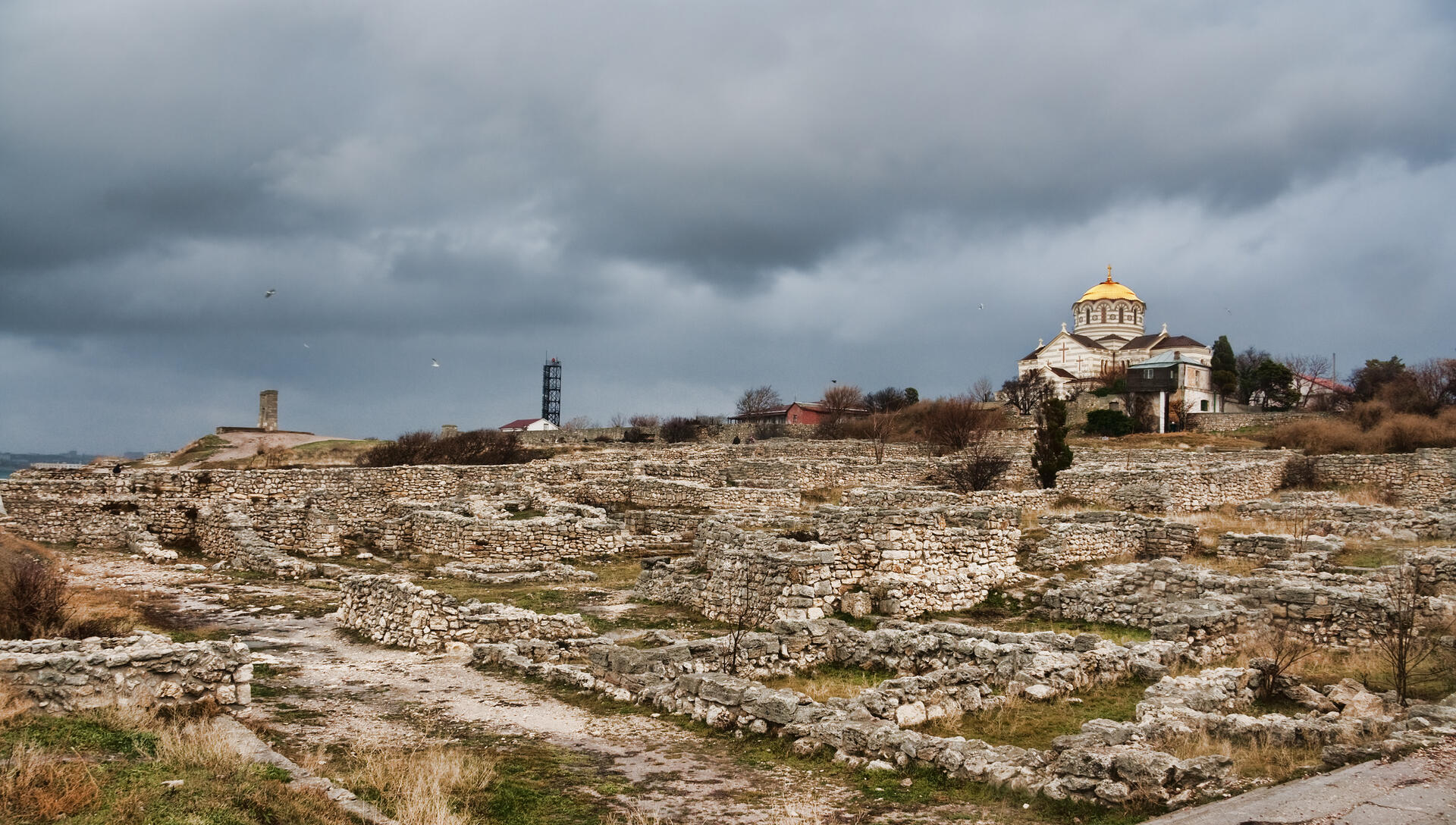
© Dmitry A. Mottl, CC BY-SA 3.0 Resized from original. (This derivative is under the same CC BY-SA license.)
World Heritage Research
Discover scientific research and academic studies that deepen our understanding of Ancient City of Tauric Chersonese and its Chora from its history and significance to its conservation, management, and contemporary challenges.
-
UNESCO World Heritage Sites in Crimea Under the Conditions of Russian Occupation (2014–2021)
Russia's occupation of Crimea has led to the systematic destruction and ideological appropriation of Ukraine's UNESCO-protected cultural heritage sites, including the Ancient City of Tauric Chersonese. The study reveals that under Russian control, these sites face irreversible damage through theft, illegal excavations, and rushed 'restorations' prioritizing military infrastructure over authenticity. Despite limited physical access, Ukraine's proactive engagement with international organizations like UNESCO ensures the issue remains on the global agenda, creating a legal framework for future accountability. The research highlights the criminal nature of Russia's actions, which disregard international conventions and exploit these sites to promote a false historical narrative.
Herehova, S., & Varvarych, K. (2026). UNESCO World Heritage Sites in Crimea Under the Conditions of Russian Occupation (2014–2021). History Journal of Yuriy Fedkovych Chernivtsi National University, 132. https://doi.org/10.31861/hj2026.63.132-144
View Publication Record | Read Publication -
Integrated Archaeological and Geophysical Researches in the Port Area of Tauric Chersonese
Researchers have determined that the sea level around Karantinnaia Bay, near the port area of Tauric Chersonese, rose by approximately 1 meter between the ninth and tenth centuries AD and the late eleventh to early thirteenth centuries. This discovery was made through an integrated approach combining archaeological excavations and advanced geophysical methods, such as seismoacoustic profiling and bottom electrotomography. The study identified three terraces and associated morphological elements that indicate ancient coastlines, providing a spatial relationship between underwater archaeological objects and historical periods. Notably, the 'diamond-shaped tower' and other construction remains were found on the same terrace, suggesting they coexisted during the ninth and tenth centuries. Additionally, an extended linear anomaly, hidden beneath a thick layer of sediment, was linked to the early period of the ancient city.
Bukatov, A., Glazunov, V., Efimova, N., & Panchenko, V. (2022). Integrated Archaeological and Geophysical Researches in the Port Area of Tauric Chersonese. Materials in Archaeology, History and Ethnography of Tauria, 0(XХVII), 26–45. https://doi.org/10.29039/2413-189x.2022.27.26-45
View Publication Record | Read Publication -
A Pottery Assemblage from the Burial M26 in the Hellenistic Neсropoleis of Tauric Chersonese
A pottery assemblage from the Hellenistic necropolis of Tauric Chersonese, dated to the end of the 4th century to the third quarter of the 3rd century BCE, provides valuable insights into burial practices and material culture during this period. The analysis of 3015 ceramic fragments, primarily black-glazed tableware such as fish plates, saltcellars, and bowls, along with plain wares like lopadions, jugs, and plates, reveals a sophisticated ceramic tradition. These findings were derived from burial M26 and an associated ritual fireplace, excavated in 1963 on the Eastern slope of Pesochnaya Bay, near the ancient road leading to the Western city gate. The study suggests that the assemblage represents approximately 90–130 whole vessels, offering a glimpse into the ritualistic and domestic practices of the time.
STOYANOV, R. V. (2019). A Pottery Assemblage from the Burial M26 in the Hellenistic Neсropoleis of Tauric Chersonese. Ancient World and Archaeology, 19, 257–273. https://doi.org/10.18500/0320-961x-2019-19-257-273
View Publication Record | Read Publication -
Developing the pattern of ancient city of Tauric Chersonese valorisation: risks, values, identity
A comprehensive approach to valorizing the UNESCO-listed Ancient City of Tauric Chersonese reveals that its authenticity hinges on preserving and developing three interconnected values: archaeological, religious, and touristic. Research demonstrates that isolating any single value risks fragmenting the site's identity, undermining its historical integrity. The study proposes a balanced pattern for valorization, emphasizing concerted preservation efforts to maintain the site's multifaceted significance. This approach not only safeguards its cultural heritage but also maximizes potential benefits through sustainable tourism and religious reverence.
Snitko, I., Veprytska, K., & Lombardini, N. (2015). Developing the pattern of ancient city of Tauric Chersonese valorisation: risks, values, identity. Restauro Archeologico, 23(1), 54–73. https://doi.org/10.13128/ra-17574
View Publication Record | Read Publication
