World Heritage Identification Number: 588
World Heritage since: 1991
Category: Natural Heritage
WHE Type: Natural Landscapes & Geographic Features
Transboundary Heritage: No
Endangered Heritage: No
Country: 🇷🇴 Romania
Continent: Europe
UNESCO World Region: Europe and North America
Map
The Danube Delta: A Biodiverse European River Delta
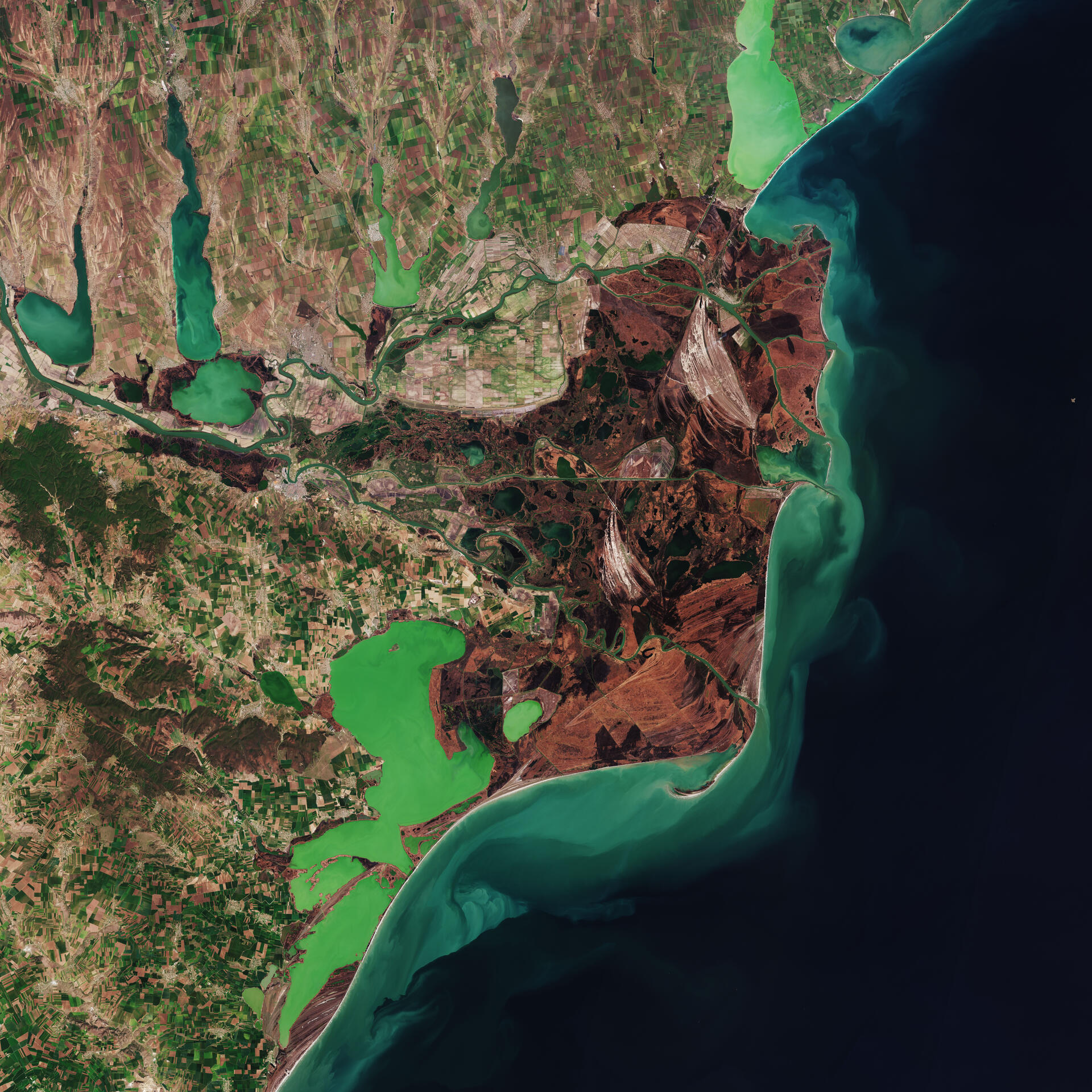
The Danube Delta, inscribed as a UNESCO World Heritage Site in 1991, is the second largest river delta in Europe, surpassed only by the Volga Delta. This expansive wetland ecosystem, covering approximately 4,150 square kilometers, is primarily situated within Romania, with a minor portion extending into Ukraine. When considering the Razim–Sinoe lagoon complex, geologically and ecologically linked to the delta proper, the total area encompasses 5,800 square kilometers.
The Danube Delta is formed where the mighty Danube River meets the Black Sea. The delta’s formation began approximately 6,000–10,000 years ago, as Black Sea levels stabilized and sediment carried by the Danube accumulated at its mouth along the Black Sea coast. Over time, the delta has evolved into a complex network of channels, lakes, and marshes that provide critical habitat for an abundance of plant and animal life.
One of the delta's most striking features is its biodiversity. More than 300 bird species call the Danube Delta home, making it one of the most important bird sanctuaries in Europe. These avian inhabitants include rare species such as the Dalmatian pelican, white-tailed eagle, and pygmy cormorant. Additionally, the delta supports around 45 resident freshwater fish species, while records identify between 75 and 135 fish species in total when migratory and marine visitors are included, including anadromous sturgeon, as well as catfish, pike, and zander.
The delta's rich biodiversity can be attributed to its diverse habitats. Freshwater lakes, brackish water lagoons, and saltwater estuaries create a gradient of salinity that supports a wide range of aquatic life. The delta's marshlands also provide essential nesting and feeding grounds for migratory birds. Furthermore, the delta's forests, reeds, and steppe grasslands offer shelter and food sources for various terrestrial animals, such as wild boars and wolves.
In addition to its natural beauty and abundant wildlife, the Danube Delta holds significant cultural value. The delta has been inhabited for thousands of years, with evidence of human settlement dating back to the Neolithic period. Today, the delta is home to several ethnic groups, including Romanians, Ukrainians, and Lipovans, each bringing their unique traditions and customs to the region.
Preserving the Danube Delta's natural and cultural heritage is crucial for future generations. Efforts to protect the delta include designating large areas as protected nature reserves, implementing sustainable tourism practices, and promoting conservation awareness among local communities. By preserving this remarkable ecosystem, we ensure not only the survival of its incredible biodiversity but also the continued enjoyment of its beauty and cultural significance for generations to come.
UNESCO Description of the World Heritage Site
The waters of the Danube, which flow into the Black Sea, form the largest and best preserved of Europe's deltas. The Danube delta hosts over 300 species of birds as well as 45 freshwater fish species in its numerous lakes and marshes.
Encyclopedia Record: Danube Delta
The Danube Delta is the second largest river delta in Europe, after the Volga Delta, and is the best preserved on the continent. Occurring where the Danube River empties into the Black Sea, most of the Danube Delta lies in Romania, with a small part located in Ukraine. Its approximate surface area is 4,152 square kilometres, of which 3,446 km2 (1,331 sq mi) is in Romania. With the lagoons of Razim–Sinoe, located south of the main delta, the total area of the Danube Delta is 5,165 km2 (1,994 sq mi). The Razim–Sinoe lagoon complex is geologically and ecologically related to the delta proper; the combined territory is listed as a World Heritage Site.Additional Site Details
Area: 312,440 hectares
Number of Components: 1
(x) — Contains most important habitats for biodiversity
Coordinates: 45.08333 , 29.5
IUCN World Heritage Outlook
The 2025 Conservation Outlook on Danube Delta reports the following assessment:
Source: International Union for Conservation of Nature (IUCN) · View assessment
World Heritage Research
Discover scientific research and academic studies that deepen our understanding of Danube Delta from its history and significance to its conservation, management, and contemporary challenges.
-
Intelligent Methods for Estimating the Flood Susceptibility in the Danube Delta, Romania
Over 65% of the Danube Delta (DD) is highly or very highly susceptible to flooding, according to a study that combined multicriteria decision-making and artificial intelligence techniques. Researchers used data from previously flooded regions alongside eight geographical factors to train models including deep learning neural networks, support vector machines, and multilayer perceptron. All models demonstrated excellent performance with an area under the curve (AUC) exceeding 0.908 in receiver operating characteristic (ROC) analysis. This finding underscores the significant vulnerability of the DD to flooding, providing a critical basis for implementing mitigation measures.
Costache, R., Crăciun, A., Ciobotaru, N., & Bărbulescu, A. (2024). Intelligent Methods for Estimating the Flood Susceptibility in the Danube Delta, Romania. Water, 16(23), 3511. https://doi.org/10.3390/w16233511
View Publication Record | Read Publication -
The Danube Delta: The Achilles Heel of Danube River–Danube Delta–Black Sea Region Fish Diversity under a Black Sea Impact Scenario Due to Sea Level Rise—A Prospective Review
Climate change-driven sea level rise in the Black Sea threatens to significantly impact fish diversity in the Danube Delta, one of Earth's most critical biodiversity hotspots. This prospective review reveals that approximately one-third of the delta's fish species could face substantial negative effects, while another third may experience lesser impacts, and the remaining third will remain unaffected. The study highlights the delta's role as a vital buffer for fish fauna in the Danube River and Black Sea, supporting reproduction, feeding, and smooth transitions for numerous species. Sea level rise has historically been a major stressor for the region's fish diversity, and this trend is expected to continue, necessitating urgent in situ-adapted management measures to mitigate risks for threatened species.
Bănăduc, D., Afanasyev, S., Akeroyd, J. R., Năstase, A., Năvodaru, I., Tofan, L., & Curtean-Bănăduc, A. (2023). The Danube Delta: The Achilles Heel of Danube River–Danube Delta–Black Sea Region Fish Diversity under a Black Sea Impact Scenario Due to Sea Level Rise—A Prospective Review. Fishes, 8(7), 355. https://doi.org/10.3390/fishes8070355
View Publication Record | Read Publication -
Modern Techniques for Flood Susceptibility Estimation across the Deltaic Region (Danube Delta) from the Black Sea’s Romanian Sector
Over 70% of the Danube Delta is highly susceptible to flooding, with slope, elevation, distance from rivers, and land use identified as critical predictors. This finding emerges from a study employing the Analytical Hierarchy Process (AHP) and Fuzzy-Analytical Hierarchy Process (FAHP) models, which quantified the influence of eight flood-related factors on spatial vulnerability. The research highlights the urgent need for mitigation strategies in this UNESCO World Heritage Site, given the increasing severity and frequency of floods linked to climate change.
Crăciun, A., Costache, R., Bărbulescu, A., Pal, S. C., Costache, I., & Dumitriu, C. Ș. (2022). Modern Techniques for Flood Susceptibility Estimation across the Deltaic Region (Danube Delta) from the Black Sea’s Romanian Sector. Journal of Marine Science and Engineering, 10(8), 1149. https://doi.org/10.3390/jmse10081149
View Publication Record | Read Publication -
Silver Carp (Hypophthalmichthys molitrix) (Asian Silver Carp) Presence in Danube Delta and Romania—A Review with Data on Natural Reproduction
Silver carp (Hypophthalmichthys molitrix), an invasive species introduced to Europe, poses significant ecological risks in the Danube Delta, particularly under global warming conditions. This review synthesizes data on its introduction, suitable water temperatures for growth and reproduction, nutritional habits, and ecological impacts. The study highlights that silver carp, while ecologically and economically valuable in its native habitat, has become a threat to European river ecosystems due to its rapid proliferation and adaptability. Research approaches included gathering historical and environmental data to assess the species' behavior and risks, providing critical insights for managing invasive species in fragile environments like UNESCO World Heritage Sites.
Jawdhari, A., Mihăilescu, D., Fendrihan, S., Jujea, V., Stoilov-Linu, V., & Negrea, B.-M. (2022). Silver Carp (Hypophthalmichthys molitrix) (Asian Silver Carp) Presence in Danube Delta and Romania—A Review with Data on Natural Reproduction. Life, 12(10), 1582. https://doi.org/10.3390/life12101582
View Publication Record | Read Publication -
Sustainable Development Scenarios in the Danube Delta—A Pilot Methodology for Decision Makers
A moderate intensification of aquaculture, combined with ecological agriculture and slow tourism, offers the most sustainable development pathway for the Danube Delta, Europe's second-largest wetland. This approach minimizes negative impacts on water quality while maintaining ecosystem services like flood protection and nutrient recycling. The study developed a novel methodology that integrates stakeholder consultations, expert validation, and system dynamics modeling to address social, economic, and environmental challenges. By simulating scenarios and engaging stakeholders, the research provides actionable policy recommendations for balancing sector-specific strategies—such as fishing, agriculture, and tourism—while preventing conflicts. This pilot model serves as a blueprint for sustainable decision-making in complex social-ecological systems like UNESCO World Heritage Sites.
Lazar, L., Rodino, S., Pop, R., Tiller, R., D’Haese, N., Viaene, P., & De Kok, J.-L. (2022). Sustainable Development Scenarios in the Danube Delta—A Pilot Methodology for Decision Makers. Water, 14(21), 3484. https://doi.org/10.3390/w14213484
View Publication Record | Read Publication -
Methane in the Danube Delta: the importance of spatial patterns and diel cycles for atmospheric emission estimates
A comprehensive study of methane emissions from the Danube Delta reveals significant spatial and diel variability, challenging previous assumptions about wetland greenhouse gas contributions. The research found that channels within the delta exhibit the highest methane concentrations, with seasonal and water flow dynamics further influencing emission patterns. Notably, diel cycles in lakes and channels showed extreme variations, with concentrations fluctuating by an order of magnitude, suggesting daily vertical stratification driven by macrophytes. This phenomenon introduces a substantial uncertainty factor of 4.5 in emission estimates. The study highlights the critical need for high-resolution, spatio-temporal data to accurately model methane emissions from complex wetland systems like the Danube Delta.
Canning, A., Wehrli, B., & Körtzinger, A. (2021). Methane in the Danube Delta: the importance of spatial patterns and diel cycles for atmospheric emission estimates. Biogeosciences, 18(12), 3961–3979. https://doi.org/10.5194/bg-18-3961-2021
View Publication Record | Read Publication -
Spatio-temporal variations in lateral and atmospheric carbon fluxes from the Danube Delta
The Danube Delta, a mosaic of ponds, channels, and wetlands, is a significant source of atmospheric carbon emissions. A two-year study found that the delta emits approximately 65 GgC yr⁻¹ of CO₂ and CH₄, with small channels contributing disproportionately to these emissions due to their high flux rates. While lakes can act as CO₂ sinks in summer, they are major emitters of methane (CH₄). The study also estimated that the delta exports about 160 ± 280 GgC yr⁻¹ of carbon to the Black Sea, a relatively small increase compared to the upstream river catchment but with a notably higher carbon yield per unit area. Researchers quantified these fluxes through monthly field campaigns at 19 sites, providing the first seasonally resolved estimates of freshwater carbon emissions in the delta.
Maier, M.-S., Teodoru, C. R., & Wehrli, B. (2021). Spatio-temporal variations in lateral and atmospheric carbon fluxes from the Danube Delta. Biogeosciences, 18(4), 1417–1437. https://doi.org/10.5194/bg-18-1417-2021
View Publication Record | Read Publication