World Heritage Identification Number: 622
World Heritage since: 1993
Category: Cultural Heritage
WHE Type: Buildings & Architectural Ensembles
Transboundary Heritage: No
Endangered Heritage: No
Country: 🇸🇰 Slovakia
Continent: Europe
UNESCO World Region: Europe and North America
Map
Vlkolínec: A Remarkable Intact Central European Village
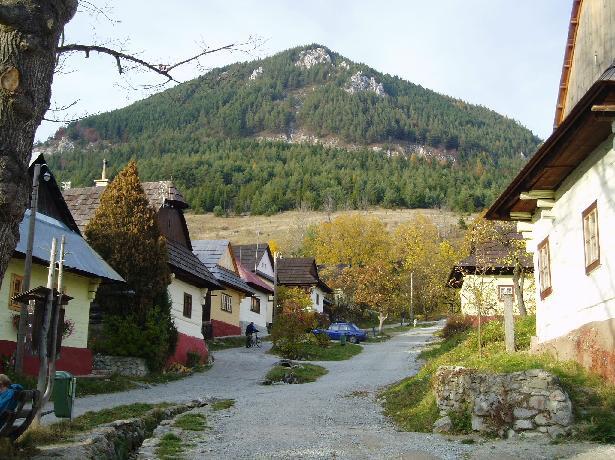
Vlkolínec (Slovak pronunciation: [ˈvlkoˌliːt͡s]) is a small, picturesque village located in the heart of Slovakia. Inscribed as a UNESCO World Heritage Site in 1993, this remarkable settlement boasts a collection of 45 traditional log houses that epitomize the architectural characteristics of central European villages, particularly those found in mountainous regions.
More to come…UNESCO Description of the World Heritage Site
Vlkolínec, situated in the centre of Slovakia, is a remarkably intact settlement of 45 buildings with the traditional features of a central European village. It is the region’s most complete group of these kinds of traditional log houses, often found in mountainous areas.
UNESCO Justification of the World Heritage Site
Criterion (iv): Vlkolínec is a remarkably intact rural settlement of a characteristic central European type with log-built architecture, which is often found in mountainous areas. The layout of the settlement has remained virtually unchanged and the architectural style has been fully retained. It is the best preserved and most comprehensive unit of its kind in the whole region.
Criterion (v): Vlkolínec is an outstanding example of a traditional Central European rural settlement, with 43 unaltered houses and ancillary buildings reflecting a multitude of archaic building elements, all set within a traditional farming landscape of strip fields which has become vulnerable due to the changed way of life.
Encyclopedia Record: Vlkolínec
Vlkolínec is a village under the administration of the town of Ružomberok in Slovakia. Historically, however, it was a separate village. The first written mention of the village came from 1376 and after 1882 it became part of Ružomberok. Its name is probably derived from the Slovak word "vlk", i.e. wolf.Additional Site Details
Area: 4.9 hectares
Number of Components: 1
(v) — Outstanding example of traditional human settlement
Coordinates: 49.0391666667 , 19.2783333333
World Heritage Research
Discover scientific research and academic studies that deepen our understanding of Vlkolínec from its history and significance to its conservation, management, and contemporary challenges.
-
The role of knowledge in supporting the revitalisation of traditional landscape governance through social innovation in Slovakia
A study on Vlkolínec, a UNESCO World Heritage Site in Slovakia, reveals that the integration of local and external knowledge through social innovation (SI) initiatives can significantly revitalize traditional farming and rural landscapes. The research demonstrates that co-production of knowledge, facilitated by networking among diverse stakeholders—including scientists, policymakers, and local communities—enhances SI development paths. This approach fosters sustainable practices such as small-scale farming, traditional crafts, green job creation, and eco-tourism, ultimately improving local quality of life. The study highlights the critical role of external knowledge in strengthening social capital and establishing regional knowledge networks, which are essential for triggering and sustaining SI in marginalized rural areas.
Špaček, M., Melnykovych, M., Kozová, M., Pauditšová, E., & Kluvánková, T. (2022). The role of knowledge in supporting the revitalisation of traditional landscape governance through social innovation in Slovakia. Environmental Policy and Governance, 32(6), 560–574. Portico. https://doi.org/10.1002/eet.2026
View Publication Record | Read Publication -
Long-Term Development Trend of the Historical Cultural Landscape of the UNESCO Monument: Vlkolínec (Slovakia)
A comprehensive analysis of Vlkolínec, a UNESCO World Heritage Site in Slovakia, reveals significant changes in its cultural landscape over nearly 250 years while emphasizing the need for balanced preservation and sustainable development. The study, using historical maps, aerial photographs from 1769 to 2017, and a 2017 questionnaire survey involving residents and users of the area, identified 13 key landscape elements and their transformations under natural and socio-economic pressures. Findings highlight the tension between maintaining Vlkolínec's unique heritage value and accommodating modern demands for living standards and tourism. The research proposes actionable plans to ensure the site’s long-term protection without compromising its authenticity or potential for sustainable growth.
Petrovič, F., Boltižiar, M., Rakytová, I., Tomčíková, I., & Pauditšová, E. (2021). Long-Term Development Trend of the Historical Cultural Landscape of the UNESCO Monument: Vlkolínec (Slovakia). Sustainability, 13(4), 2227. https://doi.org/10.3390/su13042227
View Publication Record | Read Publication -
Monuments of cultural heritage from the perspective residents – a case study of Mikulčice (Czechia) and Vlkolínec (Slovakia)
Residents' perspectives significantly influence the preservation and management of UNESCO World Heritage Sites, as demonstrated by a comparative study of Vlkolínec (Slovakia) and Mikulčice (Czechia). The research reveals that local stakeholders' traditional cultural and natural values play a crucial role in shaping heritage conservation strategies. Using questionnaire surveys, the study collected data on residents' perceptions, which highlighted the importance of integrating community input into decision-making processes for UNESCO-protected areas. This approach is particularly relevant for sites like Vlkolínec, which has been on the UNESCO list for 25 years, and Mikulčice, a potential candidate for registration. The findings underscore the need for collaborative efforts between stakeholders and institutions to ensure sustainable heritage management.
Lněnička, L., & Dvořáková, L. (2020). Monuments of cultural heritage from the perspective residents – a case study of Mikulčice (Czechia) and Vlkolínec (Slovakia). (Teaching) Regional Geography. Proceedings of 27th Central European Conference. 17th October 2019, Brno, 125–138. https://doi.org/10.5817/cz.muni.p210-9694-2020-10
View Publication Record | Read Publication -
Tradice a kulturní hodnoty území v péči UNESCO
UNESCO World Heritage Sites, such as Vlkolínec in Slovakia and the potential candidate Slovanské hradiště in Mikulčice, Czech Republic, face unique challenges in preserving their traditional natural and cultural values. This study highlights practical tools like territorial plans, management plans, and protective buffer zones to effectively safeguard these sites. It demonstrates how existing frameworks can be leveraged to integrate heritage conservation with community life, ensuring sustainable protection. The research is part of a broader project focusing on the role of UNESCO sites in local communities, offering actionable insights for policymakers and conservationists.
Lněnička, L., Kolejka, J., Kozová, M., Bašáry, J., Boltižiar, M., Čupa, P., Dvořáková, L., Pauditšová, E., Petrovič, F., Synek, F., Šrankota, P., & Vybíral, J. (2019). Tradice a kulturní hodnoty území v péči UNESCO. https://doi.org/10.5817/cz.muni.m210-9351-2019
View Publication Record | Read Publication -
UNESCO World Heritage Site of Vlkolínec (Slovakia) in Geographical Education
A UNESCO World Heritage Site, Vlkolínec (Slovakia), stands out for its unique historical landscape structures that have preserved cultural significance since the late 18th century. This study highlights how such sites can serve as valuable educational tools in geographical education, demonstrating their potential to enrich both local and global learning experiences. Through a survey of primary students in the Liptov region (2018/2019), researchers identified gaps in student knowledge about Vlkolínec, leading to the development of an educational project aimed at integrating the site's attributes into school curricula. The findings underscore the importance of leveraging UNESCO sites for tourism and pedagogy, offering a model for other regions to follow.
Rakytová, İ., & Tomčíková, I. (2019). UNESCO WORLD HERITAGE SITE OF VLKOLÍNEC (SLOVAKIA) IN GEOGRAPHICAL EDUCATION. Review of International Geographical Education Online. https://doi.org/10.33403/rigeo.573655
View Publication Record | Read Publication -
Influence of grasslands management on diversity of the diurnal butterflies of Vlkolínec Village (Central Slovakia)
Extensive grassland management significantly enhances butterfly biodiversity, particularly for specialized and protected species, while intensive practices like mulching and overgrazing lead to habitat degradation. A two-year study (2011–2012) in Vlkolínec, Slovakia, found that late-successional grasslands and extensively managed pastures hosted the highest diversity of diurnal butterflies, including rare species like Phengaris arion and Melitaea aurelia. Researchers used transect surveys and multivariate analysis (RDA) to assess how abandonment, mulching, and grazing affected butterfly communities. Results revealed that intensive management disrupted vegetation structure, negatively impacting stenotopic species, whereas extensive practices correlated with increased diversity and abundance of indicator butterflies. The study underscores the critical role of traditional land management in sustaining biodiversity within UNESCO-recognized landscapes.
Babálová, M., & Štrbová, E. (2014). Influence of grasslands management on diversity of the diurnal butterflies of Vlkolínec Village (Central Slovakia). Ecology and Noospherology, 25(1-2), 83–91. https://doi.org/10.15421/031408
View Publication Record | Read Publication