World Heritage Identification Number: 486
World Heritage since: 1988
Category: Natural Heritage
WHE Type: Natural Landscapes & Geographic Features
Transboundary Heritage: No
Endangered Heritage: No
Country: 🇦🇺 Australia
Continent: Oceania
UNESCO World Region: Asia and the Pacific
Map
The Wet Tropics of Queensland: A Biodiverse Treasure Trove
The Wet Tropics of Queensland, located along the northeast coast of Australia, spans approximately 8,940 square miles (23,150 square kilometers). This region, inscribed as a UNESCO World Heritage Site in 1988, is renowned for its rich biodiversity and unique ecosystems.
More to come…UNESCO Description of the World Heritage Site
This area, which stretches along the north-east coast of Australia for some 450 km, is made up largely of tropical rainforests. This biotope offers a particularly extensive and varied array of plants, as well as marsupials and singing birds, along with other rare and endangered animals and plant species.
UNESCO Justification of the World Heritage Site
Criterion (vii): The Wet Tropics exhibit exceptional natural beauty, with superlative scenic features highlighted by extensive sweeping forest vistas, wild rivers, waterfalls, rugged gorges and coastal scenery. This is particularly apparent between the Daintree River and Cedar Bay, where exceptional coastal scenery combines tropical rainforest and white sandy beaches with fringing offshore coral reefs. The winding channels of the Hinchinbrook Channel contain the most extensive mangroves in the region, providing a rich visual mosaic of rainforest and mangroves, and a terrestrial continuum with the Great Barrier Reef.
Criterion (viii): The Wet Tropics contains one of the most complete and diverse living records of the major stages in the evolution of land plants, from the very first pteridophytes more than 200 million years ago to the evolution of seed-producing plants including the cone-bearing cycads and southern conifers (gymnosperms), followed by the flowering plants (angiosperms). As the Wet Tropics is the largest part of the entire Australasian region where rainforests have persisted continuously since Gondwanan times, its living flora, with the highest concentration of primitive, archaic and relict taxa known, is the closest modern-day counterpart for Gondwanan forests. In addition, all of Australia’s unique marsupials and most of its other animals originated in rainforest ecosystems, and the Wet Tropics still contains many of their closest surviving members. This makes it one of the most important living records of the history of marsupials as well as of songbirds.
Criterion (ix): The Wet Tropics provides outstanding examples of significant ongoing ecological processes and biological evolution. As a centre of endemism for the region (second only to New Caledonia in the number of endemic genera per unit area), the Wet Tropics provides fundamental insights into evolutionary patterns both in isolation from and in interaction with other rainforests. Its tall, open forests on the drier western margins of the rainforest are also significant as part of an evolutionary continuum of rainforest and sclerophyll forests. Eucalypts, that now dominate the Australian landscape, are considered to have evolved from such rainforest stock and radiated into drier environments from the margins of closed forests. The area supports an exceptionally high level of diversity of both flora and fauna, with over 3,000 vascular plant species in 224 families, of which 576 species and 44 genera are endemic, including two endemic plant families. Vertebrate diversity and endemism are also very high, with 107 mammal species including 11 endemic species and two monotypic endemic genera. In terms of avifauna, there are 368 bird species, of which 11 species are endemic. For reptiles, there are 113 species of which 24 species are endemic, including three monotypic endemic genera. The diversity of amphibians includes 51 species of which 22 are endemic.
Criterion (x): The Wet Tropics holds a largely intact flora and fauna with hundreds of endemic species restricted to the property, of which many are classified as threatened. The majority of plant species have restricted distributions, and many monotypic plant genera and several species of marsupials, frogs and reptiles have very restricted distributions either as isolated or disjunct populations, reflecting the refugial nature of the rainforests found in several locations. The diversity of the plant communities and animal habitats of the Wet Tropics is recognised as being the most floristically and structurally diverse in Australia and is also outstanding on a global scale. Among many emblematic species occurring in the property is the flightless Australian cassowary, one of the largest birds in the world. In an Australian context, the Wet Tropics covers less than 0.2% of Australia, but contains 30% of the marsupial species, 60% of bat species, 25% of rodent species, 40% of bird species, 30% of frog species, 20% of reptile species, 60% of butterfly species, 65% of fern species, 21% of cycad species, 37% of conifer species, 30% of orchid species and 18% of Australia’s vascular plant species. It is therefore of great scientific interest and of fundamental importance to conservation. Although the Wet Tropics is predominantly wet tropical rainforest, it is fringed and in a few places dissected by sclerophyll forests, woodlands, swamps and mangrove forests, adding to its diversity.
Encyclopedia Record: Wet Tropics of Queensland
The Wet Tropics of Queensland World Heritage Site is an area of approximately 8,940 km2 (3,450 sq mi) of very wet forests on parts of the coast and adjacent ranges of tropical Queensland, Australia. The area meets all four of the natural heritage selection criteria for a World Heritage site. World Heritage status was declared in 1988, and on 21 May 2007 the Wet Tropics was added to the Australian National Heritage List.Additional Site Details
Area: 893,453 hectares
Number of Components: 14
(viii) — Outstanding example representing major earth stages
(ix) — Outstanding example representing ecological and biological processes
(x) — Contains most important habitats for biodiversity
Coordinates: -15.65 , 144.9666667
IUCN World Heritage Outlook
The 2025 Conservation Outlook on Wet Tropics of Queensland reports the following assessment:
Source: International Union for Conservation of Nature (IUCN) · View assessment
Image
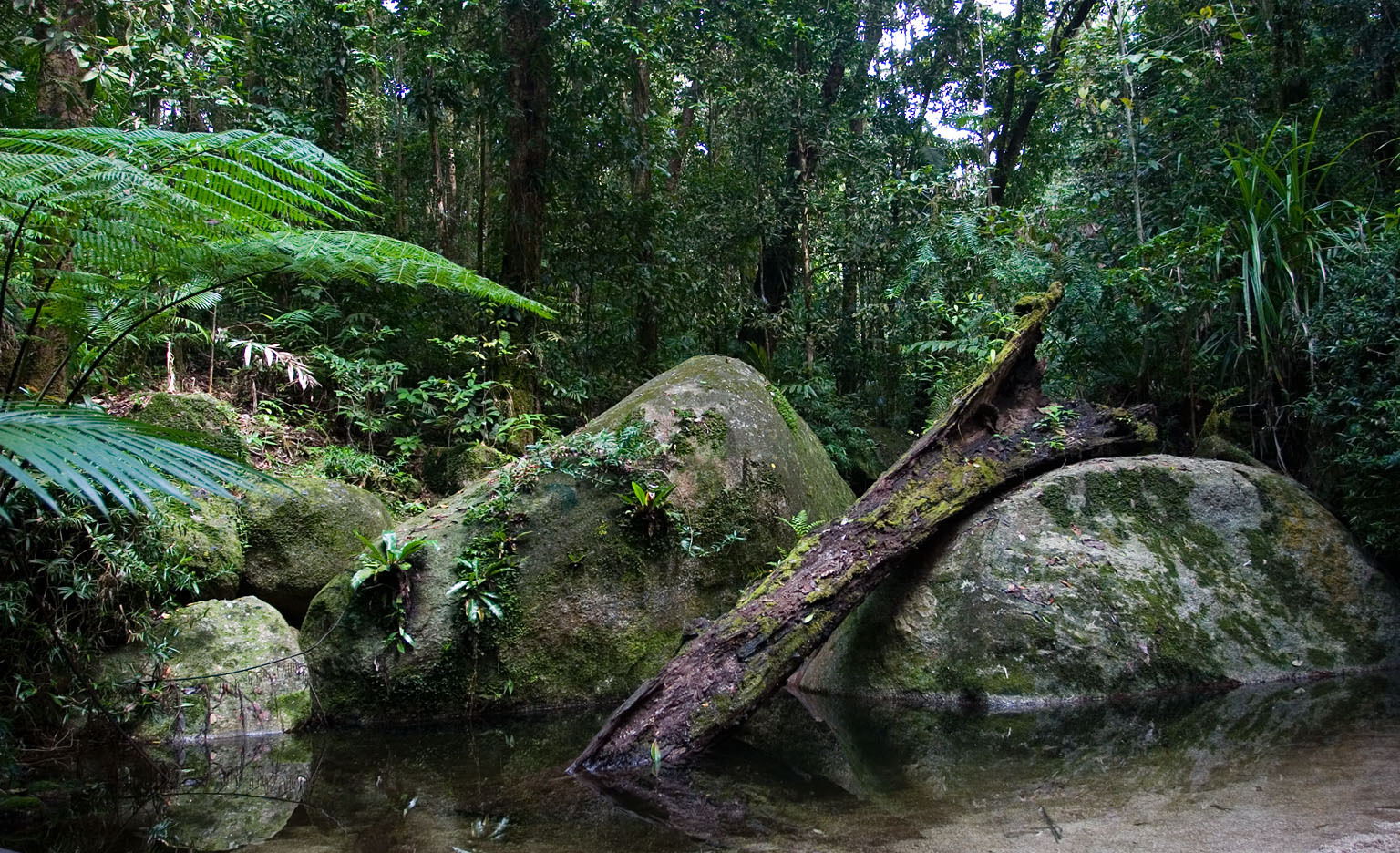
© User:Diliff, CC BY-SA 2.5 Resized from original. (This derivative is under the same CC BY-SA license.)
World Heritage Research
Discover scientific research and academic studies that deepen our understanding of Wet Tropics of Queensland from its history and significance to its conservation, management, and contemporary challenges.
-
How did rivers in the wet tropics (NE Queensland, Australia) respond to climate changes over the past 30 000 years?
A complex, non-linear relationship between river behavior and climate change emerges from a 30,000-year analysis of the Wet Tropics of Queensland. The study reveals that periods of fluvial aggradation (sediment deposition) occurred synchronously at 30–13 ka, 8–5 ka, and after 1 ka, while terrace incision (erosion) dominated between 13–8 ka and 5–1 ka. Contrary to expectations, river responses did not consistently align with wetter or drier conditions, suggesting that other continental-scale factors may have played a significant role in shaping fluvial dynamics during the Late Quaternary in Australia. The research integrates multiple palaeoenvironmental proxies to reconstruct these changes, offering insights into the resilience and vulnerability of tropical river systems under climate variability.
Hughes, K., & Croke, J. (2017). How did rivers in the wet tropics (NE Queensland, Australia) respond to climate changes over the past 30 000 years? Journal of Quaternary Science, 32(6), 744–759. Portico. https://doi.org/10.1002/jqs.2956
View Publication Record | Read Publication -
New species of mite harvestmen from the Wet Tropics of Queensland, Australia, with commentary on biogeography of the genus Austropurcellia (Opiliones: Cyphophthalmi: Pettalidae)
Researchers have identified four new species of mite harvestmen (Austropurcellia alata, A. culminis, A. despectata, and A. vicina) from the Wet Tropics of Queensland, Australia, significantly expanding the known diversity of this cryptic genus. These narrow-range endemics, each represented by a single collection and few specimens, offer valuable insights into historical forest fragmentation's role in rainforest animal evolution. The study provides the first key to Austropurcellia species, a catalogue of collecting localities, and a distribution map, though it acknowledges that current knowledge remains incomplete. This work highlights the potential of Austropurcellia as a model system for understanding biogeographical patterns in rainforest fauna.
Boyer, S. L., & Reuter, C. N. (2012). New species of mite harvestmen from the Wet Tropics of Queensland, Australia, with commentary on biogeography of the genus Austropurcellia (Opiliones: Cyphophthalmi: Pettalidae). Journal of Arachnology, 40(1), 96–112. https://doi.org/10.1636/ha11-44.1
View Publication Record | Read Publication -
Using canopy bridges to link habitat for arboreal mammals: successful trials in the Wet Tropics of Queensland
Canopy bridges significantly aid arboreal mammals, including rare and endemic species, in crossing roads within the Wet Tropics of Queensland. The study found that nine mammal species, five of which are endemic or listed as rare, utilized three types of rope canopy bridges—single rope, ladder-like, and tunnel-shaped—to traverse a 15-meter-wide tourist road and a highway. Notably, over 50 crossings were observed on an elevated ladder-like bridge, while longer (~40 m) bridges were used by four species. These findings suggest that such structures can mitigate road-kill risks and reduce subpopulation isolation, offering potential broad applications for conserving arboreal mammals in fragmented habitats.
Weston, N., Goosem, M., Marsh, H., Cohen, M., & Wilson, R. (2011). Using canopy bridges to link habitat for arboreal mammals: successful trials in the Wet Tropics of Queensland. Australian Mammalogy, 33(1), 93–105. https://doi.org/10.1071/am11003
View Publication Record | Read Publication -
Cooperative Research: An Example from the Wet Tropics of Queensland
Cooperative research integrating Indigenous and scientific knowledge can effectively guide natural resource management (NRM) strategies, particularly in the Wet Tropics of Queensland. The study demonstrates that multi-directional learning and mutual benefit—achieved through trust-based partnerships and genuine action research outcomes—strengthen both Indigenous knowledge systems and traditional scientific approaches. This approach ensures that Indigenous perspectives on symbolic significance and resource values are equally recognized alongside established scientific methods, fostering cross-transfer of skills and more holistic NRM solutions.
Cullen-Unsworth, L. C., Butler, J. R. A., Hill, R., & Wallace, M. (2010). Cooperative Research: An Example from the Wet Tropics of Queensland. The International Journal of Interdisciplinary Social Sciences: Annual Review, 5(6), 139–154. https://doi.org/10.18848/1833-1882/cgp/v05i06/51776
View Publication Record | Read Publication