World Heritage Identification Number: 893
World Heritage since: 1999
Category: Natural Heritage
WHE Type: Protected Areas & National Parks
Transboundary Heritage: No
Endangered Heritage: No
Country: 🇧🇷 Brazil
Continent: Americas
UNESCO World Region: Latin America and the Caribbean
Map
Atlantic Forest South-East Reserves: A Biodiversity Haven in Brazil
The Atlantic Forest South-East Reserves, inscribed as a UNESCO World Heritage Site in 1999, is a vast network of protected areas spanning over 470,000 hectares across the states of Paraná and São Paulo in Brazil. This expansive region showcases some of the finest and most comprehensive examples of the Atlantic forest ecosystem, which is one of the world's 25 biodiversity hotspots.
More to come…UNESCO Description of the World Heritage Site
The Atlantic Forest South-East Reserves, in the states of Paraná and São Paulo, contain some of the best and most extensive examples of Atlantic forest in Brazil. The 25 protected areas that make up the site (some 470,000 ha in total) display the biological wealth and evolutionary history of the last remaining Atlantic forests. From mountains covered by dense forests, down to wetlands, coastal islands with isolated mountains and dunes, the area comprises a rich natural environment of great scenic beauty.
UNESCO Justification of the World Heritage Site
Criterion (vii): The site represents one of one of the largest continuous areas of exuberant Brazilian Atlantic Forest connected with coastal ecosystems. From mountains covered by dense forests with an abundance of orchids and bromeliads to coastal islands and estuaries with a wealth of vast mangroves, the property offers a natural environment of great beauty with tremendous terrestrial and marine biodiversity. More than 300 caves (including the Casa de Pedra Cave which has the largest portico in the world at 215 meters high, and Santana Cave which is one of the most highly decorated), the rugged mountains and breathtaking coastal scenery, contribute to the exceptional aesthetic interest of the region.
Criterion (ix): Historically partly isolated, the Atlantic Forest has evolved into a complex biome with a multitude of endemic species, comprising around 70% of the tree species, 85% of the primates and 39% of the mammals. As the most important ecological corridor of the Atlantic Forest, the site represents the best guarantee for the sustainability of the ongoing evolution of the biome and its associated marine and coastal ecosystems.
Criterion (x): The flora and fauna are extremely diverse and very rich. The flora is among the most diverse in the world, and in some areas one can encounter over 450 species of trees per hectare. As for mammals, they number 120 species, probably the largest in Brazil. Amongst the flagship species are the jaguar, ocelot and the bush dog (Speothos venaticus). The property is rich in primates, some of which are highly endangered, such as the woolly spider monkey (Brachyteles arachnoides), the largest primate in the Americas, and the little “black-faced lion” monkey (Leontopithecus caissara), recorded only in 1990 and endemic to the region. The avifauna is very diverse with 350 species recorded, including the blue-cheeked Amazon (Amazona brasiliensis), classified vulnerable. The scarlet ibis (Eudocimus ruber), a large bird with bright red plumage, is a local symbol.
Encyclopedia Record: Serra do Mar
The Serra do Mar is a 1,500-kilometre-long (930 mi) system of mountain ranges and escarpments in Southeastern Brazil.Additional Site Details
Area: 468,193 hectares
Number of Components: 21
(ix) — Outstanding example representing ecological and biological processes
(x) — Contains most important habitats for biodiversity
Coordinates: -24.16667 , -48
IUCN World Heritage Outlook
The 2025 Conservation Outlook on Atlantic Forest South-East Reserves reports the following assessment:
Source: International Union for Conservation of Nature (IUCN) · View assessment
Image
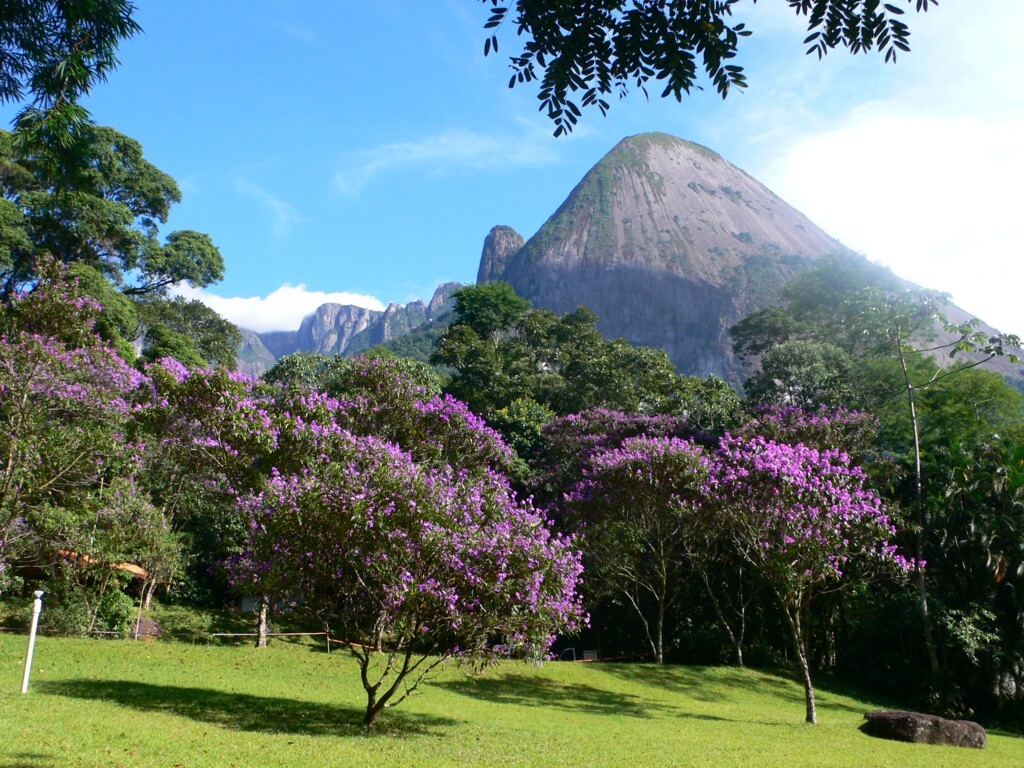
© Jimfbleak, CC BY-SA 3.0 Resized from original. (This derivative is under the same CC BY-SA license.)
World Heritage Research
Discover scientific research and academic studies that deepen our understanding of Atlantic Forest South-East Reserves from its history and significance to its conservation, management, and contemporary challenges.
-
Jaguars and wild pigs indicate protected area connectivity in the south-east Atlantic Forest (Brazil)
Despite the highly fragmented landscape of Brazil's south-east Atlantic Forest, both jaguars and wild pigs exhibit connectivity among protected areas. While wild pigs, with their lower environmental requirements, show more connectivity opportunities, the study reveals that even threatened species like jaguars can traverse narrow corridors through protected areas of sustainable use and private reserves. This finding underscores the critical role these areas play in maintaining landscape integrity for both native and invasive species. The research employed expert opinion, Circuitscape analysis, and least-cost-path modeling to assess connectivity, highlighting a concerning dual-use of landscapes that benefits conservation efforts while also facilitating the spread of invasive species.
Silva, M. P., Massi, K. G., Negri, R. G., & Pedrosa, F. (2023). Jaguars and wild pigs indicate protected area connectivity in the south-east Atlantic Forest (Brazil). Environmental Conservation, 50(1), 22–30. https://doi.org/10.1017/s0376892922000479
View Publication Record | Read Publication -
Relative importance of anthropogenic landscape characteristics for Neotropical frugivores at multiple scales
Frugivores, crucial to Neotropical forest ecosystems, face significant threats from human activities. This study reveals that anthropogenic landscape characteristics—such as human accessibility, proximity to reserves, and forest cover—are the primary determinants of occupancy for frugivorous species like the paca (Cuniculus paca), brocket deer (Mazama sp.), and collared peccary (Pecari tajacu) in the Atlantic Forest South-East Reserves. Environmental and geomorphometric variables played a weaker role, while weather, season, and habitat factors influenced detection probability. The research employed camera traps and call surveys across 45 sites over a year, analyzing landscape metrics at three spatial scales (200, 500, and 1000 meters) using multi-season occupancy modeling. Findings underscore the need for a multi-taxa and multi-scale approach to conservation planning, as different frugivore species respond variably to landscape attributes depending on their perceptual scale.
Nagy‐Reis, M. B., Estevo, C. A., Setz, E. Z. F., Ribeiro, M. C., Chiarello, A. G., & Nichols, J. D. (2017). Relative importance of anthropogenic landscape characteristics for Neotropical frugivores at multiple scales. Animal Conservation, 20(6), 520–531. Portico. https://doi.org/10.1111/acv.12346
View Publication Record | Read Publication -
Estudo da Amenidade Térmica Proporcionada Pela Reserva Ecológica de Dois Irmãos, Recife - PE (Study of Thermal Amenity Provided by the Ecological Reserve of Dois Irmãos, Recife - PE)
Urbanization significantly impacts thermal comfort, with green spaces offering substantial climate regulation. A study of the Ecological Reserve of Dois Irmãos in Recife, Brazil, found a 5°C difference in temperature between urbanized areas and the forest reserve, alongside a 20% increase in humidity within the green space. The research compared microclimatic conditions—temperature, humidity, and wind speed—across urban, edge, and interior zones of the reserve using strategically positioned measurement points. Results underscored the critical role of urban forests in mitigating heat stress, improving air quality, and enhancing thermal comfort for city dwellers. Preservation of such green areas is highlighted as essential for both climate adaptation and public well-being.
Arruda, K. E. C. (2011). Estudo da Amenidade Térmica Proporcionada Pela Reserva Ecológica de Dois Irmãos, Recife - PE (Study of Thermal Amenity Provided by the Ecological Reserve of Dois Irmãos, Recife - PE). Revista Brasileira de Geografia Física, 3(3), 196–203. https://doi.org/10.26848/rbgf.v3i3.232665
View Publication Record | Read Publication