
World Heritage Identification Number: 1434
World Heritage since: 2018
Category: Natural Heritage
WHE Type: Natural Landscapes & Geographic Features
Transboundary Heritage: No
Endangered Heritage: No
Country: 🇫🇷 France
Continent: Europe
UNESCO World Region: Europe and North America
Map
The Chaîne des Puys - Limagne Fault Tectonic Arena: An Emblematic Segment of the West European Rift
The Chaîne des Puys - Limagne fault tectonic arena, inscribed as a UNESCO World Heritage Site in 2018, offers a unique insight into the geological processes that have shaped our planet over millions of years. This remarkable region, situated in the heart of France, provides an exceptional illustration of continental break-up, or rifting, one of the five major stages of plate tectonics.
More to come…UNESCO Description of the World Heritage Site
Situated in the centre of France, the property comprises the long Limagne fault, the alignments of the Chaîne des Puys volcanoes and the inverted relief of the Montagne de la Serre. It is an emblematic segment of the West European Rift, created in the aftermath of the formation of the Alps, 35 million years ago. The geological features of the property demonstrate how the continental crust cracks, then collapses, allowing deep magma to rise and cause uplifting at the surface. The property is an exceptional illustration of continental break-up – or rifting – which is one of the five major stages of plate tectonics.
UNESCO Justification of the World Heritage Site
Criterion (viii): Continental drift, manifested through plate tectonics, is an essential paradigm for the history of the Earth as it explains the current make-up of oceans and continents and their past and future movements. The property is an exceptional illustration of the phenomenon of continental break-up, or rifting, which is one of the five major stages of plate tectonics. The Chaîne des Puys - Limagne fault tectonic arena presents a coincident view of all the representative processes of continental break-up and reveals their intrinsic links. The geological formations of the property, and their specific layout, illustrate with clarity this planet-wide process and its effects on a large and small scale on the landscape. This concentration has a demonstrated global significance in terms of its completeness, density and expression and has contributed to the site’s prominence since the 18th century for the study of classical geological processes.
Encyclopedia Record: Chaîne des Puys
The Chaîne des Puys is a north-south oriented volcanic field, about 40 kilometres (25 mi) long, comprising 48 cinder cones, eight lava domes, and 15 maars and explosion craters, in the Massif Central of France. Its highest point is the lava dome of Puy de Dôme, located near the middle of the chain, which is 1,465 metres (4,806 ft) high. The name of the range comes from a regional French term, puy, which refers to a volcanic mountain with a rounded profile. A date of 4040 BC is usually given for the last eruption of a Chaîne des Puys volcano.Additional Site Details
Area: 24,223 hectares
Number of Components: 1
Coordinates: 45.7793888889 , 2.9651111111
IUCN World Heritage Outlook
The 2025 Conservation Outlook on Chaîne des Puys - Limagne fault tectonic arena reports the following assessment:
Source: International Union for Conservation of Nature (IUCN) · View assessment
Image
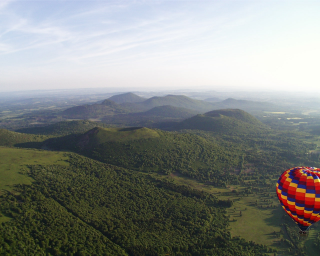
© F. THURION Original uploader was Accrochoc at fr.wikipedia, CC BY-SA 3.0 Resized from original. (This derivative is under the same CC BY-SA license.)
World Heritage Research
Discover scientific research and academic studies that deepen our understanding of Chaîne des Puys - Limagne fault tectonic arena from its history and significance to its conservation, management, and contemporary challenges.
-
La fréquentation touristique et ses effets économiques : des enjeux pour des politiques de gestion et de valorisation de sites naturels patrimoniaux
Tourist spending at the UNESCO-listed Chaîne des Puys - Limagne fault tectonic arena significantly outweighs that of excursionists, with accommodation costs dominating overall expenditures. While tourists contribute 74% to paid activities, excursionists still represent a substantial 26%, offering a more evenly distributed economic resource throughout the year. The study introduces an analytic framework to quantify and qualify tourist frequentation, visitor expenses, and local economic impacts, addressing methodological challenges in monitoring open, extended sites. By combining diverse data sources with face-to-face surveys, researchers reveal insights into visitor motivations, practices, and the broader tourism system linked to the site, providing critical guidance for sustainable management and valorization policies.
Marsat, J.-B., Boris Djongon, K., Veslot, J., & Polge, É. (2025). La fréquentation touristique et ses effets économiques : des enjeux pour des politiques de gestion et de valorisation de sites naturels patrimoniaux. Revue d’Économie Régionale & Urbaine, Décembre(5), 717–742. https://doi.org/10.3917/reru.245.0717
View Publication Record | Read Publication -
The UNESCO World Heritage Site of the Chaîne des Puys–Limagne Fault Tectonic Arena (Auvergne, France)
The Chaîne des Puys–Limagne fault tectonic arena, inscribed as a UNESCO World Heritage Site in 2018, serves as a natural scale model illustrating continental rift processes. This site uniquely combines the Limagne fault (a graben border), the granitic Plateau des Dômes with its Quaternary volcanic alignment (Chaîne des Puys), and an inverted relief from Pliocene lava flow erosion (Montagne de la Serre). The study highlights how these structural and volcanic features, when viewed globally, provide a tangible understanding of deep tectonic dynamics. As an inhabited environment supporting 30,000 residents with traditional agroforestry practices, the site now faces the challenge of balancing conservation, sustainable development, and international recognition post-inscription.
Merle, O., Boivin, P., Langlois, E., de Larouzière, F.-D., Michelin, Y., & Olive, C. (2023). The UNESCO World Heritage Site of the Chaîne des Puys–Limagne Fault Tectonic Arena (Auvergne, France). Geosciences, 13(7), 198. https://doi.org/10.3390/geosciences13070198
View Publication Record | Read Publication -
Lake Chauvet Maar in the Chaîne des Puys Volcano Group, Central France
The Chaîne des Puys - Limagne fault tectonic arena, located in central France, features the Lake Chauvet Maar, a volcanic crater formed approximately 10,000 years ago during the end of the last glacial period. This maar, with a diameter of 600 meters and a depth of 73 meters, is part of a larger group of about 100 scoria cones, maars, and lava domes that stretch along the western edge of the Limagne graben, a rift valley formed by the Alpine orogeny starting in the late Mesozoic era. The study highlights the geological significance of this region, which has experienced volcanic activity extending into the Quaternary period, with the most recent eruption dated to around 7,000 years ago at Lake Pavin Maar, located nearby.
(Ed.). (2022). Lake Chauvet Maar in the Chaîne des Puys Volcano Group, Central France. Journal of Geography (Chigaku Zasshi), 131(5), Cover05. https://doi.org/10.5026/jgeography.131.cover05_01
View Publication Record | Read Publication -
Robust Bayesian Joint Inversion of Gravimetric and Muographic Data for the Density Imaging of the Puy de Dôme Volcano (France)
Scientists have successfully created the most precise 3D density image of the Puy de Dôme volcano, revealing it to be dry and permeable with a dense trachytic core. This groundbreaking achievement was accomplished by jointly inverting gravimetric and muographic data using a robust Bayesian method, which automatically adjusts for data-specific artifacts and potential density offsets. The approach overcomes limitations of traditional methods, such as the non-uniqueness of solutions in gravimetry and the geometric constraints of muography. By combining these techniques, researchers have gained deeper insights into the volcano's internal structure, improving our understanding of magma pathways and structural weaknesses.
Barnoud, A., Cayol, V., Lelièvre, P. G., Portal, A., Labazuy, P., Boivin, P., & Gailler, L. (2021). Robust Bayesian Joint Inversion of Gravimetric and Muographic Data for the Density Imaging of the Puy de Dôme Volcano (France). Frontiers in Earth Science, 8. https://doi.org/10.3389/feart.2020.575842
View Publication Record | Read Publication -
Development of a New Type of Geodiversity System for the Scoria Cones of the Chaîne des Puys Based on Geomorphometric Studies
A new geodiversity system for scoria cones, developed through geomorphometric studies of the Chaîne des Puys UNESCO World Heritage site, addresses a critical limitation in existing methods. Traditional geodiversity indices often underestimate the aesthetic and scientific value of symmetrical volcanic features like scoria cones due to their regular shapes. The proposed approach modifies these indices by adapting them to cone geometry, enhancing the representation of uniformity and symmetry in larger landscape elements. This method is computationally simple yet effective, applicable to thousands of monogenetic volcanoes globally and extendable to other volcanic features such as domes or even larger volcanoes. It bridges the gap between scientific quantification and aesthetic appreciation, offering a robust tool for analyzing geodiversity in volcanic landscapes.
Vörös, F., Pál, M., van Wyk de Vries, B., & Székely, B. (2021). Development of a New Type of Geodiversity System for the Scoria Cones of the Chaîne des Puys Based on Geomorphometric Studies. Geosciences, 11(2), 58. https://doi.org/10.3390/geosciences11020058
View Publication Record | Read Publication -
DTM-Based Morphometric Analysis of Scoria Cones of the Chaîne des Puys (France)—The Classic and a New Approach
A novel sectorial approach to analyzing scoria cones in the Chaîne des Puys (France) reveals that most cones exhibit asymmetry and elongation, with lithology influencing shape more than age. This DTM-based morphometric study contrasts classic descriptors with detailed slope distributions, uncovering systematic trends in cone symmetry and morphology. While regression models show partial success in linking parameters to age, further research is needed to fully understand the relationship between lithology, shape, and symmetry.
Vörös, F., van Wyk de Vries, B., Karátson, D., & Székely, B. (2021). DTM-Based Morphometric Analysis of Scoria Cones of the Chaîne des Puys (France)—The Classic and a New Approach. Remote Sensing, 13(10), 1983. https://doi.org/10.3390/rs13101983
View Publication Record | Read Publication -
L’usage des trachytes de la chaîne des Puys depuis deux millénaires / The use of trachytic lava in the chaîne des Puys for two millennia
A groundbreaking study reveals that trachytic lavas from the Chaîne des Puys volcanoes exhibit unique petrographic identities, enabling precise sourcing of archaeological materials. The research, part of a collective project, identified distinct lava types for most volcanoes, with exceptions like Cliersou and Aumône sharing the same composition. Notably, the Puy de Dôme and Cratère Kilian each consist of two different lavas. This fine characterization allows archaeologists to trace trachyte materials used in ancient buildings, tombs, and sculptures—such as those from the Temple of Mercury and the Tourette d'Enval sanctuary—to their original volcanic sources. The study also uncovered extensive quarrying activities during antiquity and the High Middle Ages, including previously unknown underground exploitations. Additionally, it highlights the use of trachytes in Romanesque architecture and modern civil construction, offering new insights into ancient economic circuits and craft practices.
Boivin, P., Dousteyssier, B., Miallier, D., Arbaret, L., Gaime, S., Hénault, D., Martin, G., & Roger, J. (2021). L’usage des trachytes de la chaîne des Puys depuis deux millénaires / The use of trachytic lava in the chaîne des Puys for two millennia. Revue Des Sciences Naturelles d’Auvergne, 85(1), 45–77. https://doi.org/10.3406/rsna.2021.3524
View Publication Record | Read Publication
