World Heritage Identification Number: 726
World Heritage since: 1995
Category: Cultural Heritage
WHE Type: Historic Cities & Urban Areas
Transboundary Heritage: No
Endangered Heritage: No
Country: 🇮🇹 Italy
Continent: Europe
UNESCO World Region: Europe and North America
Map
The Historic Centre of Naples: A Cultural Mosaic Spanning Millennia
The Historic Centre of Naples, located in the southern Italian region of Campania, stands as a testament to the rich cultural heritage that has unfolded across the Mediterranean basin over millennia. Inscribed as a UNESCO World Heritage Site in 1995, this ancient urban landscape offers a captivating glimpse into the myriad civilizations that have left their indelible mark upon its streets, squares, and architectural marvels.
The origins of Naples can be traced back to the establishment of Neapolis by Greek settlers around 470 BC. The city's name, derived from the Greek word for 'new town,' reflects the fresh chapter in human history that was being written at this time. Over the centuries, the city would undergo numerous transformations, each contributing to its distinctive character and vibrant tapestry of culture.
One of the most striking examples of Naples' historical evolution can be found in the Church of Santa Chiara, a Gothic-style edifice that dates back to the 14th century. Commissioned by King Robert of Anjou (Robert the Wise) and his wife Queen Sancia of Mallorca, the church serves as a poignant reminder of the city's connections to the Kingdom of Sicily during the Middle Ages.
Its intricate façade, adorned with delicate sculptures and frescoes, provides a visual feast for visitors seeking to immerse themselves in the artistic splendor of the era. The church's most famous attraction is the Majolica Cloister, which features 18th-century hand-painted ceramic tiles. The Church of Santa Chiara church underwent significant restoration after it was damaged during World War II, which has helped preserve its beauty for future generations.
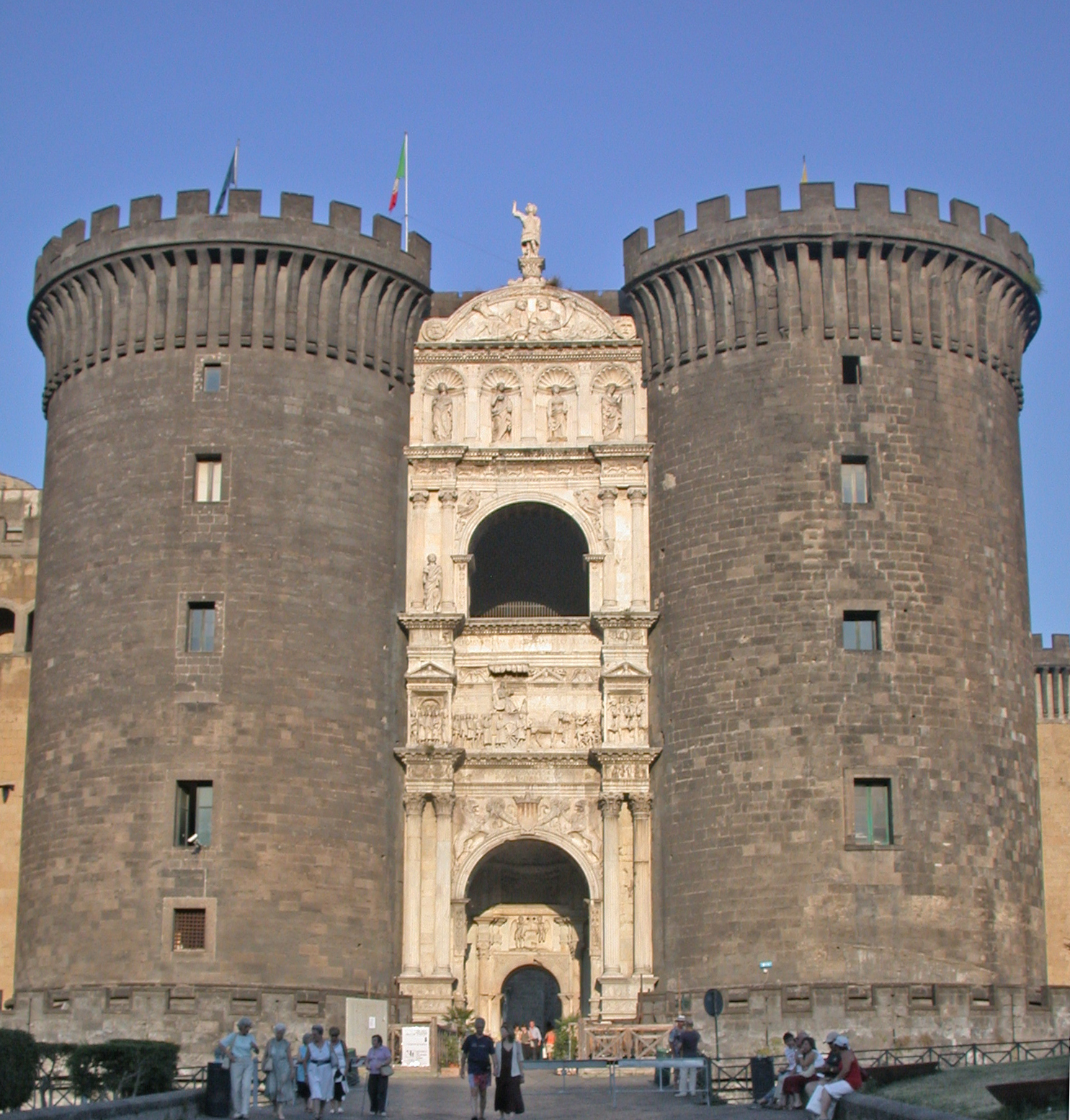
Another iconic landmark within the Historic Centre of Naples is the Castel Nuovo, or New Castle. Constructed between 1279 and 1282, this imposing fortress was built by Charles I of Anjou as a symbol of his power and authority. Throughout its history, the castle has served various functions, including a royal residence, a prison, and even a military academy. Today, it stands as a monument to the city's tumultuous past and the many rulers who have sought to claim Naples as their own.
Beyond these notable sites, the Historic Centre of Naples is home to countless other treasures waiting to be discovered. Wandering through the labyrinthine streets, one might stumble upon hidden courtyards, bustling markets, and charming cafés where locals gather to share stories and savor the flavors of traditional Neapolitan cuisine. The area's rich history is palpable, weaving itself into the very fabric of daily life and imbuing every corner with a sense of timelessness and wonder.
To conclude, the Historic Centre of Naples represents more than just a collection of ancient buildings and artifacts; it is a living embodiment of the human spirit, a testament to our capacity for creativity, resilience, and adaptation. As of late 2025, the historic center remains one of the largest in Europe.
By preserving and celebrating this extraordinary urban landscape, we pay tribute not only to the people who have shaped its history, but also to the enduring power of culture to unite us across generations and continents. As we continue to learn from the lessons of the past, may the Historic Centre of Naples serve as a reminder of the boundless potential that lies within us all.
UNESCO Description of the World Heritage Site
From the Neapolis founded by Greek settlers in 470 B.C. to the city of today, Naples has retained the imprint of the successive cultures that emerged in Europe and the Mediterranean basin. This makes it a unique site, with a wealth of outstanding monuments such as the Church of Santa Chiara and the Castel Nuovo.
UNESCO Justification of the World Heritage Site
Criterion (ii): The city’s setting on the Bay of Naples gives it an Outstanding Universal Value which has had a profound influence in many parts of Europe and beyond. Naples has exerted great influence on the rest of Europe ever since the antiquity, as a major centre in Magna Graecia and of the Roman Republic. Its role as one of the most influential cultural centres in the Mediterranean region was reconfirmed in the Middle Ages and again from the 16th to 18th centuries, being one of the major European capitals, and exerting important influences in many cultural fields, especially related to art and architecture.
Criterion (iv): Naples is one of the most ancient cities in Europe, whose contemporary urban fabric preserves the elements of its long and eventful history. The rectangular grid layout of the ancient Greek foundation of Neapolis is still discernible and has indeed continued to provide the basic form for the present-day urban fabric of the Historic Centre of Naples, one of the foremost Mediterranean port cities. From the Middle Ages to the 18th century, Naples was a focal point in terms of art and architecture, expressed in its ancient forts, the royal ensembles such as the Royal Palace of 1600, and the palaces and churches sponsored by the noble families.
Encyclopedia Record: Historic Centre of Naples
The historic center of Naples, Italy, is the oldest part of the city, with a history that spans over 2,700 years.Additional Site Details
Area: 1,021 hectares
Number of Components: 4
(iv) — Outstanding example of a type of building or landscape
Coordinates: 40.85138889 , 14.26277778
World Heritage Research
Discover scientific research and academic studies that deepen our understanding of Historic Centre of Naples from its history and significance to its conservation, management, and contemporary challenges.
-
Urban poverty and informality in Southern Europe: a view from Naples
Naples' urban poverty, characterized by high informality and close social proximity, reveals a distinct southern European model of social regulation. Unlike anomalies of modernity, the city's 'porous' structures both empower disadvantaged groups and entrench inequalities, reflecting broader regional dynamics. The study examines how global forces like migration and tourism reshape Naples' historic center, offering insights into the interplay between local poverty and urban transformation in Southern Europe.
Laino, G., & Trifuoggi, M. (2026). Urban poverty and informality in Southern Europe: a view from Naples. A Modern Guide to Urban Poverty, 123–135. https://doi.org/10.4337/9781800889699.00014
View Publication Record | Read Publication -
Greening Heritage: Sustainable Interventions in the Historic Center of Naples
Sustainable green interventions can enhance environmental resilience and community well-being in densely built historic centers without compromising cultural heritage. A study on the UNESCO-listed Historic Centre of Naples demonstrates that temporary landscape designs improve social life while preserving architectural integrity, offering a replicable model for other urban areas facing similar challenges. The research employed a multi-methodological approach to assess spatial and environmental features, identifying short-term actions that balance sustainability with historical preservation.
Abdou, A. H. El. S. A. (2025). Greening Heritage: Sustainable Interventions in the Historic Center of Naples. Proceedings of the International Conference of Contemporary Affairs in Architecture and Urbanism-ICCAUA, 8(1), 1643–1658. https://doi.org/10.38027/iccaua2025en0541
View Publication Record | Read Publication -
Il Writing in (Pseudo)Francese nel Centro Storico di Napoli
A notable density of (pseudo-)French graffiti tags, primarily found in Naples' historic center and Piazza Garibaldi, suggests the influence of youth, artistic, and translocal circuits rather than resident francophone communities. These tags, characterized by their hybrid or creative orthography, contribute to the urban linguistic landscape by embedding French elements visually, enriching the city's multilingualism, and fostering translocal circulation of graphic and linguistic repertoires. The study analyzed a non-systematic corpus from 2018–2025, integrating linguistic, grapho-stylistic, and spatial analyses to explore how these tags function as semiotic-material practices, offering new symbolic valences to urban spaces.
Puolato, D. (2025). IL WRITING IN (PSEUDO)FRANCESE NEL CENTRO STORICO DI NAPOLI. Italiano LinguaDue, 17(2), 1025–1057. https://doi.org/10.54103/2037-3597/30474
View Publication Record | Read Publication -
Cultural Heritage as a Relational Device: Comparing Institutional and Collaborative Models
Collaborative governance models in cultural heritage management can act as catalysts for social innovation, fostering inclusive forms of cultural citizenship and urban resilience. A comparative analysis of four Italian sites—including the Historic Centre of Naples—reveals that traditional institutional frameworks often lead to social exclusion and touristification, whereas participatory approaches promote mutualistic economies and shared responsibility. This study underscores the potential of co-managed heritage to transcend the protection-participation dichotomy, integrating conservation with social inclusion and cultural creativity. The research draws on documentary sources, institutional reports, and scientific literature to highlight adaptive, context-sensitive governance as a driver for sustainable urban regeneration.
Fatigati, L. (2025). Cultural Heritage as a Relational Device: Comparing Institutional and Collaborative Models. UPLanD - Journal of Urban Planning, Landscape & Environmental Design, 9(2), 37–54. https://doi.org/10.6093/2531-9906/12801
View Publication Record | Read Publication -
Reducing UHI in historical centres: the greening transformation of open small spaces in San Lorenzo district in the city of Naples (Italy)
Targeted greening interventions in small, open spaces within historical city centers can significantly mitigate Urban Heat Island (UHI) effects and improve thermal comfort. A study focusing on the San Lorenzo district of Naples demonstrates that restoring inner courtyards—originally designed as gardens or orange groves—to their green function enhances cooling potential in dense, heritage-constrained urban fabrics. Using ENVI-met 5.7 simulations, researchers modeled microclimatic conditions under current and greened scenarios, incorporating detailed urban morphology, vegetation types, and local climate data. The findings highlight the physiological benefits of such interventions, as measured by indices like Physiological Equivalent Temperature (PET) and Mean Radiant Temperature (MRT), offering a sustainable approach to urban planning that addresses thermal discomfort and energy consumption in Mediterranean historical centers.
Gargiulo, C., Stiuso, T., & Zucaro, F. (2025). Reducing UHI in historical centres: the greening transformation of open small spaces in San Lorenzo district in the city of Naples (Italy). TeMA - Journal of Land Use, Mobility and Environment, 2, 67–87. https://doi.org/10.6093/1970-9870/12416
View Publication Record | Read Publication -
Rebel Walls
Graffiti writing in Naples serves as a powerful visual form of protest, addressing pressing social issues such as the right to housing amid gentrification pressures. The study reveals how this practice transforms urban walls into spaces of resistance and sociocultural affirmation, creating a bottom-up urban discourse that challenges traditional narratives. By analyzing graffiti's role in expressing identity and critiquing transformational pressures, the research demonstrates its potential as an alternative tool for communication and struggle. The findings highlight graffiti's significance in preserving Naples' cultural identity while making visible conflicts often ignored by regulatory frameworks.
Russo, Y., & Coppola, A. (2025). Rebel Walls. GSA - Graffiti and Street Art, 3(1), 126–127. https://doi.org/10.48619/GSA.V3I1.A1132
View Publication Record | Read Publication -
The Agency of Socially Mixed Neighbourhoods Insights from the Historic Centre of Naples
Socially mixed neighbourhoods, shaped by diverse housing situations and economic activities, play a crucial role in defining the identity of urban spaces, particularly in historic centres like Naples. This study highlights the 'agency of place'—how spatial relationships and social heterogeneity influence neighbourhood dynamics—and underscores its importance for inclusive urban policies. Through an analysis of the Condominio Sociale di via S. Nicola a Nilo, a city council initiative aimed at fostering social inclusion, the research demonstrates that the coexistence of various social groups, networks, and spatial configurations is fundamental to the concept of neighbourhood in Naples. Unlike formal administrative definitions, these informal yet dynamic interactions reveal how social difference actively shapes urban life, offering insights for more equitable urban planning.
Mattiucci, C. (2024). The Agency of Socially Mixed Neighbourhoods Insights from the Historic Centre of Naples. Built Environment, 50(1), 42–53. https://doi.org/10.2148/benv.50.1.42
View Publication Record | Read Publication