World Heritage Identification Number: 784
World Heritage since: 1996
Category: Cultural Heritage
WHE Type: Historic Cities & Urban Areas
Transboundary Heritage: No
Endangered Heritage: No
Country: 🇦🇹 Austria
Continent: Europe
UNESCO World Region: Europe and North America
Map
The Historic Centre of the City of Salzburg: A Blend of Medieval and Baroque Architecture
The Historic Centre of the City of Salzburg, officially recognized as a UNESCO World Heritage Site in 1996, brings together a remarkably intact medieval and Baroque cityscape shaped by centuries of religious, political, and artistic influence. Situated on both banks of the Salzach River, this vibrant district stands as one of Europe's best-preserved urban landscapes.
While the origins of Salzburg date back to the Roman era, the city truly flourished during the Middle Ages under the rule of prince-archbishops. The historic center preserves an extraordinary urban fabric that evolved over centuries of ecclesiastical rule. Notable examples include Hohensalzburg Fortress, one of the largest and best-preserved medieval fortresses in Central Europe, and Residenzplatz, which is surrounded by some of the city's most important historic buildings, including the Salzburg Residenz.
Nestled against a dramatic backdrop of hills and mountains—including the Mönchsberg, Festungsberg, and Kapuzinerberg—Salzburg's urban landscape is closely connected to its natural setting. For centuries, the city functioned as an independent ecclesiastical state ruled by powerful prince-archbishops who wielded considerable wealth and political influence. They invested heavily in monumental architecture, transforming Salzburg into an important center of the Counter-Reformation and shaping a compact urban core within the river valley.
In addition to its medieval heritage, Salzburg's distinctive Baroque appearance owes much to Italian architectural influence, particularly the work of Vincenzo Scamozzi and Santino Solari. Scamozzi was invited to Salzburg around 1600 by Prince-Archbishop Wolf Dietrich von Raitenau and developed plans for the transformation of the city. Solari later became chief architect and played a major role in shaping Salzburg's Baroque character, most notably through the construction of Salzburg Cathedral. Later architects, including Johann Bernhard Fischer von Erlach, further enriched the city with buildings such as the Kollegienkirche.
Beyond the fortress and the cathedral, the historic center is home to several other architectural treasures. On the left bank of the Salzach lies St. Peter's Abbey, traditionally dated to 696, which anchors the city's long monastic tradition. Across the river, the magnificent Mirabell Palace and its geometrically designed gardens offer a striking example of Baroque architecture and landscape design. Together with the city's other historic landmarks, these buildings demonstrate how Salzburg's architecture developed in close relationship with its dramatic natural setting.
No figure is more closely associated with Salzburg's cultural identity than Wolfgang Amadeus Mozart, one of the most influential composers in Western music. Born in Salzburg in 1756, Mozart spent his childhood and youth in the city, where he received his early musical education. His connection with Salzburg forms an important part of the city's cultural identity and is also reflected in UNESCO's recognition of the historic center's significance as a meeting point between northern and southern European cultural traditions.
Visitors can explore several places closely associated with Mozart, most notably his birthplace in Getreidegasse and the Mozart Residence on Makartplatz, where the Mozart family lived from 1773. Mozartplatz, with its monument to the composer, is another prominent reminder of his enduring presence in the city's cultural landscape. Together, these sites help preserve the memory of the composer and his connection to Salzburg.
Music remains central to Salzburg's cultural life. The city hosts the annual Salzburg Festival, one of the world's leading festivals of opera, classical music, and drama. Founded in 1920, the festival has become an important part of Salzburg's international cultural reputation and reinforces the city's longstanding association with music and the performing arts.
The Historic Centre of the City of Salzburg offers a captivating glimpse into the city's past, showcasing a distinctive blend of medieval and Baroque architecture. From the imposing Hohensalzburg Fortress to the elegant Residenzplatz, and from the city's historic churches to the sites connected with Mozart, the center invites exploration and discovery. Its urban fabric reflects the meeting of northern and southern European cultural traditions that helped shape Salzburg over the centuries.
As a UNESCO World Heritage Site, the Historic Centre of the City of Salzburg represents an exceptionally well-preserved historic urban landscape. Its architecture, public spaces, churches, and cultural traditions provide a vivid record of the city's development and its enduring role as a meeting point between northern and southern Europe.
UNESCO Description of the World Heritage Site
Salzburg has managed to preserve an extraordinarily rich urban fabric, developed over the period from the Middle Ages to the 19th century when it was a city-state ruled by a prince-archbishop. Its Flamboyant Gothic art attracted many craftsmen and artists before the city became even better known through the work of the Italian architects Vincenzo Scamozzi and Santini Solari, to whom the centre of Salzburg owes much of its Baroque appearance. This meeting-point of northern and southern Europe perhaps sparked the genius of Salzburg’s most famous son, Wolfgang Amadeus Mozart, whose name has been associated with the city ever since.
UNESCO Justification of the World Heritage Site
Criterion (ii): Salzburg played a crucial role in the interchange between Italian and German cultures, resulting in a flowering of the two cultures and a long-lasting exchange between them.
Criterion (iv): Salzburg is an exceptionally important example of a European ecclesiastical city-state, with a remarkable number of high-quality buildings, both secular and ecclesiastical, from periods ranging from the late Middle Ages to the 20th century.
Criterion (vi): Salzburg is noteworthy for its associations with the arts, and in particular with music, in the person of its famous son, Wolfgang Amadeus Mozart.
Encyclopedia Record: Historic Centre of the City of Salzburg
The Historic Centre of the City of Salzburg, also known as the Altstadt, is a district of Salzburg, Austria, recognized as UNESCO World Heritage Site since 1996. It corresponds with the historic city center, situated on the left and right banks of the Salzach river.Additional Site Details
Area: 236 hectares
Number of Components: 1
(iv) — Outstanding example of a type of building or landscape
(vi) — Directly associated with events or living traditions
Coordinates: 47.80055556 , 13.04333333
Image
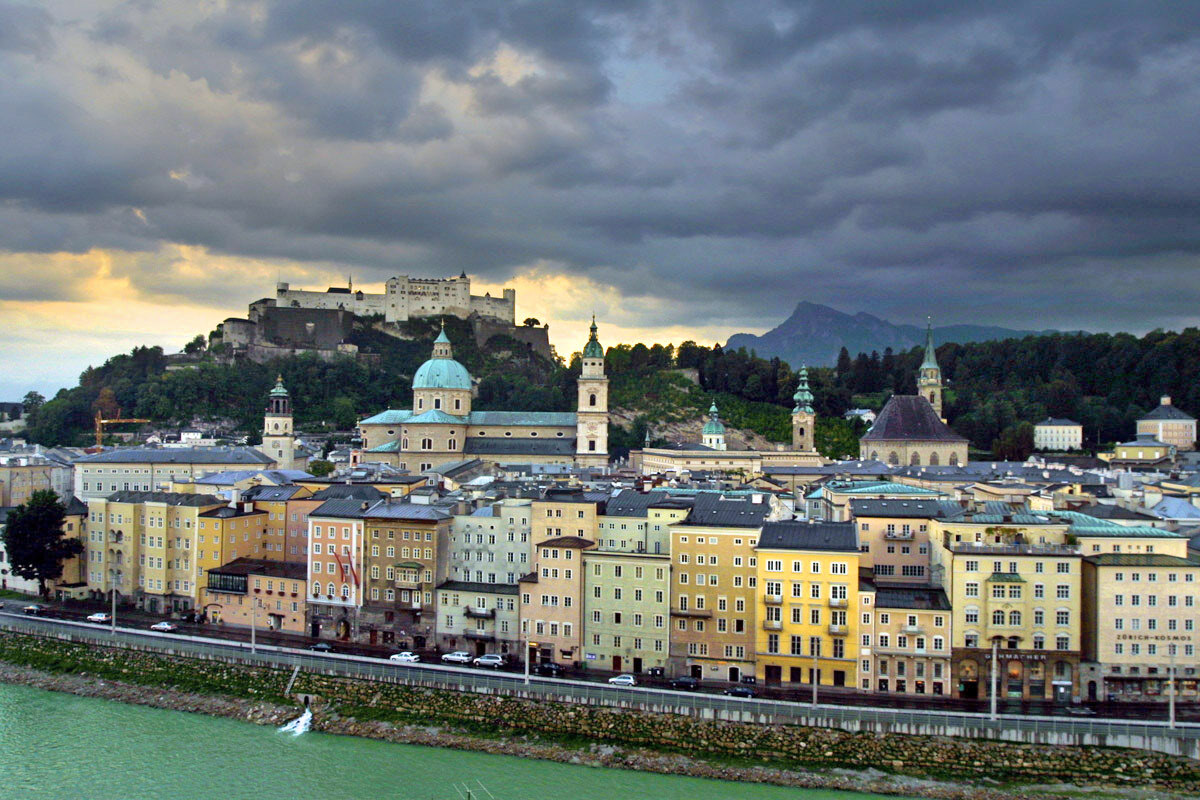
© Thomas Pintaric (= Pintaric), CC BY-SA 3.0 Resized from original. (This derivative is under the same CC BY-SA license.)
World Heritage Research
Discover scientific research and academic studies that deepen our understanding of Historic Centre of the City of Salzburg from its history and significance to its conservation, management, and contemporary challenges.
-
S-LINK – future oriented inner-city transport project of the climate and energy transition
Salzburg's historic city center faces chronic traffic congestion that hinders mobility and sustainability. The proposed S-LINK project aims to address this by extending the local railway network underground through the city, offering a seamless connection to existing public transport. This innovative approach must navigate unique challenges posed by Salzburg's mountainous terrain, the Salzach River, and its densely built-up, heritage-rich old town. The project is subject to rigorous environmental impact assessments (EIA) due to its significant cultural and architectural implications, requiring compliance with multiple regulatory frameworks including railway law, water law, nature conservation, and monument protection. The first section of the S-LINK, spanning 843 meters from Salzburg's main train station to Mirabellplatz, includes a 628-meter double-track tunnel and a new station, all built on challenging ground conditions characterized by thick gravel layers over fine-sand and silt sediments with high water content. The study emphasizes the technical and logistical complexities of integrating modern railway infrastructure within a historic urban landscape while mitigating impacts on noise, vibration, groundwater, and air quality for residents.
Jedlitschka, G., Lauffer-Neumann, D., Eder, M., Kohlböck, B., Eybl, D., Greinmeister, A., & Kastner, P. (2025). S-LINK – future oriented inner-city transport project of the climate and energy transition. Tunnelling into a Sustainable Future – Methods and Technologies, 821–829. https://doi.org/10.1201/9781003559047-106
View Publication Record | Read Publication -
Bird community responses to urbanization and vegetation parameters across the city of Salzburg, Austria
Urbanization poses significant threats to biodiversity, yet cities can still foster avian diversity through strategic planning of green spaces. A study in Salzburg, Austria, reveals that bird species richness increases with grass cover and the presence of native trees, even in highly urbanized areas. While exotic tree species dominate overall, native trees prevail in areas with abundant vegetation. Building density negatively impacts bird diversity at all scales, but local-scale factors like unsealed soil (grass) and native trees play a crucial role in supporting bird communities. The research highlights that different bird species respond uniquely to habitat parameters, suggesting tailored urban configurations can promote biodiversity even within dense urban matrices.
Apfelbeck, B. A., Navalpotro Buscail, M., Sommer, A., & Petermann, J. S. (2025). Bird community responses to urbanization and vegetation parameters across the city of Salzburg, Austria. Urban Ecosystems, 28(4). https://doi.org/10.1007/s11252-025-01738-y
View Publication Record | Read Publication -
Assessing the association between overcrowding and human physiological stress response in different urban contexts: a case study in Salzburg, Austria
A novel approach using wearable sensors reveals that overcrowding in urban environments significantly impacts human physiological stress responses, varying notably across different contexts such as green spaces, transit areas, commercial zones, and blue spaces. The study, conducted in Salzburg's historic center, employed a combination of first-person video data (analyzed via Mask R-CNN), GPS tracking, and biometric measurements from an Empatica E4 wristband to quantify stress levels through galvanic skin response (GSR) and skin temperature changes. Findings highlight the critical role of urban elements like human crowds, sitting facilities, vehicles, and bikes in modulating stress at street level, underscoring the potential of sensor-based methods for future urban planning and mental health research.
Zhang, Z., Měchurová, K., Resch, B., Amegbor, P., & Sabel, C. E. (2023). Assessing the association between overcrowding and human physiological stress response in different urban contexts: a case study in Salzburg, Austria. International Journal of Health Geographics, 22(1). https://doi.org/10.1186/s12942-023-00334-7
View Publication Record | Read Publication -
Touristification, rent gap and the local political economy of Airbnb in Salzburg (Austria)
Salzburg, one of Europe's most touristified cities, experiences accelerated processes of touristification and gentrification due to the proliferation of short-term rentals (STRs) like Airbnb. This study reveals that a new platform real estate market has emerged, dominated by local commercial providers, which fuels a 'short-term rent gap'—a disparity between long-term housing demand and supply due to STR dominance. The research demonstrates how STR extraction motives and actor relations reshape the housing market, pushing out long-term residents while attracting short-term users and capital. Using fine-grained fieldwork, the study also critiques recent policy measures attempting to regulate STRs, highlighting their limitations in addressing deeper economic tensions. The findings underscore the need for more robust interventions to mitigate the negative impacts of STR on urban housing affordability and community stability.
Smigiel, C. (2023). Touristification, rent gap and the local political economy of Airbnb in Salzburg (Austria). Urban Geography, 45(4), 713–733. https://doi.org/10.1080/02723638.2023.2233352
View Publication Record | Read Publication -
Improvement of foundation soil behavior for Gründerzeit buildings in Austria using polyurethane resin injections
Polyurethane resin injections prove to be an effective method for enhancing foundation soil behavior, crucial for preserving and renovating Gründerzeit buildings—a defining architectural style from Austria's 19th-century industrial and cultural boom. This study demonstrates how the treatment stabilizes soil beneath these historic masonry structures, mitigating risks posed by increased loads due to modern renovations. The approach was tested on a case study in Salzburg, showcasing its practical application for safeguarding UNESCO-listed heritage sites while addressing contemporary real estate demands.
Dominijanni, A., Gabassi, M., Kopf, F. F., Minardi, A., & Pasquetto, A. (2022). Improvement of foundation soil behavior for Gründerzeit buildings in Austria using polyurethane resin injections. Geotechnical Engineering for the Preservation of Monuments and Historic Sites III, 964–976. https://doi.org/10.1201/9781003308867-75
View Publication Record | Read Publication -
Building stock characteristics of residential buildings in Salzburg, Austria based on a structured analysis of energy performance certificates
A significant portion of residential buildings in Salzburg, Austria, still relies on fossil fuels such as oil and gas for heating, despite the growing adoption of heat pumps (65% for new single-family houses) and district heating (46% for new multi-family houses). The analysis of energy performance certificates reveals high potential for improving thermal performance across all construction periods, building types, and conditions—retrofitted buildings show median U-values for ceilings/roofs ranging from 0.17 to 0.26 W/(m²K), compared to 0.14 W/(m²K) for the most recent non-retrofitted structures. This study highlights the need for standardized data notation in energy performance databases to avoid information loss and enable international comparability, providing a robust foundation for future urban building energy modeling and policy improvements.
Heidenthaler, D., Leeb, M., Reindl, P., Kranzl, L., Bednar, T., & Moltinger, M. (2022). Building stock characteristics of residential buildings in Salzburg, Austria based on a structured analysis of energy performance certificates. Energy and Buildings, 273, 112401. https://doi.org/10.1016/j.enbuild.2022.112401
View Publication Record | Read Publication -
The temporality of commodified landscapes at events & local constructions of identity in Salzburg
Temporary, event-specific semiotic landscapes in Salzburg contribute significantly to local identity construction through commodified practices. The study finds that linguistic features such as blackletter historicizing and Austro-Bavarian dialect localization index local pride while being leveraged for economic gain during events like the Ruperti fair and Christmas market. These signs exhibit temporary or volatile indexicality, creating distinct semiotic registers tied to specific occasions. A multimodal qualitative analysis reveals how these practices enhance temporary local authentication, offering insights into the temporality of signs in event spaces.
Niehaus, K. (2022). The temporality of commodified landscapes at events & local constructions of identity in Salzburg. Linguistic Landscape, 9(4), 357–386. Portico. https://doi.org/10.1075/ll.22008.nie
View Publication Record | Read Publication