World Heritage Identification Number: 1155
World Heritage since: 2006
Category: Cultural Heritage
WHE Type: Historic Cities & Urban Areas
Transboundary Heritage: No
Endangered Heritage: No
Country: 🇩🇪 Germany
Continent: Europe
UNESCO World Region: Europe and North America
Map
The Old Town of Regensburg with Stadtamhof: A Medieval Gem on the Danube
The Old Town of Regensburg with Stadtamhof, located in the southeastern part of Bavaria, Germany, stands as a testament to the region's rich historical and architectural heritage. Inscribed as a UNESCO World Heritage Site in 2006, this medieval town boasts a remarkable collection of buildings spanning over two millennia, from ancient Roman structures to Gothic masterpieces.
More to come…UNESCO Description of the World Heritage Site
Located on the Danube River in Bavaria, this medieval town contains many buildings of exceptional quality that testify to its history as a trading centre and to its influence on the region from the 9th century. A notable number of historic structures span some two millennia and include ancient Roman, Romanesque and Gothic buildings. Regensburg’s 11th- to 13th-century architecture – including the market, city hall and cathedral – still defines the character of the town marked by tall buildings, dark and narrow lanes, and strong fortifications. The buildings include medieval patrician houses and towers, a large number of churches and monastic ensembles as well as the 12th-century Old Bridge. The town is also remarkable for the vestiges testifing to its rich history as one of the centres of the Holy Roman Empire that turned to Protestantism.
UNESCO Justification of the World Heritage Site
Criterion (ii): The architecture of Regensburg represents the city's role as a medieval trading centre and its influence in the region north of the Alps. Regensburg was an important transition point on continental trade routes to Italy, Bohemia, Russia and Byzantium. It also had multiple connections with the transcontinental Silk Roads. As such, the city exhibits an important interchange of cultural and architectural influences, which have shaped its urban landscape.
Criterion (iii): The Old Town of Regensburg bears an exceptional testimony to cultural traditions especially in the Holy Roman Empire, being the location for most of the assemblies of the Empire in the High Middle Ages. Regensburg also significantly contributed to more recent European history being the seat of the Perpetual Assembly from 1663 to 1806. As a testimony to these functions, there are the remains of two imperial Palatine palaces from the 9th century, and a large number of other well preserved historic buildings, which are testimony to the wealth and political importance of the community.
Criterion (iv): The Old Town of Regensburg with Stadtamhof is an outstanding example of a central-European medieval trading town, which has well preserved its historical stages of development, and which is an exceptional illustration to the development of commerce particularly from the 11th to 14th centuries.
Encyclopedia Record: Regensburg
Regensburg is a city in eastern Bavaria, at the confluence of the rivers Danube, Naab and Regen, Danube's northernmost point. It is the capital of the Upper Palatinate subregion of the state. With more than 150,000 inhabitants, Regensburg is the fourth-largest city in the State of Bavaria after Munich, Nuremberg and Augsburg and the eighth-largest of all cities on the river Danube. From its foundation as an imperial Roman river fort, the city has been the political, economic, and cultural centre of the surrounding region. Later, under the rule of the Holy Roman Empire, it housed the Perpetual Diet of Regensburg.Additional Site Details
Area: 182.8 hectares
Number of Components: 1
(iii) — Unique or exceptional testimony to a cultural tradition
(iv) — Outstanding example of a type of building or landscape
Coordinates: 49.02055556 , 12.09916667
Image
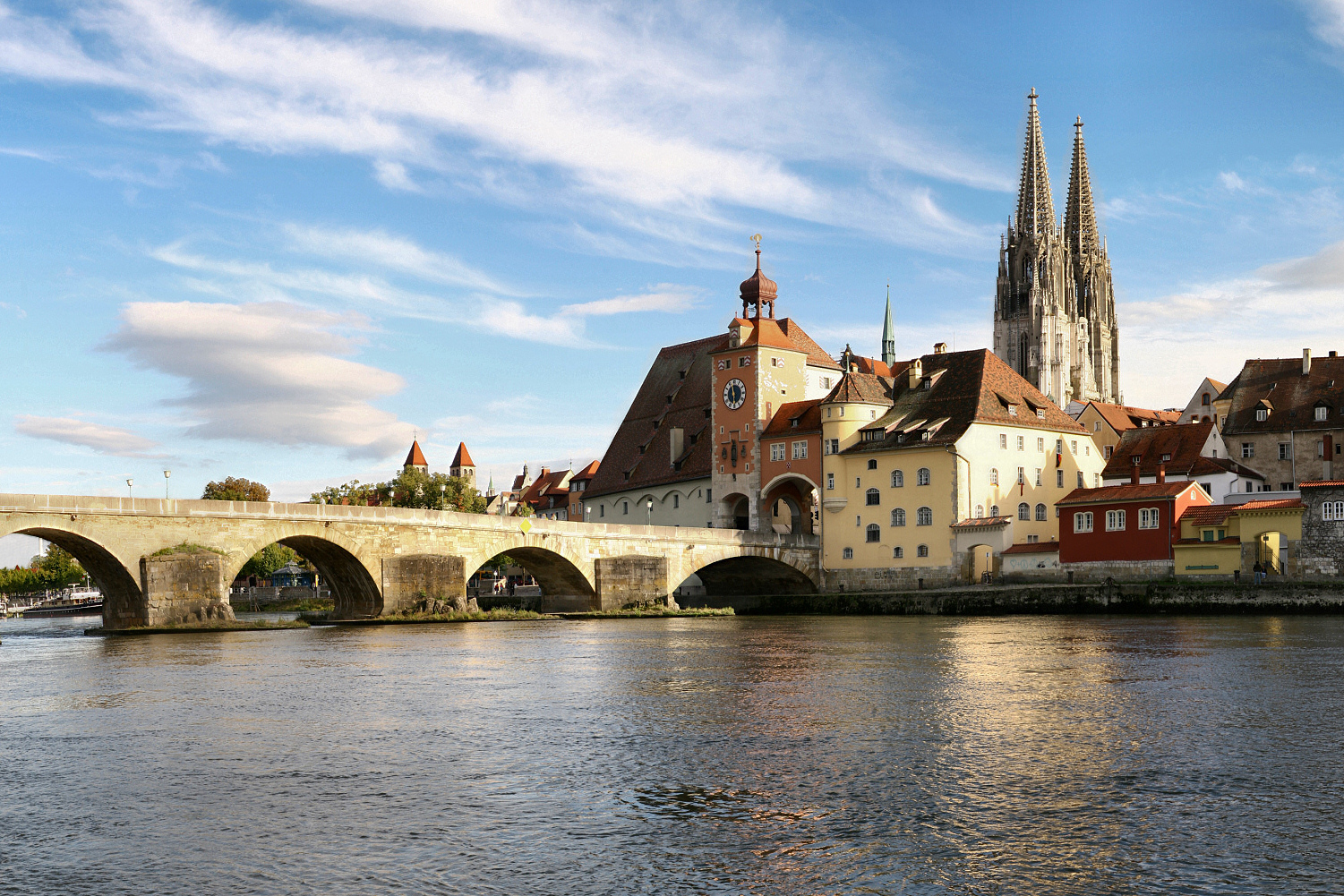
© No machine-readable author provided. Grizurgbg assumed (based on copyright claims)., CC BY-SA 3.0 Resized from original. (This derivative is under the same CC BY-SA license.)
World Heritage Research
Discover scientific research and academic studies that deepen our understanding of Old town of Regensburg with Stadtamhof from its history and significance to its conservation, management, and contemporary challenges.
-
Cultural Heritage in the face of climate change: Between preservation and adaptation. An exploratory case study on the integration of climate adaptation into UNESCO World Heritage Site "Old Town of Regensburg with Stadtamhof"
Climate adaptation within UNESCO World Heritage Sites (WHS) is feasible but fraught with challenges, particularly when balancing preservation needs with structural or visible modifications. A case study of Regensburg’s Old Town and Stadtamhof reveals that while measures like greening or depaving offer climate resilience benefits, they often clash with heritage conservation goals and aesthetic concerns about the historic townscape. Additional barriers include social resistance, institutional constraints, technical limitations, and financial resource shortages. However, the site’s inherent features—such as cool streets, robust historic structures, adaptive reuse potential, and historical knowledge—provide opportunities for climate adaptation. Successful integration requires systemic approaches, cross-sector collaboration, public acceptance, sufficient resources, and a more flexible interpretation of heritage conservation. The study underscores that effective climate adaptation in WHS demands more than technical solutions; it necessitates a holistic, cooperative, and adaptive framework to navigate complex trade-offs.
Brunkhorst, H. (2026). Cultural Heritage in the face of climate change: Between preservation and adaptation. An exploratory case study on the integration of climate adaptation into UNESCO World Heritage Site "Old Town of Regensburg with Stadtamhof" [Zenodo]. https://doi.org/10.5281/ZENODO.22813579
View Publication Record | Read Publication -
Patrimonialization and Cooperation
Regensburg's medieval Jewish community, though historically significant and internationally important, has left little visible trace in the UNESCO-listed Old Town. This study reveals how Jewish cultural heritage is currently presented in museums and the old town, highlighting the role of various actors—cultural, political, and scientific—in shaping its narrative. A key finding is the limited engagement of the present-day Jewish community in defining and preserving their heritage, despite efforts to foster participation through collaborative projects like a DFG-funded initiative. The research employs a mixed-methods approach, combining historical analysis with participatory strategies to explore opportunities and challenges in patrimonialization. The study underscores the need for inclusive approaches to ensure active community involvement in heritage preservation.
Haverkamp-Rott, E., Riedler-Pohlers, A., Weigand, S., & Weigand, S. (2025). 53Patrimonialization and Cooperation. Partizipation Damals Und Heute, 53–65. https://doi.org/10.1515/9783111494616-006
View Publication Record | Read Publication -
Study on the Design of Playable Urban Public Space
Diverse and continuous participation is the key to creating active, playful urban public spaces that cater to children and young people. This study examines Germany's 'master plan of play' as a systematic framework for integrating playful design into urban environments, using Regensburg's old town as a case study. The research analyzes the planning process, organizational structure, and strategies for developing playful public spaces, emphasizing the importance of sustained engagement from stakeholders, including children and youth. By exploring potential spaces and implementing participatory design approaches, the study provides insights that could inform child-friendly urban development in China and other regions.
(Ed.). (2022). Study on the Design of Playable Urban Public Space. Academic Journal of Humanities & Social Sciences, 5(8). https://doi.org/10.25236/ajhss.2022.050802
View Publication Record | Read Publication -
Das Besucherzentrum Welterbe Regensburg
A groundbreaking visitor center design for the UNESCO World Heritage Site, Old Town of Regensburg with Stadtamhof, successfully integrates advanced exhibition techniques to narrate the city's economic and social evolution. This collaborative effort between the Visitor Center and FH JOANNEUM University of Applied Sciences in Graz demonstrates how scenography can effectively communicate complex historical narratives. The center employs modern presentation methods, blending academic insights on visitor engagement with artistic photography by Elisa Wüntscher to create an immersive experience. Published as a best-practice case study, this initiative offers valuable lessons for heritage site interpretation and urban history education.
Stocker, K., & Ripp, M. (Eds.). (2022). Das Besucherzentrum Welterbe Regensburg. De Gruyter. https://doi.org/10.1515/9783035625905
View Publication Record | Read Publication -
Performative experiential learning strategies: reenacting the historical, enacting the everyday
A study demonstrates the pedagogical potential of two distinct performative strategies—reenactment and public art intervention—to foster dialogue about historical events and contemporary issues. The research found that reenacting a specific historical event, such as the 1941 massacre in Odessa, facilitated focused discussions on individual biographies, while a public performance using nuclear bunker beds in Regensburg's Old Town sparked diverse interpretations among passers-by, addressing themes like comfort, safety, and privacy. Both approaches reveal the challenges and rewards of engaging with strangers, offering new perspectives on the past and present through dialogue.
Duijzings, G., Lange, F., & Walther, E.-M. (2021). Performative experiential learning strategies: reenacting the historical, enacting the everyday. Engaging with Historical Traumas, 217–232. https://doi.org/10.4324/9781003046875-15-21
View Publication Record | Read Publication -
Regensburg Old Town
Regensburg's Old Town stands as a testament to its pivotal role as a medieval trading hub and political center, showcasing the cultural traditions of the Holy Roman Empire. The city's architecture, built primarily from Jurassic massive limestone and Regensburg Green Sandstone, reflects its significance in continental trade routes connecting Italy, Bohemia, Russia, and Byzantium. Additionally, Regensburg served as a key location for Imperial Assemblies during the High Middle Ages and hosted the Perpetual Imperial Diet from 1663 to 1806. The city's historical importance is further underscored by its status as the first Bavarian capital under the Agilolfinger dynasty in the 6th century and the establishment of the diocese in 739.
Poschlod, K. (2021). Regensburg Old Town. Natural Stone and World Heritage, 54–58. https://doi.org/10.1201/9780367823061-11
View Publication Record | Read Publication -
Strategies, policies and tools for an integrated World Heritage management approach
A novel integrated management approach for UNESCO World Heritage Sites has been successfully implemented in Regensburg, Germany. This model effectively addresses urban heritage challenges by combining theoretical and practical guidelines with local, regional, and national stakeholder engagement. The strategy offers adaptable tools and policies that can be tailored to other historic cities, depending on factors such as size, tourism intensity, ownership, and governance. While the approach is site-specific due to varying heritage values, its core principles provide a sustainable framework for integrating cultural heritage into urban development.
Ripp, M., Eidenschink, U., & Milz, C. (2011). Strategies, policies and tools for an integrated World Heritage management approach. Facilities, 29(7/8), 286–302. https://doi.org/10.1108/02632771111130906
View Publication Record | Read Publication