World Heritage Identification Number: 806
World Heritage since: 1997
Category: Cultural Heritage
WHE Type: Cultural Landscapes
Transboundary Heritage: No
Endangered Heritage: No
Country: 🇦🇹 Austria
Continent: Europe
UNESCO World Region: Europe and North America
Map
The Cultural Landscape of Hallstatt-Dachstein / Salzkammergut: A Millennia-Old Symbiosis of Nature and Civilization
The Hallstatt-Dachstein / Salzkammergut Cultural Landscape, inscribed as a UNESCO World Heritage Site in 1997, offers a unique glimpse into the intricate relationship between human civilization and its natural environment, spanning over 7,000 years. Located in the picturesque Salzkammergut region of Austria, this cultural landscape is characterized by its breathtaking natural beauty and the rich historical legacy it harbors.
The heart of this cultural landscape is the ancient town of Hallstatt, nestled between the tranquil waters of Hallstätter See and the imposing Dachstein massif. The town's origins can be traced back to the Neolithic period, around 5,000 years ago, with intensive salt production becoming a defining feature by the Bronze Age, around 3,000 years ago. Salt extraction became the primary economic activity for the inhabitants of Hallstatt, shaping their way of life and architecture for centuries to come.
A significant aspect of the area’s historical legacy is the Hallstatt culture, an important phase of the Iron Age (approximately 800 BCE to 500 BCE), named after the town where early excavations revealed a wealth of archaeological findings. The Hallstatt people were skilled metalworkers, particularly in iron, and their settlements were key centers for trade and cultural exchange. The cultural influence of the Hallstatt people spread widely, leaving a lasting impact on surrounding regions in Europe.
The prosperity derived from the salt industry is evident in the town's architectural heritage. The narrow, winding streets lined with colorful houses, many adorned with wooden balconies, bear testament to the wealth accumulated over the centuries. One of the most iconic structures in Hallstatt is the Parish Church, which dates back to the 12th century and features a distinctive Gothic tower topped with a Baroque hood. Another notable landmark is the prehistoric burial ground in the high valley above the town, where the graves date back to the Iron Age, while the modern cemetery on the hill is famous for its 12th-century ossuary.
Beyond the town of Hallstatt, the cultural landscape extends across the vast Salzkammergut region, encompassing numerous other towns, villages, and natural sites. The region's natural beauty is truly awe-inspiring, with its crystal-clear lakes, towering mountains, and verdant valleys providing a stunning backdrop to the human settlements.
One such natural site is the Dachstein Massif, a vast mountain range that forms part of the Northern Limestone Alps. The massif is home to several glaciers, including the Gosau Glacier and Schladminger Glacier, though the Hallstätter Glacier has largely receded in recent decades, and offers opportunities for hiking, mountaineering, and skiing. Another notable attraction is the Hallstatt Skywalk, a tapered steel observation platform that provides breathtaking views of the town and the surrounding landscape from 350 meters above the roofs.
The cultural landscape of Hallstatt-Dachstein / Salzkammergut is not just a testament to the resilience and ingenuity of human civilization; it also serves as a reminder of the delicate balance between human activities and the natural world. The ongoing preservation and conservation efforts aim to ensure that future generations can continue to appreciate the unique symbiosis of nature and culture that defines this remarkable World Heritage Site.
UNESCO Description of the World Heritage Site
Human activity in the magnificent natural landscape of the Salzkammergut began in prehistoric times, with the salt deposits being exploited as early as the 2nd millennium BC. This resource formed the basis of the area’s prosperity up to the middle of the 20th century, a prosperity that is reflected in the fine architecture of the town of Hallstatt.
UNESCO Justification of the World Heritage Site
Criterion (iii): Humankind has inhabited the valleys between huge mountains for over three millennia. It is the mining and processing of salt, a natural resource essential to human and animal life, which has given this area its prosperity and individuality as a result of a profound association between intensive human activity in the midst of a largely untamed landscape.
Criterion (iv): The Hallstatt-Dachstein/Salzkammergut alpine region is an outstanding example of a natural landscape of great beauty and scientific interest which also contains evidence of fundamental human economic activity. The cultural landscape of the region boasts a continuing evolution covering 2500 years. Its history from the very beginning is linked primarily with the economic history of salt extraction. Salt mining has always determined all aspects of life as well as the architectural and artistic material evidence. Salt production on a major scale can be traced back in Hallstatt to the Middle Bronze Age.
Encyclopedia Record: Hallstatt
Hallstatt is a small town in the Gmunden District of the Austrian state of Upper Austria. Situated between the southwestern shore of Hallstätter See and the steep slopes of the Dachstein massif, the town lies in the Salzkammergut region, on the national road linking Salzburg and Graz.Additional Site Details
Area: 28,637 hectares
Number of Components: 1
(iv) — Outstanding example of a type of building or landscape
Coordinates: 47.55944444 , 13.64638889
Image
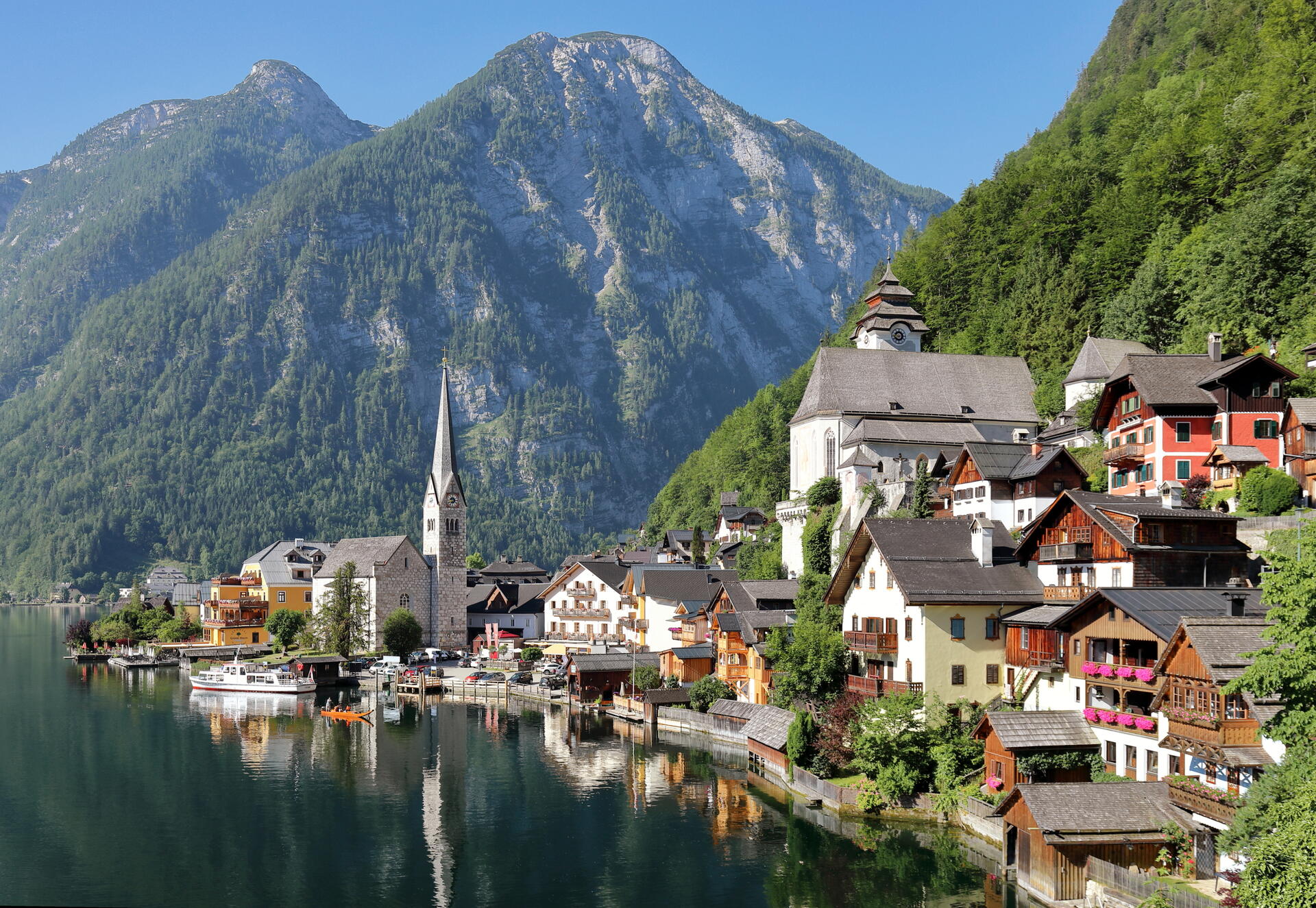
© C.Stadler/Bwag, CC BY-SA 4.0 Resized from original. (This derivative is under the same CC BY-SA license.)
World Heritage Research
Discover scientific research and academic studies that deepen our understanding of Hallstatt-Dachstein / Salzkammergut Cultural Landscape from its history and significance to its conservation, management, and contemporary challenges.
-
Recentring Peripheral Europe: Spatial Imaginaries and Regional Rescaling in the European Capital of Culture Programme
Peripheral European regions gain symbolic revaluation through the European Capital of Culture (ECoC) programme, but structural change remains limited. The study reveals that peripheral attributes—such as frontier, bridge, or cultural landscape—are institutionally recognized and rescaled into broader territorial platforms only when paired with programmatic materialization. Analysis of six ECoC sites (Matera/Basilicata 2019, Pafos 2017, Leeuwarden–Friesland 2018, Veszprém–Balaton 2023, Bad Ischl–Salzkammergut 2024, and Bodø/Nordland 2024) using bid documents, surveys, and evaluations shows that while symbolic de-peripheralization occurs, governance constraints and mobility issues persist. The findings highlight the programme's role in redistributing visibility without erasing peripherality.
Liu, Y.-D. (2026). Recentring Peripheral Europe: Spatial Imaginaries and Regional Rescaling in the European Capital of Culture Programme. European Journal of Geography, 17(1), 320–336. https://doi.org/10.48088/ejg.y.liu.17.1.320.336
View Publication Record | Read Publication -
Late Pleistocene to Holocene event stratigraphy of Lake Hallstatt (Salzkammergut, Austria): revealed by the Hipercorig drilling system and borehole logging
A groundbreaking sediment core from Lake Hallstatt, Austria, reveals the first high-resolution Late Pleistocene to Holocene record of an intra-mountainous lake in the Eastern Alps. The Hipercorig drilling system enabled recovery of 51 meters of undisturbed sediments, surpassing previous limits and providing a continuous archive spanning over 2,300 years. This core exposes two major lithostratigraphic units: Unit 1 (Holocene) with instantaneous deposits indicating rapid environmental changes, and Unit 2 (Late Pleistocene), likely extending back to the Allerød interstadial. The study also links borehole logging data to core-seismic correlations, offering unprecedented insights into past climate, natural hazards, human-environment interactions, and prehistoric mining activities in this UNESCO World Heritage Site. The findings highlight Lake Hallstatt as a critical archive for understanding the region's rich cultural history, including one of the oldest documented salt-mining landscapes.
Ortler, M., Brauer, A., Fabbri, S. C., Haas, J. N., Hajdas, I., Kowarik, K., Kueck, J., Reschreiter, H., & Strasser, M. (2024). Late Pleistocene to Holocene event stratigraphy of Lake Hallstatt (Salzkammergut, Austria): revealed by the Hipercorig drilling system and borehole logging. Scientific Drilling, 33(1), 1–19. https://doi.org/10.5194/sd-33-1-2024
View Publication Record | Read Publication -
Neolithic Hallstatt – a special mining place
Archaeological evidence reveals that Hallstatt, part of the UNESCO World Heritage Site Hallstatt-Dachstein / Salzkammergut Cultural Landscape, was a sophisticated mining hub for salt exploitation as early as 5000 BC. The discovery of four prestigious stone axes and a deer pick within the Salzberg mining galleries underscores the region's advanced technology and specialization in salt extraction during the Neolithic period. Spatial analyses and use-wear studies on these tools provide new insights into human activity, highlighting the continuity and significance of this industry from ancient times.
Fíguls, A., & Reschreiter, H. (2024). Neolithic Hallstatt – a special mining place. Vall Salina E-Journal, (1), 53. https://doi.org/10.69736/22190105
View Publication Record | Read Publication -
Hipercorig Hallstatt History (H3) reveals a high-resolution Late Pleistocene to Holocene sediment record at Lake Hallstatt (Salzkammergut, Austria)
A groundbreaking sediment core from Lake Hallstatt, Austria, reveals a high-resolution record spanning the Late Pleistocene to Holocene, offering unprecedented insights into the 7,000-year history of human salt mining and environmental changes in this UNESCO World Heritage Site. The Hipercorig platform enabled the recovery of two undisturbed cores (41m and 51m) from 122m water depth, revealing distinct lithostratigraphic units—Holocene sediments marked by laminated clays, mass-movement deposits, and turbidites, and Late Pleistocene layers characterized by thin-bedded silty clays with intermittent laminations. Multi-proxy analyses, including x-ray tomography and core logging, confirm the cores' representativeness and promise to elucidate early human settlement patterns, climatic shifts, and geological events in this Alpine cultural landscape.
Ortler, M., Brauer, A., Fabbri, S. C., Kowarik, K., Kueck, J., & Strasser, M. (2022). Hipercorig Hallstatt History (H3) reveals a high-resolution Late Pleistocene to Holocene sediment record at Lake Hallstatt (Salzkammergut, Austria). https://doi.org/10.5194/egusphere-egu22-3428
View Publication Record | Read Publication -
Researching Change – Understanding Change – Facing Change. 3500 years of human-environment relations in the Hallstatt/Dachstein region
Bronze and Iron Age communities in the Hallstatt-Dachstein region demonstrated remarkable resilience to extreme natural events, including mass movements and climate shifts. This finding emerges from a study analyzing 3500 years of human-environment relations, leveraging unique archaeological, historical, and environmental data preserved in salt mines. The research highlights sophisticated adaptation strategies developed by these societies, offering insights into their technological advancements and raw material management. By examining the long-term evolution of human-environment interactions, the study also addresses the role of archaeologists in understanding climate change impacts on past civilizations.
Kowarik, K., Brandner, D., Hofmann, K., Strasser, M., & Reschreiter, H. (2022). Researching Change – Understanding Change – Facing Change. 3500 years of human-environment relations in the Hallstatt/Dachstein region. Internet Archaeology, (60). https://doi.org/10.11141/ia.60.7
View Publication Record | Read Publication -
Deformation of the Dachstein Limestone in the Dachstein thrust sheet (Eastern Alps, Austria)
Salt tectonics played a crucial role in shaping the Dachstein thrust sheet, influencing its structural evolution from the Late Triassic to the Late Cretaceous. The study identifies six key deformation events, including syn-depositional instability and slumping, growth of the Hallstatt diapir, salt-driven extensional faulting, Jurassic re-activation of faults, Early Cretaceous shortening, and Late Cretaceous extensional reactivation. These findings were derived from a multi-scale analysis combining conventional outcrop observations with digital fieldwork using drone-captured virtual outcrops and GoogleMaps 3D terrain renderizations. The research highlights the significance of salt tectonics in controlling the structure of this UNESCO World Heritage Site, offering new insights into its tectonic history.
Fernandez, O., Grasemann, B., & Sanders, D. (2022). Deformation of the Dachstein Limestone in the Dachstein thrust sheet (Eastern Alps, Austria). Austrian Journal of Earth Sciences, 115(1), 167–190. https://doi.org/10.17738/ajes.2022.0008
View Publication Record | Read Publication -
Prehistoric salt mining in Hallstatt, Austria. New chronologies out of small wooden fragments
A groundbreaking analysis of prehistoric salt mining at the Hallstatt-Dachstein/Salzkammergut Cultural Landscape, Austria, has revealed new dendrochronological chronologies spanning from 1393 BCE to 425 BCE. These findings, derived from over 760 small wooden fragments, provide precise dating for various tree species—fir, spruce, larch, and beech—using advanced crossdating techniques and radiocarbon wiggle matching. The study sheds light on the Hallstatt period (800–400 BCE), a pivotal epoch in European prehistory, by leveraging the exceptional preservation of organic materials within rock salt deposits. This research not only refines our understanding of prehistoric mining activities but also offers unprecedented insights into ancient timber use and environmental conditions.
Grabner, M., Wächter, E., Nicolussi, K., Bolka, M., Sormaz, T., Steier, P., Wild, E. M., Barth, F. E., Kern, A., Rudorfer, J., Kowarik, K., Stöllner, T., & Reschreiter, H. (2021). Prehistoric salt mining in Hallstatt, Austria. New chronologies out of small wooden fragments. Dendrochronologia, 66, 125814. https://doi.org/10.1016/j.dendro.2021.125814
View Publication Record | Read Publication