World Heritage Identification Number: 1538
World Heritage since: 2018
Category: Cultural Heritage
WHE Type: Infrastructure & Industry
Transboundary Heritage: No
Endangered Heritage: No
Country: 🇮🇹 Italy
Continent: Europe
UNESCO World Region: Europe and North America
Map
Ivrea, Industrial City of the 20th Century: A Model Social Project
Ivrea, a town and comune in the Metropolitan City of Turin, Piedmont region, Italy, is renowned as the industrial city of the 20th century. Inscribed as a UNESCO World Heritage Site in 2018, Ivrea offers a unique blend of industrial innovation, architectural design, and social experimentation that reflects the ideals of the Community Movement (Movimento Comunità).
More to come…UNESCO Description of the World Heritage Site
The industrial city of Ivrea is located in the Piedmont region and developed as the testing ground for Olivetti, manufacturer of typewriters, mechanical calculators and office computers. It comprises a large factory and buildings designed to serve the administration and social services, as well as residential units. Designed by leading Italian urban planners and architects, mostly between the 1930s and the 1960s, this architectural ensemble reflects the ideas of the Community Movement (Movimento Comunità). A model social project, Ivrea expresses a modern vision of the relationship between industrial production and architecture.
UNESCO Justification of the World Heritage Site
Criterion (iv): The industrial city of Ivrea is an ensemble of outstanding architectural quality that represents the work of Italian modernist designers and architects and demonstrates an exceptional example of 20th century developments in the design of production, taking into account changing industrial and social needs. Ivrea represents one of the first and highest expressions of a modern vision in relation to production, architectural design and social aspects at a global scale in relation to the history of industrial construction, and the transition from mechanical to digitalised industrial technologies. The attributes of the property are: the spatial plan of the industrial city, the public buildings and spaces, and residential buildings developed by Olivetti (including their extant interior elements). The influences of the Community Movement on the provision of buildings for residential and social purposes is an important intangible element, although the functions of most non-residential buildings have ceased.
Encyclopedia Record: Ivrea
Ivrea is a town and comune of the Metropolitan City of Turin in the Piedmont region of northwestern Italy. Situated on the road leading to the Aosta Valley, it straddles the Dora Baltea and is regarded as the capital of the Canavese area.Additional Site Details
Area: 52.37 hectares
Number of Components: 1
Coordinates: 45.4575 , 7.8691666667
Image
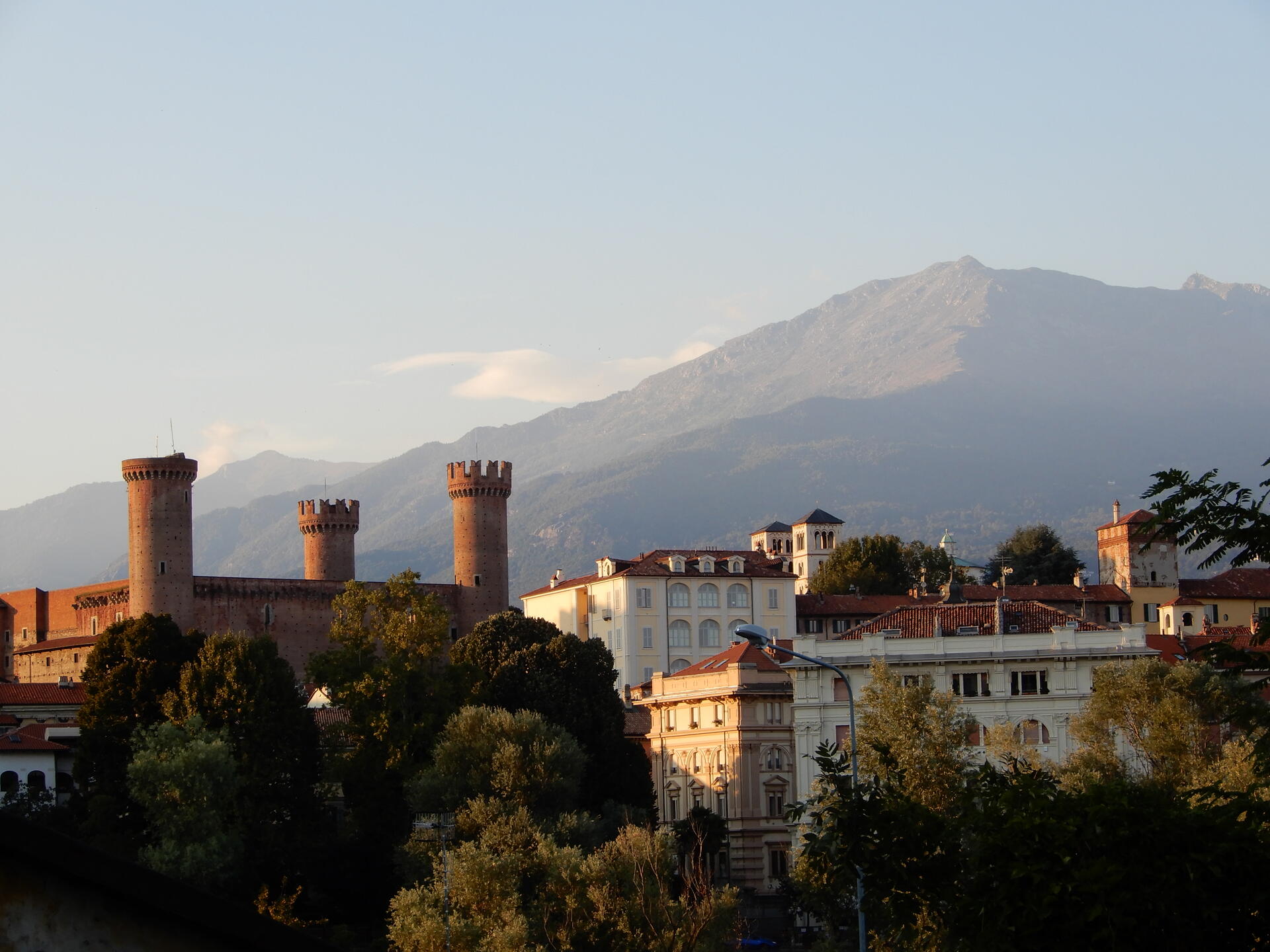
© Plumbago Capensis, CC BY-SA 4.0 Resized from original. (This derivative is under the same CC BY-SA license.)
World Heritage Research
Discover scientific research and academic studies that deepen our understanding of Ivrea, industrial city of the 20th century from its history and significance to its conservation, management, and contemporary challenges.
-
La « collection » Olivetti. Architecture et enjeux du moderne dans l’Ivrée contemporaine | The Olivetti ‘Collection’: Architecture and the Challenges of Modernism in Contemporary Ivrée
Ivrea's industrial modernity, epitomized by the Olivetti project, is revealed as a complex urban system integrating architecture, production, social reform, and territorial planning. Unlike traditional interpretations focusing on individual buildings, this study highlights the interconnectedness of factories, welfare facilities, residential districts, infrastructures, and landscapes, with via Jervis, Talponia, and La Serra serving as key examples. The research also addresses the challenges of preserving Ivrea's modernist heritage post-UNESCO World Heritage List inscription in 2018, particularly concerning boundaries, authenticity, adaptive reuse, and conservation of materials. It advocates for an integrated strategy to safeguard spatial, social, and landscape relationships, ensuring the enduring relevance of Olivetti's architectural legacy.
Martellini, M. (2026). La « collection » Olivetti. Architecture et enjeux du moderne dans l’Ivrée contemporaine | The Olivetti ‘Collection’: Architecture and the Challenges of Modernism in Contemporary Ivrée. Restauro Archeologico, 34(1), 106–123. https://doi.org/10.36253/rar-21107
View Publication Record | Read Publication -
Beyond the Factory Town: Sustainable New Uses and Cultural Continuity of Olivetti’s Architectural Heritage in Ivrea, Italy
Adaptive reuse of twentieth-century architectural heritage, such as Olivetti’s buildings in Ivrea, Italy, must balance contemporary functionality with cultural and material integrity to ensure long-term sustainability. A qualitative study of four case studies within the UNESCO World Heritage site revealed that successful reuse depends on preserving spatial structure, constructional logic, and urban context while accommodating new functions. The research used an interdisciplinary framework of eight indicators—spatial adaptability, social impact, heritage conservation, and environmental performance—to assess transformations from original to post-reuse configurations (T0 to T1). Findings highlight cultural continuity as a multidimensional condition, offering a critical evaluation tool for modern architectural heritage conservation.
Calcagni, L., Canducci, A., & Vetere, I. (2026). Beyond the Factory Town: Sustainable New Uses and Cultural Continuity of Olivetti’s Architectural Heritage in Ivrea, Italy. Sustainability, 18(18), 9248. https://doi.org/10.3390/su18189248
View Publication Record | Read Publication -
Understanding Youth and Empowering Cultural Heritage Transformation: A Case Study of HEY Ivrea! Heritage Enhancement Through Youth
A groundbreaking initiative, 'HEY Ivrea! Heritage Enhancement Through Youth,' demonstrates how cultural sites can effectively integrate youth as co-creators in heritage management. By employing participatory methods such as hackathons and workshops, the project empowers young people (ages 15-24) to contribute meaningfully to both tangible and intangible heritage at Ivrea's UNESCO World Heritage Site. This approach shifts youth from passive beneficiaries to active stakeholders, fostering innovation while preserving tradition. The study highlights a successful model for inclusive heritage governance, aligning with international frameworks that emphasize youth participation in contemporary cultural practices.
Meneghin, E., & Ghisi, F. (2025). Understanding Youth and Empowering Cultural Heritage Transformation: A Case Study of HEY Ivrea! Heritage Enhancement Through Youth. Museum International, 77(1-2), 70–79. https://doi.org/10.1080/13500775.2025.2540208
View Publication Record | Read Publication -
Industrial Heritage and Citizen Participation: The UNESCO World Heritage Site of Ivrea, Italy
Community engagement in managing UNESCO World Heritage Sites can significantly enhance preservation efforts and foster innovation, as demonstrated by the case of Ivrea, Italy. Designated as the 'Industrial City of the 20th Century' in 2018, Ivrea's industrial heritage, particularly tied to the Olivetti factory, presents a unique opportunity for cultural and creative industries to drive social advancement and economic sustainability. A multidisciplinary participatory approach revealed limited community awareness of the Site Management Plan, highlighting the need for more inclusive governance. Collaborative efforts, especially involving youth, have generated innovative ideas that could shape Ivrea's future as a permanent cultural cluster. This study underscores the potential of citizen participation in transforming industrial heritage into a catalyst for community well-being and urban development.
Ferrero, M., Friel, M., Meneghin, E., & Lavanga, M. (2024). Industrial Heritage and Citizen Participation: The UNESCO World Heritage Site of Ivrea, Italy. Urban Planning, 9. https://doi.org/10.17645/up.8220
View Publication Record | Read Publication -
Architetture olivettiane: un itinerario da sud a nord
A notable contribution to the study of UNESCO World Heritage Sites, this work highlights Adriano's architectural and urban planning achievements within Ivrea, particularly between 1930 and 1960. It showcases innovative residential neighborhoods for Olivetti employees, such as the Summer Colony in Massa Marittima (1948-1958), which exemplifies harmonious integration with natural landscapes. The Factory of Pozzuoli (1951-1954) further illustrates Adriano's design prowess, blending industrial functionality with scenic views of the Gulf of Naples through a meticulously crafted garden. Additionally, the 1936-1937 Regolatore della Valle D'Aosta plan underscores Adriano's regional planning expertise. The study emphasizes the significance of these works in shaping Ivrea's urban landscape, which was later recognized by UNESCO in 2018.
Piccinini, M. (2024). Architetture olivettiane: un itinerario da sud a nord. Olivetti: Una Complessità Virtuosa, 95–118. https://doi.org/10.36253/979-12-215-0459-0.07
View Publication Record | Read Publication -
Color in modern architecture of Olivetti's town
A groundbreaking analysis reveals the significance of color in Adriano Olivetti's modern architectural heritage, challenging the notion that his work was limited to rationalist models. The study, conducted by Giacopelli, Gualtieri, and Zerbinatti (2023), employs a dual approach: methodologically, it delves into precise material analysis to uncover the less minimalist vision behind Olivetti's designs; operationally, it addresses conservation challenges posed by the unavailability of original materials. This research is pivotal for understanding Ivrea's UNESCO-listed industrial city, offering insights into its chromatic complexity and guiding restoration efforts. The findings highlight the importance of preserving this 'world of colors' while navigating contemporary material constraints.
Giacopelli, E., Gualtieri, S., & Zerbinatti, M. (2023). Color in modern architecture of Olivetti’s town. Color Research & Application, 49(1), 144–162. Portico. https://doi.org/10.1002/col.22893
View Publication Record | Read Publication -
DIKEDOC: a multicriteria methodology to organise and communicate knowledge
A novel multicriteria methodology, DIKEDOC, has been developed to organize and communicate dispersed knowledge about complex problems, particularly when decision-making processes are latent or inactive. This approach integrates logical and analytical tools to generate insights at a technical level and fosters interactive spaces for sharing perspectives, exploring actions, and addressing uncertainties. A pilot study applied this methodology to the UNESCO World Heritage Site 'Ivrea, industrial city of the twentieth century,' which faces challenges despite numerous research activities. DIKEDOC aims to guide incremental knowledge development, foster relationships, and inform policies by logically describing action spaces and their associated uncertainties.
Norese, M. F., Rolando, D., & Curto, R. (2022). DIKEDOC: a multicriteria methodology to organise and communicate knowledge. Annals of Operations Research, 325(2), 1049–1082. https://doi.org/10.1007/s10479-022-04711-6
View Publication Record | Read Publication