World Heritage Identification Number: 1390
World Heritage since: 2014
Category: Cultural Heritage
WHE Type: Agriculture Landscapes, Parks & Gardens
Transboundary Heritage: No
Endangered Heritage: No
Country: 🇮🇹 Italy
Continent: Europe
UNESCO World Region: Europe and North America
Map
The Vineyard Landscape of Piedmont: A Terroir of Wine, History, and Culture
The Vineyard Landscape of Piedmont: Langhe-Roero and Monferrato, inscribed as a UNESCO World Heritage Site in 2014, offers a unique blend of natural beauty, historical significance, and cultural richness. Located in the southwestern portion of Piedmont, this expansive region stretches between the Po River and the Ligurian Apennines, encompassing a diverse array of vineyards, castles, and picturesque villages.
More to come…UNESCO Description of the World Heritage Site
This landscape covers five distinct wine-growing areas with outstanding landscapes and the Castle of Cavour, an emblematic name both in the development of vineyards and in Italian history. It is located in the southern part of Piedmont, between the Po River and the Ligurian Apennines, and encompasses the whole range of technical and economic processes relating to the winegrowing and winemaking that has characterized the region for centuries. Vine pollen has been found in the area dating from the 5th century BC, when Piedmont was a place of contact and trade between the Etruscans and the Celts; Etruscan and Celtic words, particularly wine-related ones, are still found in the local dialect. During the Roman Empire, Pliny the Elder mentions the Piedmont region as being one of the most favourable for growing vines in ancient Italy; Strabo mentions its barrels.
UNESCO Justification of the World Heritage Site
Criterion (iii): The cultural landscapes of the Piedmont vineyards provide outstanding living testimony to winegrowing and winemaking traditions that stem from a long history, and that have been continuously improved and adapted up to the present day. They bear witness to an extremely comprehensive social, rural and urban realm, and to sustainable economic structures. They include a multitude of harmonious built elements that bear witness to its history and its professional practices.
Criterion (v): The vineyards of Langhe-Roero and Monferrato constitute an outstanding example of man’s interaction with his natural environment. Following a long and slow evolution of winegrowing expertise, the best possible adaptation of grape varieties to land with specific soil and climatic components has been carried out, which in itself is related to winemaking expertise, thereby becoming an international benchmark. The winegrowing landscape also expresses great aesthetic qualities, making it into an archetype of European vineyards.
Encyclopedia Record: Vineyard Landscape of Piedmont: Langhe-Roero and Monferrato
Vineyard Landscape of Piedmont: Langhe-Roero and Monferrato is the official name of a UNESCO World Heritage Site comprising "five distinct wine-growing areas with outstanding landscapes" plus the Castle of Grinzane Cavour in the region of Piedmont, Italy.Additional Site Details
Area: 10,789 hectares
Number of Components: 6
(v) — Outstanding example of traditional human settlement
Coordinates: 44.6086111111 , 7.9636111111
Image
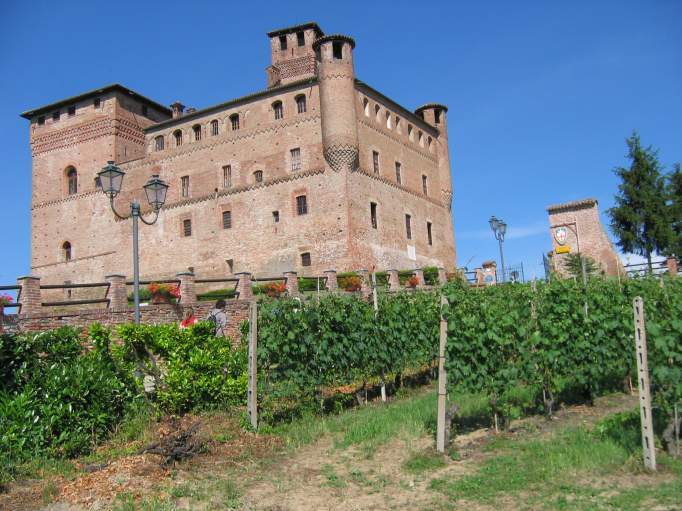
© Cloud7, CC BY-SA 3.0 Resized from original. (This derivative is under the same CC BY-SA license.)
World Heritage Research
Discover scientific research and academic studies that deepen our understanding of Vineyard Landscape of Piedmont: Langhe-Roero and Monferrato from its history and significance to its conservation, management, and contemporary challenges.
-
Implementing supportive policies to promote nature-based solutions at regional level through collaboration with winegrowers
A pioneering governmental application of nature-based solutions (NbS) in the UNESCO-listed Vineyard Landscape of Piedmont, Italy, demonstrates their potential to enhance vineyard ecosystems while supporting sustainable wine production. The study highlights 12 agroecology-based practices integrated into vineyards within Europe’s Nature 2000 protected areas, showcasing positive ecological impacts through a participatory approach involving local winegrowers and regional authorities. Case studies from the Monte Fenera Regional Park reveal that collaborative policies, such as the Ecologic Incidence Assessment process, can effectively promote NbS adoption, fostering biodiversity conservation while maintaining traditional viticultural practices like Nebbiolo production in Boca. This model underscores the feasibility of integrating environmental goals with economic and cultural heritage objectives at a regional scale.
Rivella, E., Pompilio, L., Denicola, R., & Bettini, M. (2026). Implementing supportive policies to promote nature-based solutions at regional level through collaboration with winegrowers. Nature-Based Solutions for European Vineyards, 224–238. https://doi.org/10.4324/9781003715108-14
View Publication Record | Read Publication -
Digital technology and risk management in rural tourism: Insights from Langhe, Roero and Monferrato
Rural tourism in UNESCO-listed regions can enhance competitiveness and sustainability through strategic digitalization aligned with risk management. A study on Italy's Langhe, Roero, and Monferrato vineyard landscapes reveals how local actors leverage digital tools—such as data analytics, online marketing, and platform-based collaboration—to mitigate environmental, market, and climate-related risks while preserving cultural identity. The research identifies key risk categories and demonstrates that digital innovation, when integrated with resilience strategies, fosters long-term adaptability in rural destinations. This approach offers practical insights for policymakers and destination managers to navigate post-pandemic challenges and ensure sustainable development.
Crocco, E., Giacosa, E., & Culasso, F. (2026). Digital technology and risk management in rural tourism: Insights from Langhe, Roero and Monferrato. Management Control, (1), 143–166. https://doi.org/10.3280/maco2026-001007
View Publication Record | Read Publication -
Literary Tourism and Cultural Sustainability: The Landscape of Beppe Fenoglio in the Langhe, Italy
Literary tourism, particularly through the lens of Beppe Fenoglio's works, emerges as a unique driver for cultural sustainability in the Langhe-Roero and Monferrato region of Piedmont. This niche form of tourism, distinct from the area’s established food-and-wine appeal, offers a deeper connection to local rural life, culture, and Resistance history, fostering new interpretations of the landscape and strengthening collective memory. While limited by sample size, the study identifies 'Fenoglians'—special interest tourists drawn to Fenoglio's narrative—as a promising avenue for tourism diversification. The research employs mixed methods, including documentary analysis, questionnaires, and interviews, revealing how fictional narratives shape tourist perceptions and community heritage preservation. This approach underscores the role of local communities in bridging literary narratives with landscape sustainability.
Rech, G., Pini, C., Migliorati, L., & Mori, L. (2025). Literary Tourism and Cultural Sustainability: The Landscape of Beppe Fenoglio in the Langhe, Italy. Sustainability, 17(3), 1237. https://doi.org/10.3390/su17031237
View Publication Record | Read Publication -
Alba, la città delle “cento” torri: una proposta per la valorizzazione delle strutture evidenti e latenti
Alba, Italy, is renowned for its medieval towers, which once symbolized the political and military power of leading families. While often described as the 'city of a hundred towers,' this perception is an overestimation, yet it reflects the significant density of these structures in the city's historic core. A notable aspect of this research is the identification and documentation of both visible and latent tower structures—those integrated into building facades or concealed underground—which are crucial to understanding Alba's architectural heritage. The study proposes strategies for preserving and enhancing these structures, emphasizing their importance within the cultural policies of a city that leads the UNESCO World Heritage Site of Langhe-Roero-Monferrato. By focusing on both evident and latent traces, this work aims to foster greater citizen involvement and sensitivity among tourists, contributing to the sustainable development of Alba's cultural landscape.
Ambrogio, F. (2025). Alba, la città delle “cento” torri: una proposta per la valorizzazione delle strutture evidenti e latenti. PROCEEDINGS of the International Conference on Fortifications of the Mediterranean Coast FORTMED 2025. Vol. 21, 1239–1246. https://doi.org/10.4995/fortmed2025.2025.20387
View Publication Record | Read Publication -
Heritage Interpretation and First-Person Narratives
First-person narratives can effectively challenge traditional heritage interpretations and promote gender-inclusive perspectives. A study of the UNESCO World Heritage vineyard landscape of Piedmont, Italy, reveals that women have played an agentic role in shaping the site's identity despite being marginalized in dominant narratives. Through interviews and analysis of Nuto Revelli's work, researchers demonstrate how oral history captures intimate aspects of women's lives, exposing material and symbolic constraints. These narratives can be translated into heritage interpretation practices, fostering critical understanding of gender diversity and advancing progressive social change through dynamic cultural policies.
Settimini, E. (2025). Heritage Interpretation and First-Person Narratives. The Routledge Handbook of Heritage and Gender, 161–169. https://doi.org/10.4324/9781003258193-14
View Publication Record | Read Publication -
“It’s Years of Walking, of Reading the Forest”: White Truffle Hunters’ Perception of Socio-Ecological Change in Langhe and Roero, NW Italy
White truffle hunting in the Piedmontese landscapes of Italy is more than a foraging practice—it embodies deep, intergenerational relationships with forests, shaped by sensory attunement and emotional connections. A study reveals that socio-ecological transformations, such as land privatization, vineyard expansion, and monocultural plantations, are disrupting these traditional practices, leading to ecological estrangement, dispossession, and the erosion of knowledge transmission. Hunters report a loss of sensory orientation, access to ancestral lands, and a breakdown in the human–dog forest relational web, accompanied by grief and identity erosion. These changes threaten not only ecological but also emotional and cultural sustainability, underscoring the need for a broader understanding of sustainability that includes affective and place-based knowledge systems.
Alrhmoun, M., Zanaria, M., Elia, F., Sulaiman, N., Pieroni, A., & Corvo, P. (2025). “It’s Years of Walking, of Reading the Forest”: White Truffle Hunters’ Perception of Socio-Ecological Change in Langhe and Roero, NW Italy. Sustainability, 17(17), 8053. https://doi.org/10.3390/su17178053
View Publication Record | Read Publication -
The evolution of an epidemic: age-period-cohort modelling of mesothelioma in Casale Monferrato, 1990–2021, with projections to 2042
A study projecting the future of mesothelioma incidence in Casale Monferrato, Italyreveals that the epidemic driven by asbestos exposure will decline steadily but persist until mid-century. Using Age-Period-Cohort (APC) models with data from 1990 to 2021, researchers estimated that cases will return to early 1990s levels by 2035 and drop further by 2042, despite the disease's long latency. The analysis highlighted higher environmental exposure risks for women, who accounted for 58% of non-occupational cases compared to 22% in men. Projections used three modeling approaches, all yielding consistent results, underscoring the need for continued surveillance due to the lingering health burden.
Giraldo, M., Zugna, D., Migliore, E., Ramos-Bonilla, J. P., & Maule, M. (2025). The evolution of an epidemic: age-period-cohort modelling of mesothelioma in Casale Monferrato, 1990–2021, with projections to 2042. Environmental Health, 24(1). https://doi.org/10.1186/s12940-025-01236-w
View Publication Record | Read Publication