World Heritage Identification Number: 803
World Heritage since: 1997
Category: Cultural Heritage
WHE Type: Archaeological Sites
Transboundary Heritage: No
Endangered Heritage: No
Country: 🇪🇸 Spain
Continent: Europe
UNESCO World Region: Europe and North America
Map
The Ancient Gold Mining Landscape of Las Médulas: A UNESCO World Heritage Site
The ancient gold mining landscape of Las Médulas, located in the north-western region of Spain, stands as a testament to the ingenuity and ambition of the Roman Empire. This historic site, inscribed as a UNESCO World Heritage Site in 1997, offers a unique insight into the mining techniques employed during the 1st century AD.
More to come…UNESCO Description of the World Heritage Site
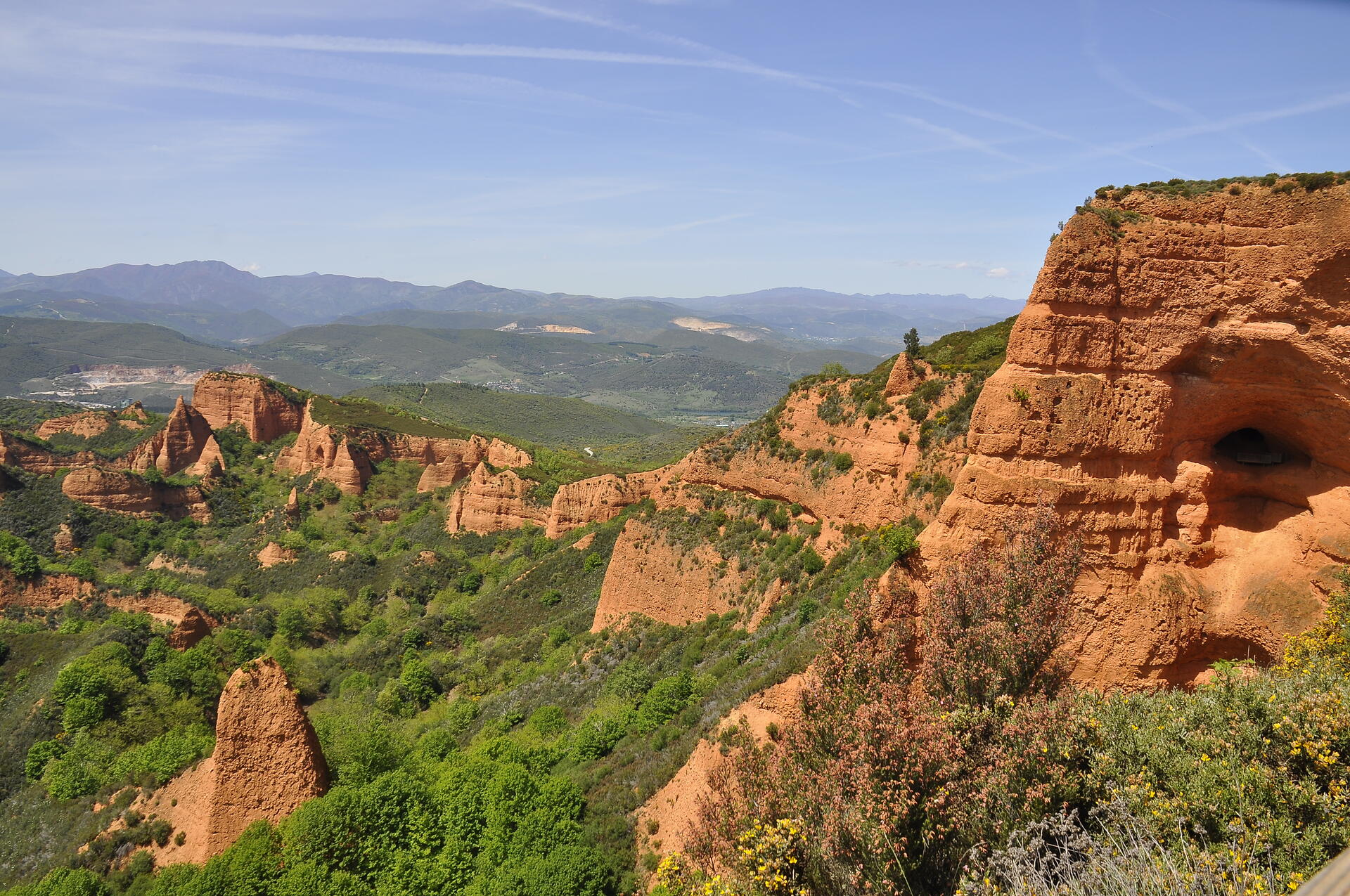
In the 1st century A.D. the Roman Imperial authorities began to exploit the gold deposits of this region in north-west Spain, using a technique based on hydraulic power. After two centuries of working the deposits, the Romans withdrew, leaving a devastated landscape. Since there was no subsequent industrial activity, the dramatic traces of this remarkable ancient technology are visible everywhere as sheer faces in the mountainsides and the vast areas of tailings, now used for agriculture.
UNESCO Justification of the World Heritage Site
Criterion (i): Las Médulas is a major work of human creative genius in the field of mining, and specifically the technology of ruina montium, the application of water power, and systems of gold mining on a scale, efficiency, and economic importance that were of decisive economic importance for the Roman Empire in the first two centuries AD.
Criterion (ii): Las Médulas is a remarkable example of the application of Roman mining techniques to exploit precious metals. It is exceptional that subsequent works, which have largely destroyed such evidence elsewhere, were here limited or non-existent, so that this property is unquestionably the best preserved and most representative of all the mining areas of the Greco-Roman world in classical times.
Criterion (iii): The Roman gold-mining operations in the Las Médulas area were the most extensive ones in Antiquity. The spectacular remains illustrate both the remarkable technology and the administration of this Imperial estate in every detail.
Criterion (iv): The Las Médulas gold-mining area is an outstanding example of innovative Roman technology, in which all the elements of the ancient landscape, both industrial and domestic, have survived to an exceptional degree.
Encyclopedia Record: Las Médulas
Las Médulas is a historic gold-mining site near the town of Ponferrada in the comarca of El Bierzo. It was the most important gold mine, as well as the largest open-pit gold mine, in the entire Roman Empire. Las Médulas Cultural Landscape is listed by UNESCO as a World Heritage Site. Advanced aerial surveys conducted in 2014 using LIDAR have confirmed the wide extent of the Roman-era works.Additional Site Details
Area: 2,208.2 hectares
Number of Components: 4
(ii) — Significant interchange of human values
(iii) — Unique or exceptional testimony to a cultural tradition
(iv) — Outstanding example of a type of building or landscape
Coordinates: 42.46939 , -6.77075
World Heritage Research
Discover scientific research and academic studies that deepen our understanding of Las Médulas from its history and significance to its conservation, management, and contemporary challenges.
-
The Value Assessment and Planning of Industrial Mining Heritage as a Tourism Attraction: The Case of Las Médulas Cultural Space
Las Médulas, a historic gold mining site in Spain, exemplifies the challenges and opportunities of repurposing industrial heritage for tourism. Research reveals that while Las Médulas has enhanced its tourist value through its historical and cultural significance, fragmented management by multiple stakeholders and limited local community engagement hinder effective tourism planning. The study, combining documentary analysis, fieldwork, and surveys, identifies key factors influencing resident support for tourism development, including financial benefits and perceived impacts on the area's image. These findings provide actionable recommendations to address longstanding debates among stakeholders and optimize sustainable tourism strategies.
Caamaño-Franco, I., & Suárez, M. (2020). The Value Assessment and Planning of Industrial Mining Heritage as a Tourism Attraction: The Case of Las Médulas Cultural Space. Land, 9(11), 404. https://doi.org/10.3390/land9110404
View Publication Record | Read Publication -
Espacios patrimoniales de intervención múltiple. Conflictos territoriales en torno al Plan de Dinamización Turística de las Médulas
Las Médulas faces significant challenges due to its status as a space of multiple interventions. The implementation of the Tourist Dynamics Plan for Las Médulas has exposed latent conflicts related to cultural and tourist functionality within the Archaeological Zone, disagreements among local actors, and mismanagement by the Plan's governance. These issues are exacerbated by overlapping sectoral protection figures, leading to complex territorial management problems. While efforts towards integral valorization and ordering instruments have been delayed, establishing a dedicated management body for Las Médulas could address these challenges effectively.
Monteserín Abella, O. (2019). Espacios patrimoniales de intervención múltiple. Conflictos territoriales en torno al Plan de Dinamización Turística de las Médulas. PASOS. Revista de Turismo Y Patrimonio Cultural, 17, 209–224. https://doi.org/10.25145/j.pasos.2019.17.014
View Publication Record | Read Publication -
La Balouta exhumed karst: a Roman gold-mine-derived landscape within the Las Médulas UNESCO World Heritage Site (Spain)
Researchers have identified the La Balouta Valley, located within the Las Médulas UNESCO World Heritage Site in Spain, as a unique paleokarst landscape shaped by both natural and anthropogenic processes. This valley, once filled with red Miocene sediments, was later excavated during Roman gold mining activities over 2,000 years ago. The study reveals that the valley's current characteristics—such as limited surface water runoff, small cavities, and residual karst topography—stem from these historical mining practices. Gold particles found in sediment samples and similarities to other formations mined by the Romans support this conclusion. The findings highlight the interplay between natural geological processes and human activity, creating a distinctive cultural landscape that reflects systematic gold extraction on the NW Iberian Peninsula.
Redondo-Vega, J., Alonso-Herrero, E., Santos-González, J., González-Gutiérrez, R., Gómez-Villar, A.,. (2015). La Balouta exhumed karst: a Roman gold-mine-derived landscape within the Las Médulas UNESCO World Heritage Site (Spain). International Journal of Speleology, 44(3), 267–276. https://doi.org/10.5038/1827-806x.44.3.5
View Publication Record | Read Publication -
Beyond nature: The management of a productive cultural landscape in Las Médulas area (El Bierzo, León, Spain) during pre-Roman and Roman times
Research at Las Médulas, a UNESCO World Heritage Site in Spain, reveals the complex interplay between human activity and landscape management during pre-Roman and Roman times. Analysis of plant remains—including seeds, fruits, charcoal, pollen, spores, and non-pollen palynomorphs—from two archaeological sites demonstrates that communities in this region diversified their use of the landscape through agriculture, animal husbandry, and mining. The study highlights how these activities shaped the environment, satisfying multiple needs while leaving a lasting imprint on the cultural landscape.
López-Merino, L., Peña-Chocarro, L., Ruiz-Alonso, M., LópeZ-Sáez, J. A., & J. Sánchez-Palencia, F. (2010). Beyond nature: The management of a productive cultural landscape in Las Médulas area (El Bierzo, León, Spain) during pre-Roman and Roman times. Plant Biosystems - an International Journal Dealing with All Aspects of Plant Biology, 144(4), 909–923. https://doi.org/10.1080/11263504.2010.491976
View Publication Record | Read Publication