World Heritage Identification Number: 620
World Heritage since: 1993
Category: Cultural Heritage
WHE Type: Buildings & Architectural Ensembles
Transboundary Heritage: No
Endangered Heritage: No
Country: 🇸🇰 Slovakia
Continent: Europe
UNESCO World Region: Europe and North America
Map
Levoča, Spišský Hrad, and the Associated Cultural Monuments: A Glimpse into Medieval Eastern Europe
The UNESCO World Heritage Site of Levoča, Spišský Hrad, and the Associated Cultural Monuments offers a captivating journey through medieval Eastern Europe. This extensive site, inscribed in 1993, comprises three main components: the ruins of Spiš Castle, the historic town center of Levoča, and the ecclesiastical town of Spišská Kapitula.
More to come…UNESCO Description of the World Heritage Site
Spišský Hrad has one of the largest ensembles of 13th and 14th century military, political and religious buildings in eastern Europe, and its Romanesque and Gothic architecture has remained remarkably intact.
The extended site features the addition of the historic town-centre of Levoča founded in the 13th and 14th centuries within fortifications. Most of the site has been preserved and it includes the 14th century church of St James with its ten alters of the 15th and 16th centuries, a remarkable collection of polychrome works in the Late Gothic style, including an 18.6 metre high alterpiece by completed around 1510 by Master Paul.
UNESCO Justification of the World Heritage Site
Criterion (iv): Levoča, Spišský Hrad and the associated cultural monuments of Spišské Podhradie, Spišska Kapitula, and Zehra, extended to Levoča and the works of Master Paul in Spiš, constitute an outstanding example of a remarkably well preserved and authentic group of buildings which is characteristic of medieval settlement in Eastern Europe, in its military, political, religious, mercantile, and cultural functions.
Encyclopedia Record: Levoča, Spiš Castle and the associated cultural monuments
The ruins of Spiš Castle is one of the largest castle sites in Central Europe. The castle is situated above the town of Spišské Podhradie and the village of Žehra that with adjacent ecclesiastical town Spišská Kapitula form components of the UNESCO World Heritage Site. In 2009, the site was extended to include the famous altar by Master Paul of Levoča and the historic centre of Levoča with many well-preserved Renaissance buildings.Additional Site Details
Area: 1,351.225 hectares
Number of Components: 2
Coordinates: 48.9994444444 , 20.7675
Image
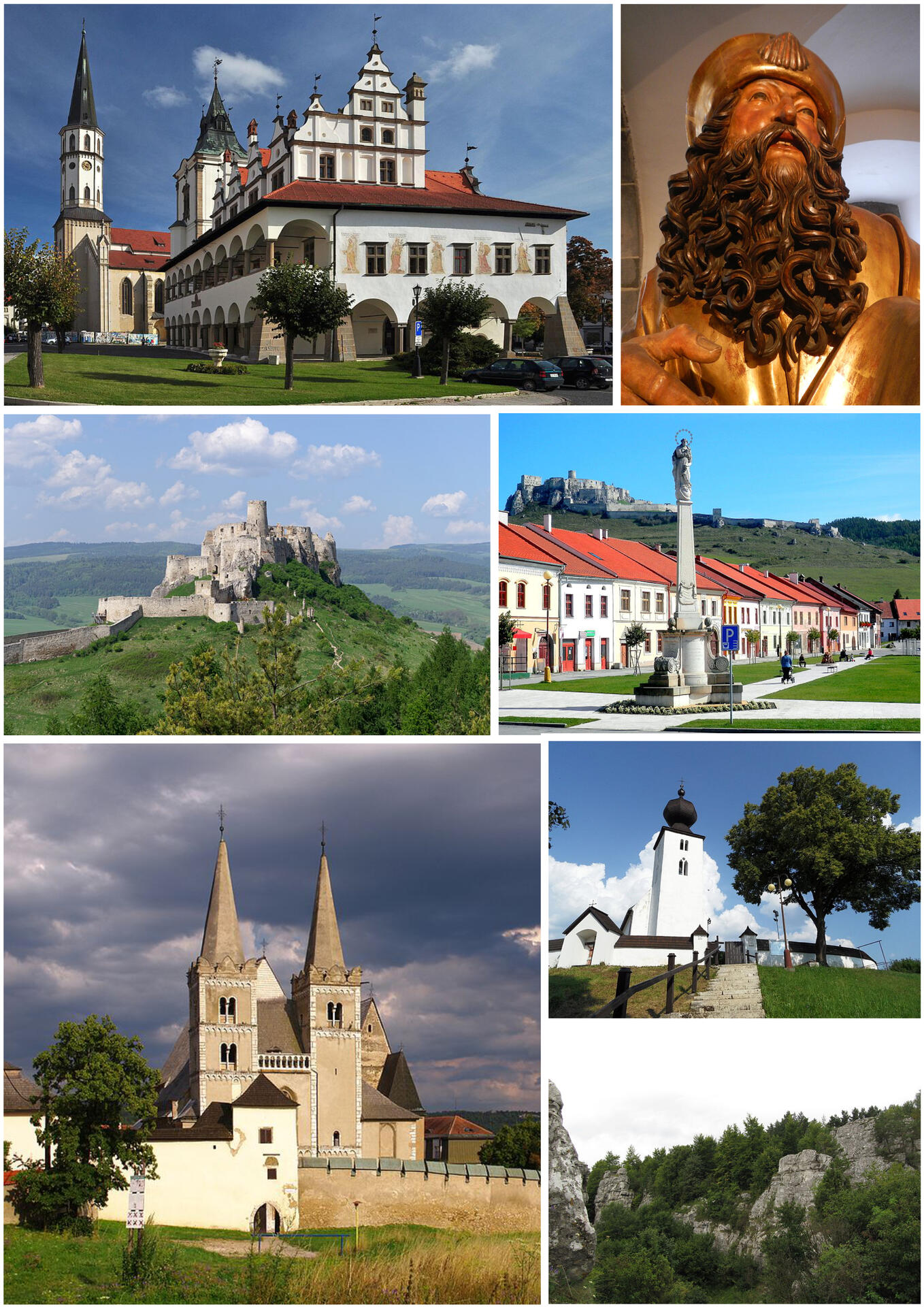
© File:Levoča (2).jpg by Sebastian Mierzwa File:St James statue by Master Paul of Levoča.jpg by Jaro Nemčok File:20180503 Zamek Spiski 2980 DxO.jpg by Jakub Hałun File:CulHer14Slovakia328.JPG by Ing.Mgr.Jozef Kotulič by Pierre Bona File:Church in Žehra.jpg by Marekkacir File:Dreveník 01.jpg by Palickap, CC BY-SA 3.0 Resized from original. (This derivative is under the same CC BY-SA license.)
World Heritage Research
Discover scientific research and academic studies that deepen our understanding of Levoča, Spišský Hrad and the Associated Cultural Monuments from its history and significance to its conservation, management, and contemporary challenges.
-
The Good Old Times? Sensory History of Master Paul Square in Levoča, 1948–1989
Levoča’s Master Paul Square, with its enduring historical architecture, resisted socialist sensory transformation during 1948–1989. While the regime aimed to reshape visual and auditory experiences through propaganda and modernization, the square’s persistent sensory environment preserved continuity with the past. Locals remembered socialism not for its ideology but for fostering community and shared experiences. The study employs a sensory history approach, analyzing how architecture, soundscapes, and daily practices anchored collective memory, revealing the resilience of cultural heritage in socialist contexts.
Štrama, V. (2026). The Good Old Times? Sensory History of Master Paul Square in Levoča, 1948–1989. Mesto a Dejiny, 14(2). https://doi.org/10.33542/cah2025-2-04
View Publication Record | Read Publication -
Tři stylové proměny v tvorbě Mistra Pavla z Levoče .......... 477
Master Paul of Levoča's artistic evolution, spanning three distinct stylistic phases, reveals a synthesis of late Gothic and Renaissance influences. The study identifies his early Nuremberg works, such as 'Christ on a Donkey,' as foundational, dated to the 1480s through comparisons with local art. His later works, including the Nativity group in Levoča and the main altar, demonstrate a creative response to Gerhaert of Leyden and Veit Stoss, blending 'gerhaertism' with an idealized divine form. A notable shift toward Renaissance motifs, like dolphins, emerges around 1516, suggesting exposure to Italianizing trends in Hungary or Venice. This transformation underscores Paul's role as a regional pioneer, influencing altarpieces in Levoča, Spišská Sobota, and Sabinov.
Kováč, P. (2026). Tři stylové proměny v tvorbě Mistra Pavla z Levoče .......... 477. Plus Ultra. https://doi.org/10.12797/9788383683959.22
View Publication Record | Read Publication -
Missale Strigoniense 1512: prameň gregoriánskeho chorálu v kontexte Levočskej zbierky hudobnín
The Missale Strigoniense, a 16th-century liturgical manuscript from the Levoča Lutheran Music Collection, emerges as a significant yet understudied source for Gregorian chant in Slovakia and Central Europe. Printed in Venice in 1512 by Urban Keym of Buda and Peter Liechtenstein, this missal preserves a rare repertoire of medieval chants within the Mass tradition. A comprehensive musicological analysis reveals its formal characteristics and contextualizes it within broader liturgical practices, offering new insights into the musical heritage of the region. This study fills a gap in scholarly attention to the manuscript, providing a detailed examination of its contents and significance.
Urdová, S. (2026). Missale Strigoniense 1512: prameň gregoriánskeho chorálu v kontexte Levočskej zbierky hudobnín. Musicologica Slovaca, 17(1), 101–125. https://doi.org/10.31577/musicoslov.2026.1.6
View Publication Record | Read Publication -
Regional cooperation as a tool for strengthening slovak-ukrainian relations: practical experience and development prospects
Interregional and intermunicipal cooperation emerges as a powerful tool for strengthening Slovak-Ukrainian relations, complementing traditional diplomatic instruments. The study highlights the catalytic role of official diplomacy alongside the complementary nature of public and business diplomacy, with NGOs like the Carpathian Platform playing a pivotal role due to their agility, resource access, and ability to innovate models of interaction. Using the partnership between Zhovkva (Ukraine) and Levoča (Slovakia) as a case study, the research demonstrates how such cooperation can foster sustainable international relations in cultural heritage, energy, local governance, education, and economics. The findings underscore the potential for deeper interregional collaboration to support Ukraine's European integration and address cross-border challenges like energy security.
Pylyaev, R., & Tatarenko, N. (2026). Regional cooperation as a tool for strengthening slovak-ukrainian relations: practical experience and development prospects. Ukrainian Journal of Applied Economics and Technology, 2026, 384–388. https://doi.org/10.36887/2415-8453-2026-3-68
View Publication Record | Read Publication -
Inscriptional Culture in Pentapolitana Cities in the Early Modern Period
A notable pattern emerges from the epigraphic landscape of the Pentapolitana cities during the Early Modern period: inscriptions served as a powerful medium for urban patricians to assert independence and reflect cultural developments shaped by Humanism, Renaissance ideals, and Protestant influences. The study highlights significant examples, such as the mid-16th-century depiction of Martin Luther in Levoča Town Hall, and early 17th-century inscriptions that underscore bourgeois aspirations. Sepulchral monuments, a dominant form of epigraphic expression, provide rich prosopographical data, including biblical quotations valuable for ecclesiastical research and literary works like epicedia. The analysis draws on these monuments to reconstruct the inscriptional culture's evolution, offering insights into the region's intellectual and social dynamics.
Čovan, M. (2025). Inscriptional Culture in Pentapolitana Cities in the Early Modern Period. Mesto a Dejiny, 14(1), 33–47. https://doi.org/10.33542/cah2025-1-02
View Publication Record | Read Publication -
Chórprefekt Friedrich Wilhelm Wagner a regionálny výskum dejín zborového spevu na Spiši
A comprehensive analysis of the Levoča/Leutschau Lutheran Music Collection (SK-Le) reveals the significant role of Chórprefekt Friedrich Wilhelm Wagner (1815–1887) in shaping the musical culture of Spiš/Zips during the Classicism and Romanticism periods. The study highlights Wagner's contributions, preserved in Part MUS B of the collection, which includes manuscripts and prints from the 18th to early 20th centuries. This research sheds light on the region's highly developed musical life, emphasizing music networking and migration patterns in Central Europe. By focusing on lesser-known sources, the study provides new insights into the historical development of choral singing and its cultural significance within the UNESCO World Heritage Site.
Petőczová, J. (2025). Chórprefekt Friedrich Wilhelm Wagner a regionálny výskum dejín zborového spevu na Spiši. Musicologica Slovaca, 16(2), 219–240. https://doi.org/10.31577/musicoslov.2025.2.4
View Publication Record | Read Publication -
Johannes Henckel (1480/81-1539), viața și opera unei personalități culturale a primei jumătăți a secolului al XVI-lea (II)
A significant cultural library assembled by Johannes Henckel (1480/81–1539) in 16th-century Levoča, Spiš region, has been rediscovered after centuries of obscurity. This collection, initially established in St Jacob’s Church and comprising books from the Saxon community alongside Henckel's personal works, survived despite the Reformation without significant damage. Its re-emergence in the late 18th century, following the interest of Ignác Batthyány, sheds light on the preservation of cultural heritage during periods of religious transition. The study highlights the resilience and historical value of this forgotten library, with surviving books now dispersed across institutions in Budapest, Martin, and Cluj-Napoca.
Mârza, A. (2025). Johannes Henckel (1480/81-1539), viața și opera unei personalități culturale a primei jumătăți a secolului al XVI-lea (II). Terra Sebus. Acta Musei Sabesiensis, 17, 87–115. https://doi.org/10.63578/terrasebus.2025.05
View Publication Record | Read Publication