World Heritage Identification Number: 384
World Heritage since: 1986
Category: Cultural Heritage
WHE Type: Historic Cities & Urban Areas
Transboundary Heritage: No
Endangered Heritage: No
Country: 🇪🇸 Spain
Continent: Europe
UNESCO World Region: Europe and North America
Map
The Historic Walled City of Cáceres: A Blend of Cultures and Architectural Styles
The Old Town of Cáceres, located in the heart of Extremadura, Spain, stands as a testament to the rich cultural tapestry that has unfolded over centuries within its ancient walls. Inscribed as a UNESCO World Heritage Site in 1986, this historic city offers visitors a unique opportunity to explore the architectural fusion of Roman, Islamic, Northern Gothic, and Italian Renaissance influences.
More to come…UNESCO Description of the World Heritage Site
The city's history of battles between Moors and Christians is reflected in its architecture, which is a blend of Roman, Islamic, Northern Gothic and Italian Renaissance styles. Of the 30 or so towers from the Muslim period, the Torre del Bujaco is the most famous.
UNESCO Justification of the World Heritage Site
Criterion (iii): The walls of Cáceres bear exceptional testimony to the fortifications built in Spain by the Almohades. Frequently compared to Torre de Espantaperros in Badajoz and to Torre del Oro in Seville, Torre Mochada in Cáceres is part of an ensemble of walls and towers, which has been largely conserved and which is representative of a civilisation.
Criterion (iv): Cáceres is an outstanding example of a city ruled during the 14th to 16th centuries by powerful rival factions, so that fortified houses, palaces and towers dominate its spatial configuration. This city in Extremadura is unique because of its historic features, which - from the Middle Ages to the classical period - bear the traces of highly diverse and contradictory influences, such as Northern Gothic, Islamic, Italian Renaissance and arts of the New World.
Encyclopedia Record: Old Town of Cáceres
Old Town of Cáceres is a historic walled city in Cáceres, Spain.Additional Site Details
Area: 9 hectares
Number of Components: 1
(iv) — Outstanding example of a type of building or landscape
Coordinates: 39.47444 , -6.37
Image
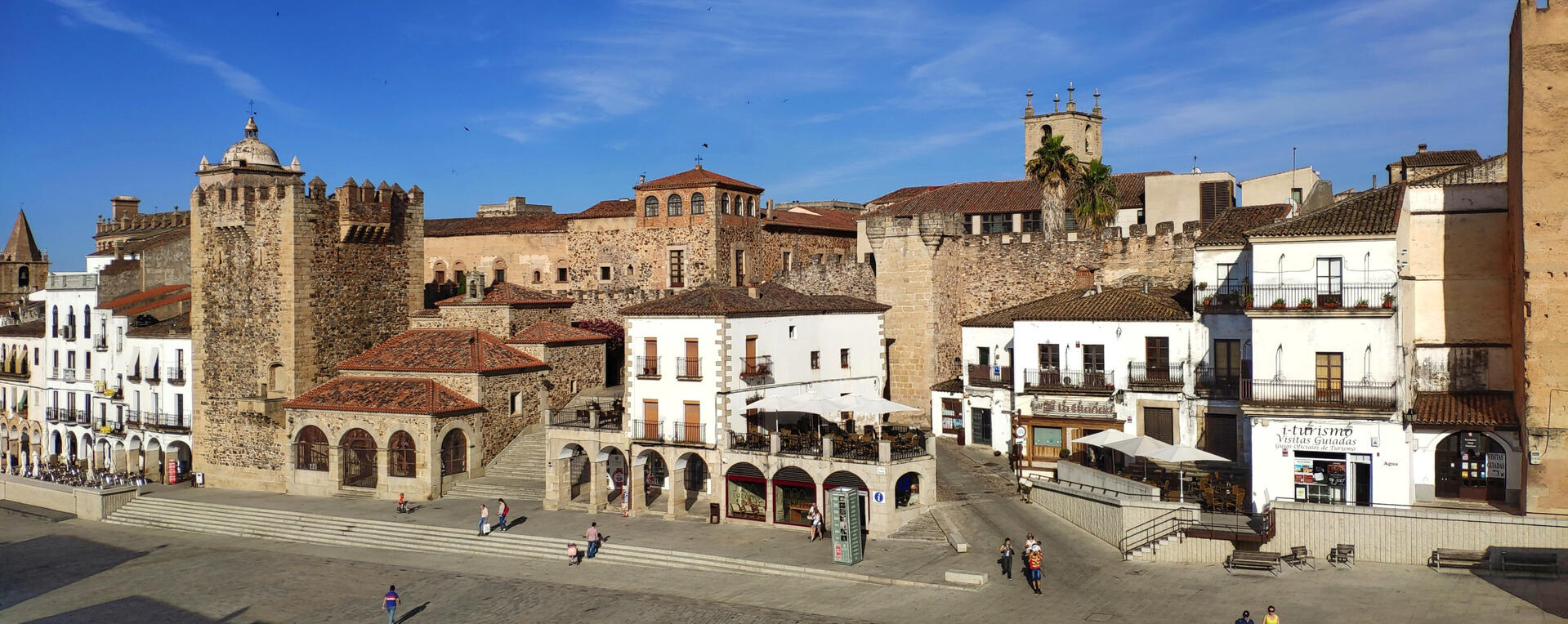
© Alonso de Mendoza, CC BY-SA 4.0 Resized from original. (This derivative is under the same CC BY-SA license.)
World Heritage Research
Discover scientific research and academic studies that deepen our understanding of Old Town of Cáceres from its history and significance to its conservation, management, and contemporary challenges.
-
Culture as a Resilient and Sustainable Strategy in Small Cities
Small cities can mitigate population decline and economic stagnation by investing in culture, as demonstrated by five Spanish case studies. Allariz, Almagro, Astorga, Puigcerdá, and Trujillo have successfully used cultural strategies—such as theater festivals, historical preservation, and identity-driven initiatives—to reverse demographic and economic challenges. Unlike nearby towns facing abandonment, these cities leveraged heritage (e.g., a 17th-century corral de comedia in Almagro or pre-Roman ruins in Trujillo) to foster resilience, improve quality of life, and boost local economies. The study highlights culture as a sustainable development model for small urban centers worldwide.
Somoza Medina, X., & Relea Fernández, C. E. (2024). Culture as a Resilient and Sustainable Strategy in Small Cities. Sustainability, 16(17), 7582. https://doi.org/10.3390/su16177582
View Publication Record | Read Publication -
Information sources and tourism heritage: a sustainable economy perspective
A positive relationship exists between the sources of information tourists use and their satisfaction with heritage tourism experiences, influencing future behavioral intentions. Conducted in Cáceres, Spainthis study applies descriptive analysis to survey data, revealing that tourist motivations are pivotal in shaping overall experience and loyalty. The findings underscore the importance of leveraging modern communication technologies and integrated planning for sustainable heritage development, aligning with UN Agenda 2030 goals. This research offers novel evidence on how information sources impact tourist behavior in a World Heritage context, providing actionable insights for heritage tourism strategies.
Folgado-Fernández, J. A., Huete-Alcocer, N., Hernández-Rojas, R., & Vileikis, O. (2024). Information sources and tourism heritage: a sustainable economy perspective. Journal of Cultural Heritage Management and Sustainable Development, 15(4), 756–770. https://doi.org/10.1108/jchmsd-05-2023-0062
View Publication Record | Read Publication -
Perceptions and effects of the acoustic environment in quiet residential areas
In quiet residential areas, the absence of daytime noise significantly enhances overall urban environmental perception more than even the sense of security. Road traffic remains the most annoying noise source, but its impact on annoyance and sleep disturbance is lower compared to previous studies with similar sound exposure levels. This study analyzed sound levels and surveyed residents' and passers-by perceptions in Cáceres' old town, revealing that low-intensity noise pollution and characteristic soundmarks like bells and birds also contribute to annoyance despite their positive acoustic environment.
Rey Gozalo, G., & Barrigón Morillas, J. M. (2017). Perceptions and effects of the acoustic environment in quiet residential areas. The Journal of the Acoustical Society of America, 141(4), 2418–2429. https://doi.org/10.1121/1.4979335
View Publication Record | Read Publication