World Heritage Identification Number: 116
World Heritage since: 1988
Category: Cultural Heritage
WHE Type: Historic Cities & Urban Areas
Transboundary Heritage: No
Endangered Heritage: Yes
Country: 🇲🇱 Mali
Continent: Africa
UNESCO World Region: Africa
Map
Exploring the Rich History of the Old Towns of Djenné
The Old Towns of Djenné, situated in the heart of Mali, West Africa, offer a unique blend of history, culture, and architectural marvel. This UNESCO World Heritage Site has been inhabited since around 250 BC, making it a significant location for understanding the region's ancient past.
More to come…UNESCO Description of the World Heritage Site
Inhabited since 250 B.C., Djenné became a market centre and an important link in the trans-Saharan gold trade. In the 15th and 16th centuries, it was one of the centres for the propagation of Islam. Its traditional houses, of which nearly 2,000 have survived, are built on hillocks (toguere) as protection from the seasonal floods.
UNESCO Justification of the World Heritage Site
Criterion (iii): Djenné-Djeno, along with Hambarketolo, Tonomba and Kaniana bears exceptional witness to the pre-Islamic civilizations on the inland Delta of the Niger. The discovery of many dwellings on the site of Djenné-Djeno (remains of traditional brick structures (djénné ferey), funerary jars) as well as a wealth of terra cotta artifacts and metal make this a major archaeological site for the study of the evolution of dwellings, industrial and craft techniques.
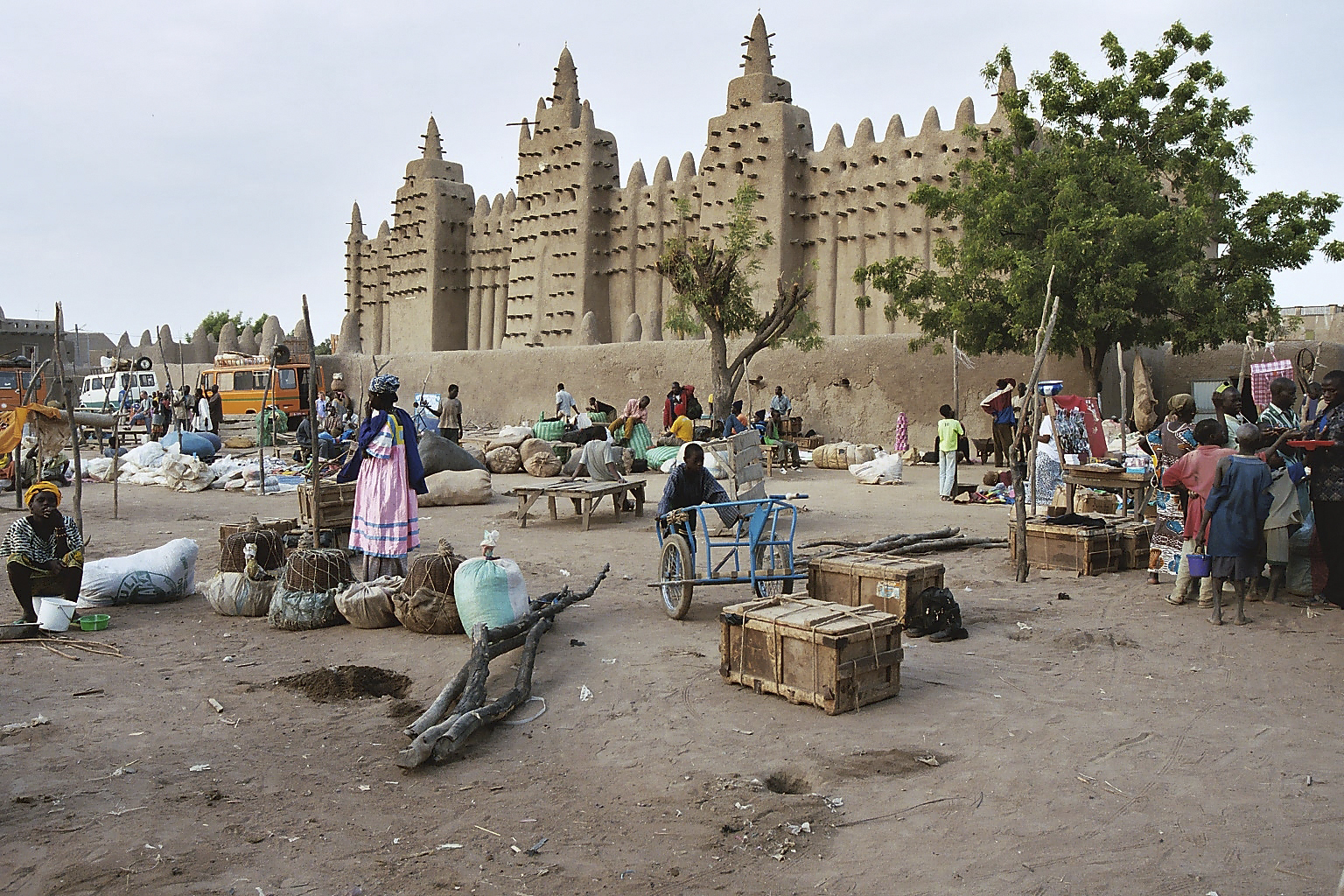
Criterion (iv): The ancient fabric of Djenné is an outstanding example of an architectural group of buildings illustrating a significant historic period. Influenced by Moroccan architecture (1591), and later marked by the Toucouleur Empire in 1862, the architecture of Djenné is characterized by its verticality, its buttresses punctuating the facades of the two-storey houses whose entrances are always given special attention. The reconstruction of the Mosque (1906-1907) resulted in the creation of a monument representing local religious architecture.
Encyclopedia Record: Old Towns of Djenné
The Old Towns of Djenné is an archaeological and urban ensemble located in the city of Djenné, in Mali. It comprises four archaeological sites, namely Djenné-Djeno, Hambarkétolo, Kaniana, and Tonomba. In 1988, it was inscribed by the UNESCO on the World Heritage list.Additional Site Details
Area: Not available
Number of Components: 5
(iv) — Outstanding example of a type of building or landscape
Coordinates: 13.90639 , -4.555
World Heritage Research
Discover scientific research and academic studies that deepen our understanding of Old Towns of Djenné from its history and significance to its conservation, management, and contemporary challenges.
-
How Is Authenticity Perceived in the Management of African World Heritage Sites? The Case of World Heritage Sites in Mali
Authenticity in the conservation of African World Heritage Sites extends beyond material criteria, encompassing deep sociocultural and spiritual dimensions. A study of Mali's four UNESCO-listed sites—Djenné, Timbuktu, Bandiagara Escarpment, and Askia’s Tomb—reveals a significant disconnect between institutional definitions of authenticity and the perspectives of local communities. These communities view authenticity through regenerative building cultures and intangible practices, contrasting with modern urban development aspirations. This holistic understanding poses challenges for sustainable conservation but underscores the importance of integrating traditional knowledge into heritage management strategies.
Cissé, L. (2026). How Is Authenticity Perceived in the Management of African World Heritage Sites? The Case of World Heritage Sites in Mali. Heritage Authenticity in Theory and Practice in Africa, 403–413. https://doi.org/10.1007/978-981-92-2619-1_29
View Publication Record | Read Publication -
‘This blessed city’: excavations at the second-millennium AD trade town of Jenné (Inland Niger Delta, Mali)
Excavations at the UNESCO World Heritage Site of Old Towns of Djenné, Mali, revealed a continuous occupation from the late 13th to early 20th century AD, providing unprecedented insights into the trade town's development and cultural evolution. Radiocarbon dating confirmed that the site's earliest phase overlapped with the final occupation of Jenné-jeno, its ancestral settlement, indicating strong temporal and cultural continuity. Five distinct phases of building, accumulation, and leveling were identified, documenting architectural and material culture changes over centuries. The study also sheds light on subsistence economy shifts and trade interactions, contributing significantly to understanding the site's historical significance as a key trade hub in West Africa.
McIntosh, S. K., Cain, C., Cissé, M., Murray, S., Stoker, K., Stone, A. C., & McIntosh, R. J. (2025). ‘This blessed city’: excavations at the second-millennium AD trade town of Jenné (Inland Niger Delta, Mali). Azania: Archaeological Research in Africa, 60(2), 165–232. https://doi.org/10.1080/0067270x.2025.2479376
View Publication Record | Read Publication -
Investigation of influential factors in Mali’s prototype mosques: A case study of the Djenné Great Mosque
The architectural form of Mali's prototype mosques, exemplified by the Great Mosque of Djenné—a global icon of Sudano-Sahelian architecture—is shaped by a dynamic interplay between local environmental conditions, accessible materials (primarily mud-brick), and deep-rooted religious and cultural traditions. This study reveals that the mosque's enduring design, influencing Sahelian mosque construction for centuries, stems from these integrated factors rather than isolated influences. Researchers employed qualitative case-study methods, including comparative stylistic analysis, architectural assessment, and literature-based evaluations, to analyze the Djenné Mosque alongside regional styles like Moroccan, Tokolar, Plain, and Neo-Sudanese. By identifying commonalities and differences, the study underscores how material constraints, climate, and cultural practices collectively define the mosque's prototype status.
Mohamed Osman, M., Abdullahi, B., & Maikudi, M. (2025). Investigation of influential factors in Mali’s prototype mosques: A case study of the Djenné Great Mosque. KIU Journal of Science Engineering and Technology, 4(2), 299–307. https://doi.org/10.59568/kjset-2025-4-2-28
View Publication Record | Read Publication -
(Re)framing built heritage through the machinic gaze
The machinic gaze emerges as a transformative force in heritage representation, reshaping how built heritage is perceived and documented through artificial intelligence (AI) models. This study introduces the concept to describe how machine learning and vision technologies distort and reorient perspectives on UNESCO World Heritage Sites, such as Old Towns of Djenné, by storing, retrieving, and resynthesizing images from vast digital archives. Employing an image-text-image pipeline, the research leverages heteroscopia and anamorphosis—concepts from media studies—to expose the artifice of human gaze assumptions embedded in established heritage narratives. The machinic gaze not only challenges traditional representations but also highlights the underlying practices that define heritage, offering a critical reconfiguration of how we engage with cultural landmarks.
Arora, V., Magee, L., & Munn, L. (2024). (Re)framing built heritage through the machinic gaze. Journal of Social Archaeology, 24(2), 197–217. https://doi.org/10.1177/14696053241237949
View Publication Record | Read Publication -
Meaning of the great mosque of Djenné: (A nonverbal communication approach)
The Great Mosque of Djenné, recognized as the largest mud structure still standing globally and a UNESCO World Heritage Site since 1988, serves as a profound symbol of shared identity and resistance for its community. This study reveals that the mosque's materials, design, shape, function, and sociocultural significance contribute to collective wellbeing, reinforcing its role as both a political icon and an architectural marvel in sub-Saharan Africa. The research employs a nonverbal communication approach to analyze these elements, highlighting the mosque's enduring legacy despite periods of ruin and restoration. Its 'Sudanese style' has influenced vernacular mosque design across the region, cementing Djenné's historical significance as a center for trade, study, and Islam since the 13th century.
Mubarak, M. O., Harcel, A., Muawiya, M., & Bashir, A. (2024). Meaning of the great mosque of Djenné: (A nonverbal communication approach). KIU Journal of Science Engineering and Technology, 84–92. https://doi.org/10.59568/kjset-2024-3-2-08
View Publication Record | Read Publication -
The Survival of Earthen Architecture in Malian Sahel, Case Study: The Historic City of Djenné
The historic city of Djenné faces significant socio-economic challenges that threaten the survival of its earthen architecture. This study reveals a decline in residents' quality of life and heritage conservation efforts due to unprecedented security pressures in the Malian Sahel. Analyzing data from administration records, surveys, and stakeholder interviews, the research highlights the complex interplay between urban heritage and local communities, emphasizing the importance of integrating religious beliefs and cultural values into urban planning. The findings urge decision-makers to implement strategies that foster a more dynamic socio-economic environment, ensuring the preservation of Djenné's architectural legacy for future generations.
Siriman, D., & Wang, Y. (2021). The Survival of Earthen Architecture in Malian Sahel, Case Study: The Historic City of Djenné Current Urban Studies, 09(01), 83–106. https://doi.org/10.4236/cus.2021.91006
View Publication Record | Read Publication -
The involvement of local communities in the conservation process of earthen architecture in the Sahel-Sahara region – the case of Djenné, Mali
Local community involvement is critical to the preservation of earthen architecture in the Sahel-Sahara region, including UNESCO World Heritage Sites like Djenné. This study highlights how traditional knowledge and cultural practices can sustainably conserve such heritage, which faces threats from disruptions, inadequate conservation strategies, and neglect. Through an anthropological approach comparing multiple sites influenced by trans-Saharan trade, the research underscores the importance of integrating tangible and intangible methods—such as oral history and adaptive construction techniques—to protect cultural landscapes, urban centers, and archaeological sites. The findings emphasize that sustainable conservation requires balancing heritage preservation with community-driven practices, ensuring long-term safeguarding against decay or abandonment.
Sacko, O. (2021). The involvement of local communities in the conservation process of earthen architecture in the Sahel-Sahara region – the case of Djenné, Mali. Built Heritage, 5(1). https://doi.org/10.1186/s43238-021-00040-y
View Publication Record | Read Publication