World Heritage Identification Number: 1106
World Heritage since: 2004
Category: Cultural Heritage
WHE Type: Archaeological Sites
Transboundary Heritage: No
Endangered Heritage: No
Country: 🇮🇷 Iran (Islamic Republic of)
Continent: Asia
UNESCO World Region: Asia and the Pacific
Map
Pasargadae: The First Dynastic Capital of the Achaemenid Empire
Pasargadae, a significant historical site located in modern-day Iran, serves as a testament to the grandeur and cultural richness of the ancient Persian civilization. Inscribed as a UNESCO World Heritage Site in 2004, this archaeological complex offers a unique glimpse into the early phases of the Achaemenid Empire, established by Cyrus the Great in the 6th century BCE.
More to come…UNESCO Description of the World Heritage Site
Pasargadae was the first dynastic capital of the Achaemenid Empire, founded by Cyrus II the Great, in Pars, homeland of the Persians, in the 6th century BC. Its palaces, gardens and the mausoleum of Cyrus are outstanding examples of the first phase of royal Achaemenid art and architecture and exceptional testimonies of Persian civilization. Particularly noteworthy vestiges in the 160-ha site include: the Mausoleum of Cyrus II; Tall-e Takht, a fortified terrace; and a royal ensemble of gatehouse, audience hall, residential palace and gardens. Pasargadae was the capital of the first great multicultural empire in Western Asia. Spanning the Eastern Mediterranean and Egypt to the Hindus River, it is considered to be the first empire that respected the cultural diversity of its different peoples. This was reflected in Achaemenid architecture, a synthetic representation of different cultures.
UNESCO Justification of the World Heritage Site
Criterion (i): Pasargadae is the first outstanding expression of the royal Achaemenid architecture.
Criterion (ii): The dynastic capital of Pasargadae was built by Cyrus the Great with a contribution by different peoples of the empire created by him. It became a fundamental phase in the evolution of the classic Persian art and architecture.
Criterion (iii): The archaeological site of Pasargadae, with its palaces, gardens, and the tomb of the founder of the dynasty, Cyrus the Great, represents an exceptional testimony to the Achaemenid civilisation in Persia.
Criterion (iv): The “Four Gardens” type of royal ensemble which was created in Pasargadae, became a prototype for Western Asian architecture and design.
Encyclopedia Record: Pasargadae
Pasargadae was the capital of the Achaemenid Empire under Cyrus the Great, located just north of the town of Madar-e-Soleyman and about 90 kilometres (56 mi) to the northeast of the city of Shiraz. It is one of Iran's UNESCO World Heritage Sites. It is considered to be the location of the Tomb of Cyrus, a tomb previously attributed to Madar-e-Soleyman, the "Mother of Solomon". It is a national tourist site administered by the Iranian culture of world heritage.Additional Site Details
Area: 159.65 hectares
Number of Components: 1
(ii) — Significant interchange of human values
(iii) — Unique or exceptional testimony to a cultural tradition
(iv) — Outstanding example of a type of building or landscape
Coordinates: 30.19383 , 53.16729
Image
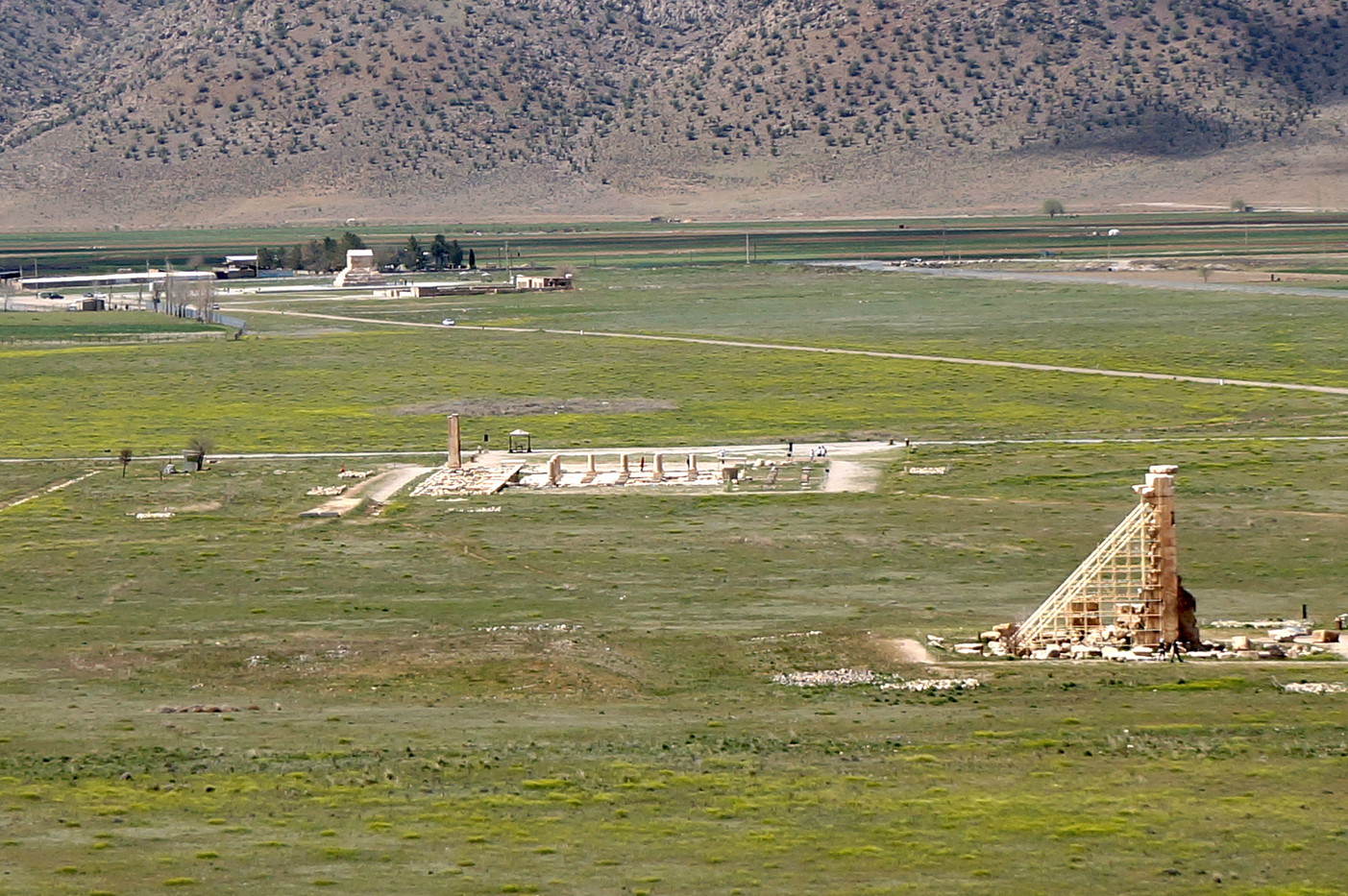
© Soheil Callage, CC BY-SA 4.0 Resized from original. (This derivative is under the same CC BY-SA license.)
World Heritage Research
Discover scientific research and academic studies that deepen our understanding of Pasargadae from its history and significance to its conservation, management, and contemporary challenges.
-
Ceremonial Landscapes of Pasargadae
Pasargadae, under Cyrus the Great's rule, established a unique Persian aesthetic by integrating cultural and natural landscapes to create ceremonial settings for large gatherings. The site's monumental structures—Gate R, Audience Palace (S), Residential Palace (P), and Zendan tower—likely served ritualistic purposes, with Gate R possibly functioning as a royal stage and the palaces hosting banquets while symbolizing the king's presence. Cyrus' burial at Pasargadae transformed the city into a focal point for funerary rites, emphasizing its role in daily homage to the departed monarch. The study reconstructs these ceremonial functions through spatial analysis and historical context.
Álvarez-Mon, J. (2026). Ceremonial Landscapes of Pasargadae. The Birth of Persian Art (c. 550–486 BC), 341–358. https://doi.org/10.4324/9781003641858-39
View Publication Record | Read Publication -
Constructing Space at Pasargadae
Pasargadae, founded around 550 BC, stands out for its vast scale, natural beauty, and decentralized architectural layout, contrasting sharply with the stratified urban designs of Elamite and Mesopotamian regions. Situated in the Dasht-i Murghab mountain plain at approximately 1,900 meters elevation, the site's spatial organization was intricately shaped by both natural topography and an advanced hydrological system. This system, comprising rivers, tributaries, dams, channels, and pools, played a crucial role in defining the city's 'urban planning.' Despite uncertain boundaries, five distinct sectors have been identified based on water features and movement patterns, revealing a sophisticated approach to urban design that integrated natural elements with engineered infrastructure.
Álvarez-Mon, J. (2026). Constructing Space at Pasargadae. The Birth of Persian Art (c. 550–486 BC), 13–18. https://doi.org/10.4324/9781003641858-4
View Publication Record | Read Publication -
The Beautiful Nothing: A Cosmic Reflection from Hafez's Tomb to Pasargadae
A groundbreaking simulation anchors the Solar System at Hafez's Tomb in Shiraz, Iran, scaling Earth to the size of a human cell. This localized model traces cosmic scales from the Sun (a 2mm bead on the tombstone) through the Oort Cloud boundary at Mount Bamu, culminating at the nearest neighboring star near Pasargadae's Almas-Bor mine. By integrating astronomical precision with Persian cultural heritage and Artemis II mission imagery, the study highlights humanity's profound isolation in the universe—a reflection on the 'Beautiful Nothing' that defines our existence.
Fotoohi Ghiam, M. (2026). The Beautiful Nothing: A Cosmic Reflection from Hafez's Tomb to Pasargadae. Zenodo. https://doi.org/10.5281/ZENODO.19697921
View Publication Record | Read Publication -
Pigments from Pasargadae and Persepolis in the Metropolitan Museum of Art (NY): recent scientific investigations on four paper squeezes
Recent scientific analysis of paper squeezes from UNESCO World Heritage Sites Pasargadae and Persepolis has identified new evidence of lazurite as a blue pigment and magnetite as black, alongside confirming previously known red pigments. These findings, derived from microscopic investigations, imaging techniques, and chemical analyses, provide deeper insights into the ancient polychromatic contexts of these sites. The study examined architectural fragments, including an anthropomorphic ear relief from Palace P in Pasargadae and a Hebrew-inscribed stone block from Persepolis' Tachara, revealing the complexity of pigment use in Achaemenid art and architecture.
Shekofteh, A., Nagel, A., & Oudbashi, O. (2025). Pigments from Pasargadae and Persepolis in the Metropolitan Museum of Art (NY): recent scientific investigations on four paper squeezes. Conservar Património. https://doi.org/10.14568/cp35708
View Publication Record | Read Publication -
Ritual, Ceremony, Dwelling: A function-space analysis of Iranian columned Halls from Hasanlu to Pasargadae (1300–540 BC)
A comparative function-space analysis of Iranian columned halls from Hasanlu to Pasargadae (1300–540 BC) reveals that functional needs were the primary determinant of spatial organization. Ritual halls, such as those at Hasanlu II, feature strong central axes, controlled access, and hierarchical circulation, while multifunctional halls like Nush-i Jan and Godin exhibit flexible, open spaces with multiple access points and lack rigid hierarchies. Residential halls, exemplified by Baba Jan II, prioritize daily functionality through asymmetry, decentralized columns, and integrated service spaces. The study identifies distinct patterns in movement (guided vs. free), spatial relationships (self-contained vs. integrated), and scale/height (monumental in ceremonial contexts).
Sarami, N. (2026). Ritual, Ceremony, Dwelling: A function-space analysis of Iranian columned Halls from Hasanlu to Pasargadae (1300–540 BC). Frontiers of Architectural Research, 15(3), 1059–1074. https://doi.org/10.1016/j.foar.2025.08.018
View Publication Record | Read Publication -
Biofilm driven bioweathering on limestone; a humidity dependent process
Cyanobacterial biofilms significantly accelerate limestone weathering at UNESCO World Heritage Site Pasargadae, with humidity playing a critical role. Research revealed that Chroococcidiopsis spp., dominant in endolithic biofilms, trigger microfracturing and mineral dissolution while forming rhombohedral CaCO₃ crystals under controlled hydration-desiccation cycles (29.5–100% RH). The study links phototrophic microbial activity to carbonate precipitation-dissolution dynamics in semiarid climates, emphasizing water availability as a key factor in biofilm-driven degradation. While findings highlight the process's humidity dependence, further research is needed to fully understand microbial community interactions.
Gholipour-Shahraki, M., Mohammadi, P., Ranjbaran, M., & Gu, J. D. (2025). Biofilm driven bioweathering on limestone; a humidity dependent process. Npj Materials Degradation, 9(1). https://doi.org/10.1038/s41529-025-00697-1
View Publication Record | Read Publication -
Resilience of the Parse-Pasargadae World Heritage Sites Against Environmental Crises Using Achaemenid Creativity and Traditional Knowledge
A study on the UNESCO World Heritage Sites of Pasargadae reveals that traditional Achaemenid engineering and knowledge can serve as a model for resilience against modern environmental crises. The research highlights how the Achaemenids designed integrated water systems to manage droughts and seasonal flash floods, while also employing seismic-resistant architectural techniques such as multi-layered stone foundations and large stone blocks to enhance structural stability. Through field investigations and historical document analysis, the study demonstrates that reapplying this ancient technical knowledge can restore human coexistence with natural hazards and protect heritage authenticity. The findings underscore the potential for traditional engineering solutions to address contemporary environmental challenges in semi-arid regions.
Fadaei, H., Kamali, A., & Karami, H. (2025). Resilience of the Parse-Pasargadae World Heritage Sites Against Environmental Crises Using Achaemenid Creativity and Traditional Knowledge. Athar, 45(4), 5–40. https://doi.org/10.66224/45.107.1
View Publication Record | Read Publication