World Heritage Identification Number: 114
World Heritage since: 1979
Category: Cultural Heritage
WHE Type: Archaeological Sites
Transboundary Heritage: No
Endangered Heritage: No
Country: 🇮🇷 Iran (Islamic Republic of)
Continent: Asia
UNESCO World Region: Asia and the Pacific
Map
Persepolis: The Imperial Capital of the Achaemenid Empire
Persepolis, located in the plains of Marvdasht, Fars Province, Iran, stands as a testament to the grandeur and architectural prowess of the ancient world. This archaeological site, founded by Darius I in 518 BC, served as the ceremonial capital of the Achaemenid Empire, a Persian empire that spanned from modern-day Afghanistan to Egypt during its height.
More to come…UNESCO Description of the World Heritage Site
Founded by Darius I in 518 B.C., Persepolis was the capital of the Achaemenid Empire. It was built on an immense half-artificial, half-natural terrace, where the king of kings created an impressive palace complex inspired by Mesopotamian models. The importance and quality of the monumental ruins make it a unique archaeological site.
UNESCO Justification of the World Heritage Site
Criterion (i): The terrace of Persepolis, with its double flight of access stairs, its walls covered by sculpted friezes at various levels, contingent Assyrianesque propylaea, the gigantic winged bulls, and the remains of large halls, is a grandiose architectural creation. The studied lightening of the roofing and the use of wooden lintels allowed the Achaemenid architects to use, in open areas, a minimum number of astonishingly slender columns (1.60 metres in diameter vis-à-vis a height of about 20 metres). They are surmounted by typical capitals where, resting on double volutes, the forequarters of two kneeling bulls, placed back-to-back, extend their coupled necks and their twin heads, directly under the intersections of the beams of the ceiling.
Criterion (iii): This ensemble of majestic approaches, monumental stairways, throne rooms (Apadana), reception rooms, and annex buildings is classified among the world’s greatest archaeological sites, among those which have no equivalent and which bear witness of a unique quality to a most ancient civilization.
Criterion (vi): The terrace of Persepolis continues to be, as its founder Darius would have wished, the image of the Achaemenid monarchy itself, the summit where likenesses of the king reappear unceasingly, here as the conqueror of a monster, there carried on his throne by the downtrodden enemy, and where lengthy cohorts of sculpted warriors and guards, dignitaries, and tribute bearers parade endlessly.
Encyclopedia Record: Persepolis
Persepolis was the ceremonial capital of the Achaemenid Empire. It is situated in the plains of Marvdasht, encircled by the southern Zagros Mountains, Fars province of Iran. It is one of the key Iranian cultural heritage sites and a UNESCO World Heritage Site.Additional Site Details
Area: 12.5 hectares
Number of Components: 1
(iii) — Unique or exceptional testimony to a cultural tradition
(vi) — Directly associated with events or living traditions
Coordinates: 29.93444 , 52.89028
Image
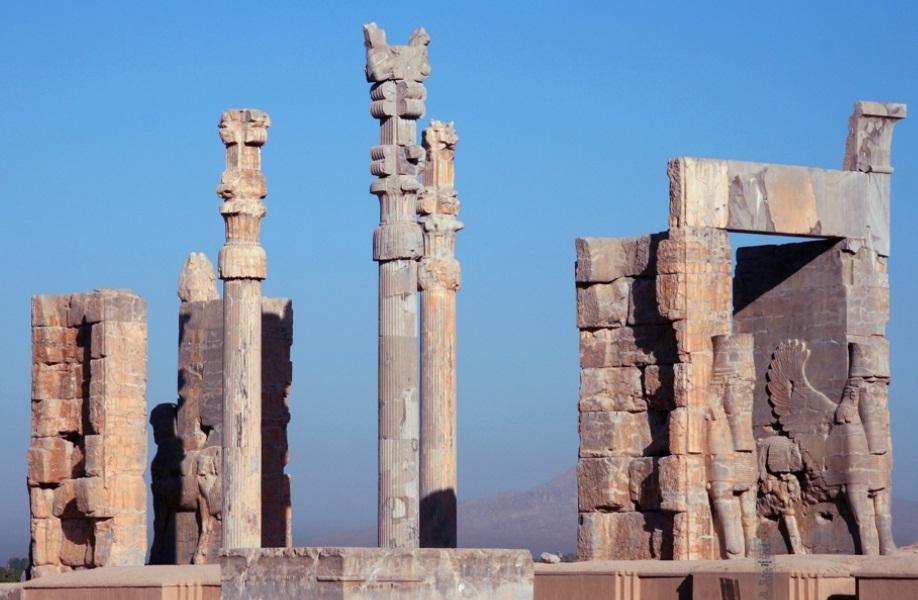
© Alborzagros, CC BY-SA 3.0 Resized from original. (This derivative is under the same CC BY-SA license.)