World Heritage Identification Number: 18
World Heritage since: 1978
Category: Cultural Heritage
WHE Type: Religious Sites & Sacred Architecture
Transboundary Heritage: No
Endangered Heritage: No
Country: 🇪🇹 Ethiopia
Continent: Africa
UNESCO World Region: Africa
Map
The Rock-Hewn Churches of Lalibela: Ethiopia's Medieval Masterpiece
The Rock-Hewn Churches of Lalibela, inscribed as a UNESCO World Heritage Site in 1978, stand as a testament to the architectural achievements of medieval Ethiopia. Situated in the highlands of northern Ethiopia, these 11 rock-hewn churches serve as a spiritual center for Ethiopian Christianity and remain a significant destination for pilgrims from around the world.
King Gebre Meskel Lalibela, ruler of the Zagwe dynasty during the late 12th and early 13th centuries, is traditionally credited with commissioning the construction of these remarkable structures. His ambition was to create a new Jerusalem within his kingdom, mirroring the religious significance of the Holy Land. According to traditional accounts, the project took approximately 24 years to complete, resulting in the 11 churches that make up the Rock-Hewn Churches of Lalibela.
The churches are arranged in distinct groups connected by a network of trenches, tunnels, and ceremonial pathways carved into the surrounding rock. This unique layout is believed to reflect King Lalibela's vision of creating a symbolic New Jerusalem, with certain features and place names echoing locations associated with the Holy Land. The interconnected design not only facilitated religious processions but also enhanced the spiritual experience of pilgrims visiting the site.
Carved directly from volcanic rock, primarily red volcanic scoria underlain by basalt, these structures demonstrate the exceptional skill of the artisans who worked on the project. The intricate designs, ornate carvings, and sophisticated engineering techniques employed in their creation showcase the mastery of Ethiopian craftsmanship during this era.
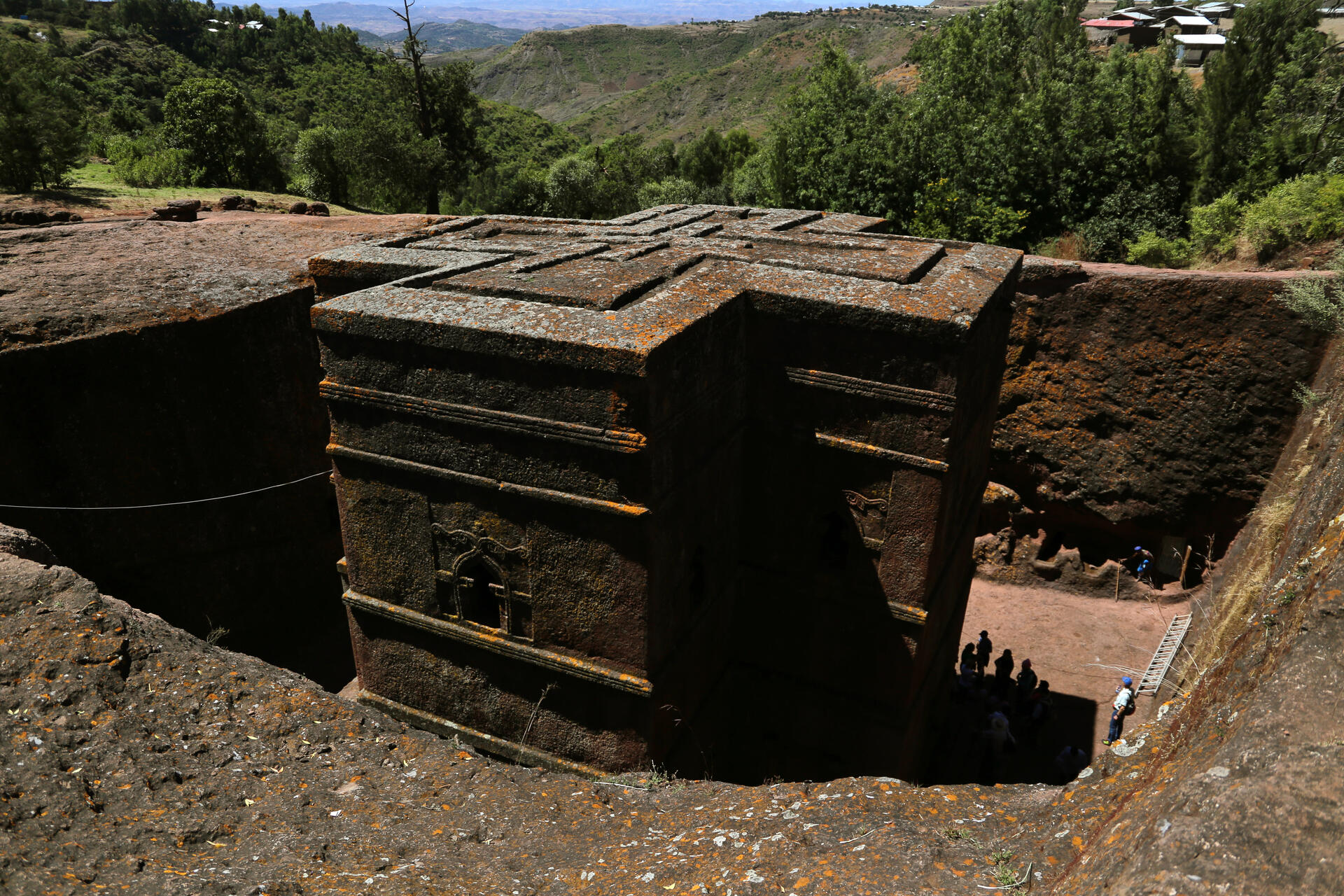
Among the most famous of these churches is Bet Giyorgis (Church of St. George), renowned for its distinctive cross-shaped design and monolithic construction, having been carved from a single mass of rock. Another notable structure is Bet Medhane Alem (Church of the Savior of the World), which is widely regarded as the largest church in the complex and is distinguished by its impressive size and colonnaded interior.
More than eight centuries after their construction, the sanctuaries continue to play a vital role in the religious life of Ethiopia. They remain active places of worship for the Ethiopian Orthodox Tewahedo Church, with religious services taking place throughout the year. The faithful travel from far and wide to visit these sacred sites, seeking spiritual renewal and a deeper connection with their faith.
Lalibela's significance is particularly evident during major religious festivals, when thousands of pilgrims gather to participate in ceremonies and celebrations. Ethiopian Christmas, known as Genna, and Timkat, the celebration of Epiphany, attract worshippers from across the country and beyond. Clad in traditional white garments, pilgrims fill the churches and courtyards, creating a powerful display of faith that has endured for centuries.
Beyond their role as places of worship, the Rock-Hewn Churches of Lalibela possess immense cultural and historical value. They offer insight into Ethiopia's rich history and traditions, providing a tangible link to the medieval past and serving as a source of national pride. UNESCO recognizes the site as an outstanding example of medieval Christian architecture and one of the world's most extraordinary religious landscapes carved directly from rock.
Despite their remarkable durability, the Rock-Hewn Churches of Lalibela face ongoing conservation challenges. Exposure to weather, water infiltration, and natural erosion has threatened parts of the complex over time. In response, preservation initiatives undertaken by Ethiopian authorities and international organizations have sought to protect the churches while maintaining their historical and religious integrity.
Today, the Rock-Hewn Churches of Lalibela attract visitors from around the globe, captivating them with their unique beauty, historical importance, and spiritual atmosphere. As a UNESCO World Heritage Site, they serve as a reminder of the remarkable achievements of human ingenuity and the enduring legacy of Ethiopian civilization. More than eight centuries after they were carved from the living rock, the churches of Lalibela remain a powerful symbol of Ethiopia's history, faith, and cultural identity.
UNESCO Description of the World Heritage Site
The 11 medieval monolithic cave churches of this 13th-century 'New Jerusalem' are situated in a mountainous region in the heart of Ethiopia near a traditional village with circular-shaped dwellings. Lalibela is a high place of Ethiopian Christianity, still today a place of pilmigrage and devotion.
UNESCO Justification of the World Heritage Site
Criterion (i): All the eleven churches represent a unique artistic achievement, in their execution, size and the variety and boldness of their form.
Criterion (ii): The King of Lalibela set out to build a symbol of the holy land, when pilgrimages to it were rendered impossible by the historical situation. In the Church of Biet Golgotha, are replicas of the tomb of Christ, and of Adam, and the crib of the Nativity. The holy city of Lalibela became a substitute for the holy places of Jerusalem and Bethlehem, and as such has had considerable influence on Ethiopian Christianity.
Criterion (iii): The whole of Lalibela offers an exceptional testimony to the medieval and post-medieval civilization of Ethiopia, including, next to the eleven churches, the extensive remains of traditional, two storey circular village houses with interior staircases and thatched roofs.
Encyclopedia Record: Rock-Hewn Churches, Lalibela
The eleven Rock-hewn Churches of Lalibela are monolithic churches located in the western Ethiopian Highlands near the town of Lalibela, named after the late-12th and early-13th century King Gebre Meskel Lalibela of the Zagwe dynasty, who commissioned the massive building project of 11 rock-hewn churches to recreate the holy city of Jerusalem in his own kingdom. The site remains in use by the Ethiopian Orthodox Christian Church to this day, and it remains an important place of pilgrimage for Ethiopian Orthodox worshipers. It took 24 years to build all the 11 rock hewn churches.Additional Site Details
Area: Not available
Number of Components: 1
(ii) — Significant interchange of human values
(iii) — Unique or exceptional testimony to a cultural tradition
Coordinates: 12.02935 , 39.04042
World Heritage Research
Discover scientific research and academic studies that deepen our understanding of Rock-Hewn Churches, Lalibela from its history and significance to its conservation, management, and contemporary challenges.
-
Wukro Medhane Alem: A Medieval Rock-hewn Church in Historic Gondar, Ethiopia
Wukro Medhane Alem, a medieval rock-hewn church in South Gondar, Ethiopia, represents a transitional architectural phase from the earlier Aksumite and Lalibela traditions to the built palaces of the Gondarine period (1636–1769). This monolithic hypogeum, traditionally attributed to King Lalibela (r. 1181–1221), features a rectangular plan with refined rock-hewn pillars, arches, and capitals partitioning its interior into distinct liturgical spaces: kine mahilet (chanting), kiddist (holy), and mekides or kiddiste kiddusan (sanctuary). The sanctuary includes six sub-sanctuaries with doubled circular domed roofs and rectangular altars, showcasing intricate cruciform, geometrical, and quadrifoliate engravings. Fieldwork, interviews, and literature review reveal its potential as an underappreciated tourist site in historic Gondar, complementing the region’s better-known built heritage.
Ebabey, T. (2023). Wukro Medhane Alem: A Medieval Rock-hewn Church in Historic Gondar, Ethiopia. Tourism and Heritage Journal, 4, 111–125. https://doi.org/10.1344/thj.2022.4.7
View Publication Record | Read Publication -
Architectural conservation of the rock-hewn churches of Lalibela, Ethiopia: A study on preservation and socio-economic conservation
Ethiopia's Rock-Hewn Churches of Lalibela, celebrated for their 12th-century monolithic structures carved from solid rock, face significant deterioration due to natural and human-induced factors. This study critically evaluates conservation efforts, emphasizing the cultural relevance and inherent values tied to these architectural marvels. It identifies critical gaps in funding and technical requirements while advocating for sustainable conservation practices that foster local ownership and awareness. The research employs qualitative methods, including in-depth case studies from Lalibela and other rock-cut structures, alongside a review of published works. Key recommendations include strengthening local capabilities and establishing a dedicated conservation fund to ensure the long-term preservation of these UNESCO World Heritage Sites. These insights provide actionable strategies for addressing similar challenges at other globally significant sites.
Richard, F. N., & Golkarian, Sh. (2023). Architectural conservation of the rock-hewn churches of Lalibela, Ethiopia: A study on preservation and socio-economic conservation. Revista Amazonia Investiga, 12(67), 127–138. CLOCKSS. https://doi.org/10.34069/ai/2023.67.07.12
View Publication Record | Read Publication -
Non-Destructive Analysis to Investigate the Stone Alterations at a UNESCO World Heritage Site
A critical finding from this study is that liquid water, rather than salt crystallization, poses the most significant threat to the preservation of scoriaceous basalt at Lalibela's rock-hewn churches—a UNESCO World Heritage Site. To address this, researchers conducted non-destructive and minimally invasive analyses during two field campaigns in 2019 and 2020, assessing surface alterations and differential weathering patterns. The study, supported by the French Development Agency and Ethiopian authorities, aimed to inform conservation strategies for the site. By comparing protected and unprotected areas, it demonstrated that prolonged exposure to moisture accelerates deterioration, necessitating comprehensive protective measures to safeguard these heritage structures in humid environments.
Giovannacci, D., Mertz, J.-D., Gemeda, B. T., Garric, A., & Mensan, R. (2022). Non-Destructive Analysis to Investigate the Stone Alterations at a UNESCO World Heritage Site. Journal of Human, Earth, and Future, 3(2), 147–158. https://doi.org/10.28991/hef-2022-03-02-01
View Publication Record | Read Publication -
Seasonality in Moisture Dynamics in the Walls of the rock-cut Churches in Lalibela, Ethiopia: Implications for Weathering
Seasonal moisture dynamics in the walls of Lalibela's rock-cut churches significantly influence weathering patterns, with complex damage profiles emerging due to contrasting saturation behaviors between wet and dry seasons. During the wet season, deeper layers retain higher moisture levels, leading to surface salt accumulation as constant-rate drying occurs. Conversely, the dry season sees increased surface saturation and subsurface salt buildup, driven by high rock temperatures. This study, using non-destructive Microwave Moisture Measurement System (MMMS) monitoring at two monolithic churches, underscores the vulnerability of these structures to moisture-related decay, particularly due to their lack of impermeable foundations or roofs. The findings reveal a dynamic interplay between moisture and temperature that exacerbates weathering, posing challenges for conservation efforts.
Taye, B., Viles, H., & Orr, S. A. (2022). Seasonality in Moisture Dynamics in the Walls of the rock-cut Churches in Lalibela, Ethiopia: Implications for Weathering. International Journal of Architectural Heritage, 18(2), 302–315. https://doi.org/10.1080/15583058.2022.2142699
View Publication Record | Read Publication -
The rock-cut churches of Lalibela and the cave church of Washa Mika'el: troglodytism and the Christianisation of the Ethiopian Highlands
Recent archaeological research challenges the notion that Lalibela's monolithic churches emerged suddenly during Ethiopia's Christian shift from Aksum to the Highlands in the 13th century. Instead, these rock-cut structures were built upon an earlier troglodytic tradition, particularly evident at Washa Mika'el. This finding reveals a continuity between pre-Christian and Christian cultures, with sculpted decor adapting within a new religious framework. The study combines archaeological evidence to illuminate medieval Ethiopia's cosmopolitan society and its role in the region's Christianization.
Derat, M.-L., Bosc-Tiessé, C., Garric, A., Mensan, R., Fauvelle, F.-X., Gleize, Y., & Goujon, A.-L. (2021). The rock-cut churches of Lalibela and the cave church of Washa Mika’el: troglodytism and the Christianisation of the Ethiopian Highlands. Antiquity, 95(380), 467–486. https://doi.org/10.15184/aqy.2021.20
View Publication Record | Read Publication -
The Use of Decision Making Multi-Media Components in Elucidating the Construction Methods of the St. George Church in Lalibela, Ethiopia
A Microsoft Windows-based multi-media graphical system offers new insights into the construction methods of St. George's Church, a UNESCO-listed 12th-century monolithic hypogea in Lalibela, Ethiopia. The system simulates two proposed engineering approaches—MEOI (Measure, Excavate, Outside, Inside) and MSOI (Measure, Simultaneous excavation, Outside, Inside)—allowing learners to virtually reconstruct the church using ancient or modern tools, varying labor forces, and volcanic tufa of different hardness levels. By providing interactive exploration of dimensions, material properties, and construction decisions, the system bridges historical gaps in engineering knowledge while inspiring sustainable modern construction techniques inspired by ancient methods.
Ridgill, B., Tan, A., Tan, F., & Yang, J. THE USE OF DECISION MAKING MULTI-MEDIA COMPONENTS IN ELUCIDATING THE CONSTRUCTION METHODS OF THE ST. GEORGE CHURCH IN LALIBELA, ETHIOPIA. 2017 ASEE Annual Conference & Exposition Proceedings. https://doi.org/10.18260/1-2--29017
View Publication Record | Read Publication -
The rock-hewn church of Nazugn Maryam: an example of the endangered antiquities of North Wallo, Ethiopia.
The rock-hewn church of Nazugn Maryam, located near Lalibela, Ethiopia, is an endangered example of ancient hypogeum architecture. Despite its historical significance and traditional attribution to Abunä Musé, the second bishop of Ethiopia, it has received little scholarly attention or professional conservation efforts. This study reveals that its architectural integrity is threatened by natural factors such as torrential rainfall and sunlight, as well as past restoration attempts using modern materials like cement and basaltic stone, which have exacerbated deterioration. The research employed interviews, field observations, and archive analysis to document the church's architecture and conservation challenges, highlighting the urgent need for compatible restoration strategies that preserve its cultural heritage without compromising structural stability.
Ebabey, T. (2018). The rock-hewn church of Nazugn Maryam: an example of the endangered antiquities of North Wallo, Ethiopia. Journal of African Cultural Heritage Studies, 1(1), 1. https://doi.org/10.22599/jachs.34
View Publication Record | Read Publication