World Heritage Identification Number: 757
World Heritage since: 1996
Category: Cultural Heritage
WHE Type: Religious Sites & Sacred Architecture
Transboundary Heritage: No
Endangered Heritage: No
Country: 🇮🇪 Ireland
Continent: Europe
UNESCO World Region: Europe and North America
Map
Sceilg Mhichíl: A Unique Medieval Monastic Settlement on the Atlantic Ocean
Sceilg Mhichíl, also known as Skellig Michael or Great Skellig, is a remarkable and distinctive medieval monastic settlement located off the coast of County Kerry, Ireland. Inscribed as a UNESCO World Heritage Site in 1996, the island offers a rare and compelling insight into the lives of early Christian monks who chose to pursue spiritual devotion in extreme isolation within a harsh and challenging environment.
The name Skellig derives from the Irish word sceilig, meaning a steep rock or splinter of stone. The island’s full Irish name, Sceilg Mhichíl (“Rock of Michael”), reflects its dedication to the Archangel Michael, part of a wider tradition in early Christianity that associated high and remote places with the cult of St Michael. A small chapel dedicated to the archangel forms part of the monastic complex.
Skellig Michael consists of two steep rocky pinnacles composed primarily of Old Red Sandstone, formed approximately 410–385 million years ago. These dramatic formations are geologically related to the mountain systems of southwest Ireland, including the nearby MacGillycuddy’s Reeks. Over millions of years, erosion and rising sea levels separated the islands from the mainland, leaving them isolated in the Atlantic Ocean.
The smaller neighboring island, Little Skellig, is inaccessible to humans and serves as an internationally important seabird sanctuary. It supports one of the world’s largest colonies of northern gannets (some 35,000 breeding pairs), along with other seabirds such as kittiwakes, storm petrels, razorbills, and puffins. Due to its ecological significance, Little Skellig is strictly protected and closed to visitors.
Skellig Michael, however, has been home to human inhabitants since the Early Christian period. The earliest evidence of habitation dates back to the 6th century AD when hermit monks began to settle on the island. By the 8th century, a well-organized monastic community had established itself, constructing numerous beehive-shaped huts, or clocháns, and churches. These structures were built using drystone construction techniques without mortar, showcasing the skill and ingenuity of the builders.
Access to the monastery is provided by three ancient, steep stone stairways carved directly into the rock. The South Steps, which form the primary route used by visitors today, consist of approximately 618 steps and lead from the landing area to the summit monastery, illustrating the physical endurance and determination required of the monastic inhabitants.
The monastic settlement flourished between the 9th and 12th centuries, although the community was always small, likely consisting of no more than a few dozen monks at any one time. Around the late 12th or early 13th century, the monks relocated to the mainland, probably due to increasingly harsh climatic conditions and changing ecclesiastical practices. While regular monastic life ceased, the island continued to hold religious significance as a place of pilgrimage.
Today, Skellig Michael stands as one of the most extraordinary surviving examples of early Christian eremitic monasticism in Europe, comparable to similar traditions found in parts of the Mediterranean and the Near East. Its exceptional preservation is largely due to its remote location and difficult access, which have limited human interference over the centuries. The surviving structures provide a powerful and tangible connection to the past and offering insights into the lives of the monks who once called this isolated outpost home.
UNESCO Description of the World Heritage Site
Sceilg Mhichíl is an outstanding, and in many respects unique, example of an early religious settlement deliberately sited on a pyramidal rock in the ocean, preserved because of a remarkable environment. It illustrates, as no other property can, the extremes of a Christian monasticism characterizing much of North Africa, the Near East, and Europe.UNESCO Justification of the World Heritage Site
Criterion (iii): Sceilg Mhichíl illustrates, as no other property can, the extremes of a Christian monasticism characterizing much of North Africa, the Near East and Europe.
Criterion (iv): Sceilg Mhichíl is an outstanding and in many respects a unique example of an early religious settlement deliberately sited on a pyramidal rock in the ocean, preserved because of a remarkable environment.
Encyclopedia Record: Skellig Michael
Skellig Michael, also called Great Skellig, is a twin-pinnacled crag 11.6 kilometres (7.2 mi) west of the Iveragh Peninsula in County Kerry, Ireland. The island is named after the archangel Michael; while "Skellig" is derived from the Irish language word sceilig, meaning a splinter of stone. Its twin island, Little Skellig, is smaller and inaccessible. The two islands were formed c. 374–360 million years ago during a period of mountain formation, along with the local MacGillycuddy's Reeks mountain range. They were later separated from the mainland by rising water levels.Additional Site Details
Area: 21.9 hectares
Number of Components: 1
(iv) — Outstanding example of a type of building or landscape
Coordinates: 51.77194 , -10.53861
Image
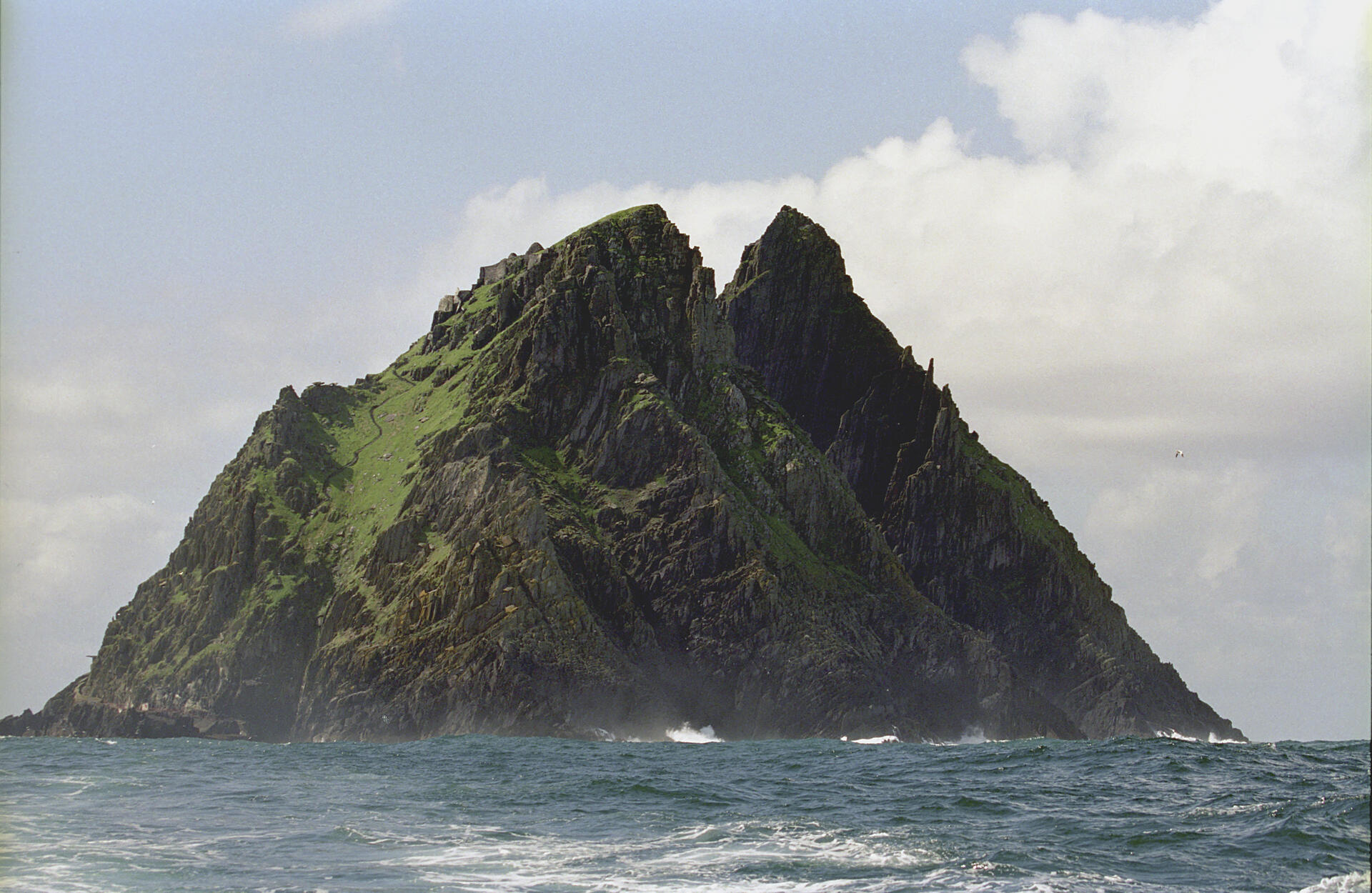
© Jerzy Strzelecki, CC BY-SA 3.0 Resized from original. (This derivative is under the same CC BY-SA license.)
World Heritage Research
Discover scientific research and academic studies that deepen our understanding of Sceilg Mhichíl from its history and significance to its conservation, management, and contemporary challenges.
-
The Book of the Skelligs ed. by John Crowley and John Sheehan (review)
The Book of the Skelligs, edited by John Crowley and John Sheehan, presents a comprehensive study of Sceilg Mhichíl, one of Ireland's most remote UNESCO World Heritage Sites. The book combines scientific research with historical and cultural analysis, revealing insights into the monastic settlement's occupation, diet, and layout changes over centuries. Limited archaeological interventions, conducted under the Office of Public Works, preserved the site's integrity while uncovering new data on its early history. The volume also explores the Skelligs' ecological significance, including its unique flora and fauna, with birds like puffins and gannets highlighting global migratory connections. Additionally, it delves into folklore and anthropology, providing a multifaceted understanding of the site's enduring cultural importance. High-quality photographs by Valerie O'Sullivan further enrich the text, offering visual context for the scientific and historical content.
Chuilleanáin, E. N. (2024). The Book of the Skelligs ed. by John Crowley and John Sheehan (review). Studies: An Irish Quarterly Review, 113(449), 125–128. https://doi.org/10.1353/stu.2024.a922774
View Publication Record | Read Publication -
Management of Isolated Islands: The example of Sceilg Mhichíl, Ireland
Skellig Michael, an isolated island off the coast of Ireland, presents unique challenges in management due to its dual designation as a UNESCO World Heritage Site and a Statutory Nature Reserve. The study highlights the complex task of balancing cultural heritage preservation with ecological conservation, particularly given the island's significant distance from the mainland. It emphasizes the need for high international standards in protection while providing essential services like guided tours. The research approaches this issue by examining the island's management strategies, which must account for its ornithological importance and cultural landscape significance. This case study offers insights into the practicalities of managing such isolated sites, where logistical constraints and the need to preserve both human heritage and wildlife are paramount.
Bourke, E. (2020). Management of Isolated Islands: The example of Sceilg Mhichíl, Ireland. Internet Archaeology. https://doi.org/10.11141/ia.54.14
View Publication Record | Read Publication