World Heritage Identification Number: 1529
World Heritage since: 2017
Category: Cultural Heritage
WHE Type: Natural Landscapes & Geographic Features
Transboundary Heritage: No
Endangered Heritage: No
Country: 🇫🇷 France
Continent: Europe
UNESCO World Region: Europe and North America
Map
Taputapuātea: A Cultural and Religious Hub of Ancient Polynesia
Taputapuātea, located on the eastern coast of Ra'iātea Island in French Polynesia, stands as a testament to over a millennium of Mā'ohi civilization. Inscribed as a UNESCO World Heritage Site in 2017, this significant cultural and religious hub lies at the heart of the 'Polynesian Triangle', a vast region of the Pacific Ocean teeming with islands.
More to come…UNESCO Description of the World Heritage Site
Taputapuātea on Ra’iātea Island is at the centre of the ‘Polynesian Triangle’, a vast portion of the Pacific Ocean, dotted with islands, and the last part of the globe to be settled by humans. The property includes two forested valleys, a portion of lagoon and coral reef and a strip of open ocean. At the heart of the property is the Taputapuātea marae complex, a political, ceremonial and funerary centre. It is characterized by several marae, with different functions. Widespread in Polynesia, the marae were places where the world of the living intersected the world of the ancestors and the gods. Taputapuātea is an exceptional testimony to 1,000 years of mā'ohi civilization.UNESCO Justification of the World Heritage Site
Criterion (iii): Taputapuātea illustrates in an exceptional way 1000 years of mā’ohi civilisation. This history is represented by the marae complex of Taputapuātea at the seashore and the variety of archaeological sites in the upland valleys. It reflects social organization with farmers who lived in the uplands and warriors, priests and kings settled near the sea. It also testifies to their skill in sailing outrigger canoes across long stretches of ocean, navigation by observation of natural phenomena, and transformation of newly settled islands into places that provided for the needs of their people.
Criterion (iv): Taputapuātea provides eminent examples of marae: temples with cult and social functions built by the mā'ohi people from the 14th to the 18th century. Marae were the points of intersection between the world of the living and that of the ancestors. Their monumental form reflects competition for prestige and power among the ari’i chiefs. Marae Taputapuātea itself is a concrete expression of the paramount alliance formed by its line of chiefs and the cult of worship associated with it, as stones were transported to other islands to found other marae with the same name.
Criterion (vi): As the ancestral homeland of Polynesian culture, Taputapuātea is of outstanding significance for people throughout the whole of Polynesia, for the way it symbolises their origins, connects them with ancestors and as an expression of their spirituality. These living ideas and knowledge are embedded in the landscapes and seascapes of Raiatea and particularly in the marae for the central roles that they once performed.
Encyclopedia Record: Taputapuatea marae
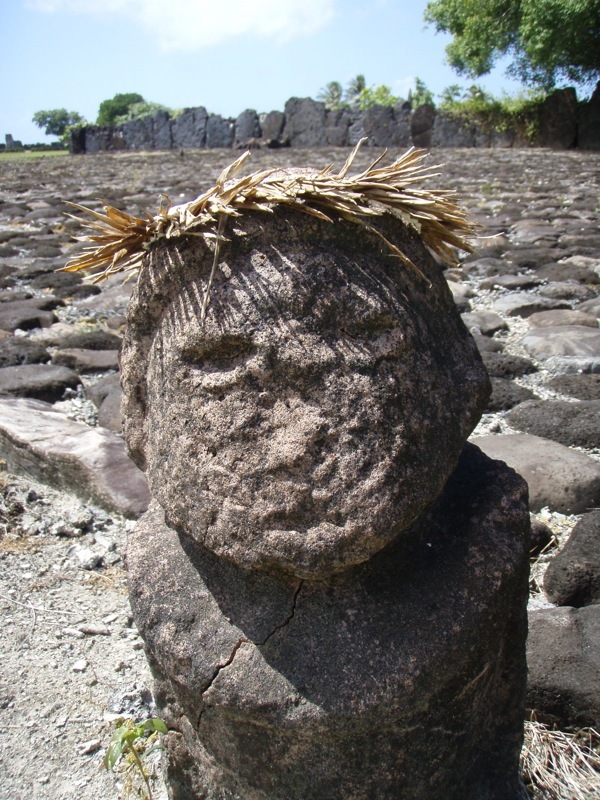
Marae Taputapuatea is a large marae complex at Opoa in Taputapuatea, on the eastern coast of Raiatea. The site features a number of marae and other stone structures and was once considered the central temple and religious center of Eastern Polynesia. In 2017, the Taputapuatea area and the marae complex were inscribed on the UNESCO World Heritage List because of its political and religious significance and its testimony to traditional eastern Polynesian culture.Additional Site Details
Area: 2,124 hectares
Number of Components: 1
(iv) — Outstanding example of a type of building or landscape
(vi) — Directly associated with events or living traditions
Coordinates: -16.8414 , -151.3723777778
World Heritage Research
Discover scientific research and academic studies that deepen our understanding of Taputapuātea from its history and significance to its conservation, management, and contemporary challenges.
-
The marae of Taputapuātea (Ra’iatea, Society Islands) in 2016: nature, age and origin of coral erected stones
Research on the Taputapuātea marae in Ra'iatea, Society Islands, reveals that its erected stones are fossilized microatolls—corals (Porites) that thrived during a Holocene sea level 0.80 meters higher than today, dating back 3 to 5 millennia. These findings challenge prior descriptions of the stones as mere 'limestone slabs,' highlighting their biological origin and ancient context. U/Th dating of 38 samples, including microatolls and coral fill blocks, also confirms that the marae's construction occurred between the 17th and 18th centuries. The study suggests that Polynesians likely collected these fossilized remains from the site, leaving others still buried underground.
Salvat, B., Maric, T., Goepfert, T., & Eisenhauer, A. (2019). The marae of Taputapuātea (Ra’iatea, Society Islands) in 2016: nature, age and origin of coral erected stones. Journal de La Société Des Océanistes, 149, 281–300. https://doi.org/10.4000/jso.11070
View Publication Record | Read Publication -
An exploratory survey method for archaeoastronomy, applied to standing stones at the hauviri and taputapuātea maraes, Ra'iātea
A systematic survey method for archaeoastronomical research, applied to standing stones at the Hauviri and Taputapuātea maraes in Ra’iātea, has identified a potential alignment with significant navigational stars during the Matariki season around AD1250. This finding suggests that the stones may serve as an analogue 'star compass,' guiding voyages or commemorating important celestial events. The method, designed for rapid, low-cost data collection, provides accurate azimuth comparisons and rich positional data, enabling further in-depth analysis. While the study confirms one specific scenario deserving deeper investigation, it also establishes a benchmark dataset for future research on Polynesian archaeoastronomy.
Goodwin, D. (2018). An exploratory survey method for archaeoastronomy, applied to standing stones at the hauviri and taputapuātea maraes, Ra’iātea. Journal of Archaeological Science: Reports, 18, 109–120. https://doi.org/10.1016/j.jasrep.2018.01.009
View Publication Record | Read Publication