World Heritage Identification Number: 130
World Heritage since: 1980
Category: Cultural Heritage
WHE Type: Archaeological Sites
Transboundary Heritage: No
Endangered Heritage: No
Country: 🇲🇹 Malta
Continent: Europe
UNESCO World Region: Europe and North America
Map
The Hal Saflieni Hypogeum: A Unique Subterranean Sanctuary and Necropolis in Malta
The Hal Saflieni Hypogeum, located in Paola, Malta, is a remarkable archaeological site that offers a unique glimpse into the ancient civilizations of prehistoric Malta. Inscribed as a UNESCO World Heritage Site in 1980, this subterranean structure dates back to approximately 2500 B.C., making it one of the most significant archaeological discoveries in the Mediterranean region.
More to come…UNESCO Description of the World Heritage Site
The Hypogeum is an enormous subterranean structure excavated c. 2500 B.C., using cyclopean rigging to lift huge blocks of coralline limestone. Perhaps originally a sanctuary, it became a necropolis in prehistoric times.
UNESCO Justification of the World Heritage Site
Criterion (iii): The Ħal Saflieni Hypogeum is a unique monument of exceptional value. It is the only known European example of a subterranean ‘labyrinth’ from about 4,000 B.C. to 2,500 B.C. The quality of its architecture and its remarkable state of preservation make it an essential prehistoric monument.
Encyclopedia Record: Ħal Saflieni Hypogeum
The Hypogeum of Ħal Saflieni is a Neolithic subterranean structure dating to the Saflieni phase in Maltese prehistory, located in Paola, Malta. It is often simply referred to as the Hypogeum, literally meaning "underground" in Greek. The Hypogeum is thought to have been a sanctuary and necropolis, with the estimated remains of more than 7,000 people documented by archeologists, and is among the best preserved examples of the Maltese temple building culture that also produced the Megalithic Temples and Xagħra Stone Circle.Additional Site Details
Area: 0.13 hectares
Number of Components: 1
Coordinates: 35.8695900049 , 14.5068833733
Image
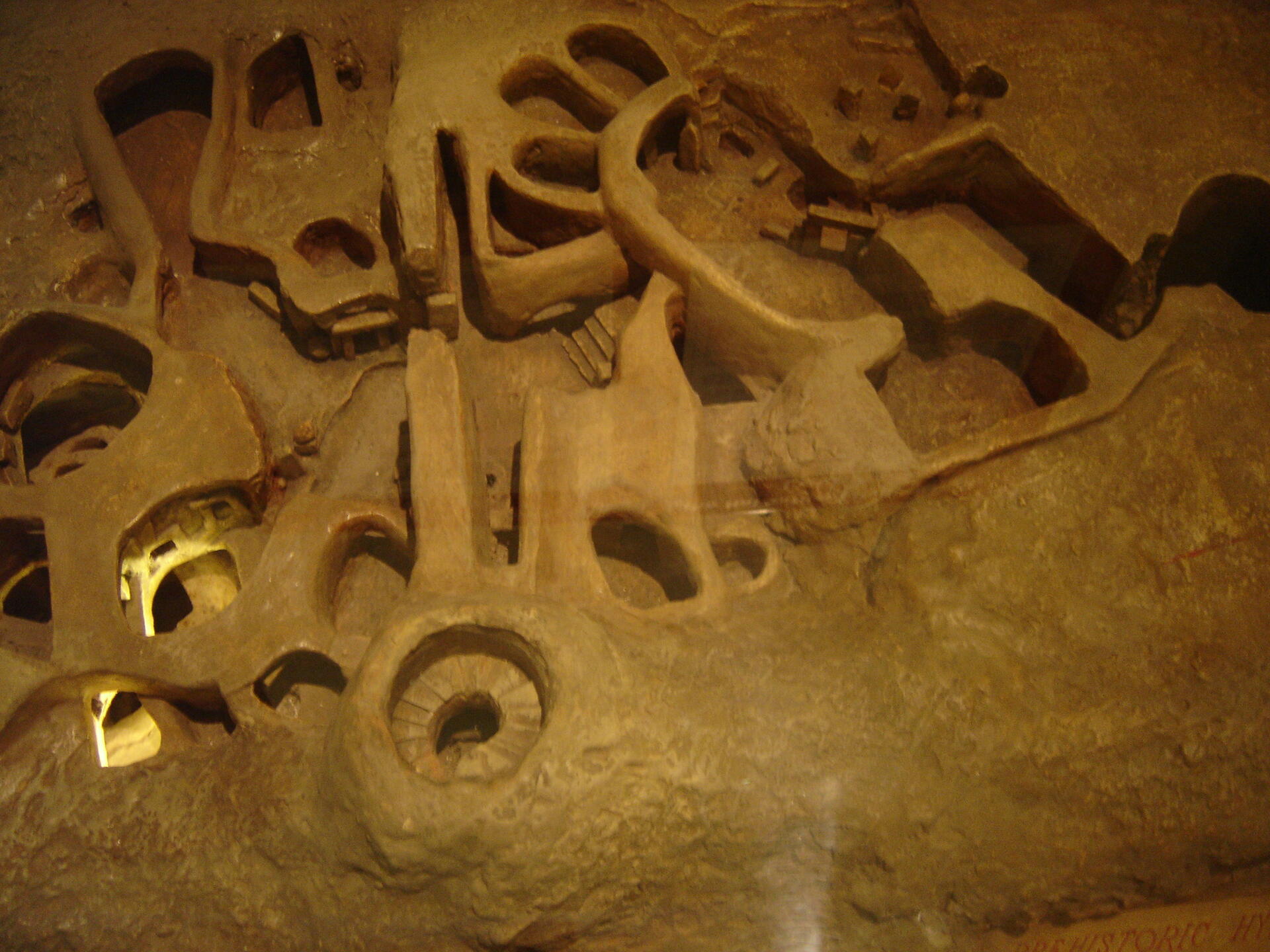
© Moonshadow, CC BY-SA 3.0 Resized from original. (This derivative is under the same CC BY-SA license.)
World Heritage Research
Discover scientific research and academic studies that deepen our understanding of Ħal Saflieni Hypogeum from its history and significance to its conservation, management, and contemporary challenges.
-
Protecting the protected: World Heritage Sites and collections; defining, recognising and protecting Outstanding Universal Value in its entirety
A critical review of the 1972 Convention Concerning the Protection of the World Cultural and Natural Heritage suggests that material culture of national significance should be recognized and protected alongside immoveable cultural heritage, such as UNESCO World Heritage Sites. The research argues for an expansion of protection mechanisms to include highly significant objects in nomination applications, thereby safeguarding them under the Convention against environmental and manmade threats. This approach is supported by case studies from three World Heritage museums: The Hyde Park Barracks (Sydney, Australia), Ħal-Saflieni Hypogeum (Paola, Malta), and Vindolanda – Hadrian’s Wall (Northumberland, Great Britain). These collections, marking significant historical periods, demonstrate the potential for a more comprehensive protection framework that encompasses both moveable and immoveable heritage.
Fabry, S. (2020). Protecting the protected: World Heritage Sites and collections; defining, recognising and protecting Outstanding Universal Value in its entirety (Version 1) [University of Leicester]. https://doi.org/10.25392/LEICESTER.DATA.12764450.V1
View Publication Record | Read Publication -
Access to Heritage: The Role of the Maltese National Cultural Heritage Agency
Heritage Malta, the national agency overseeing multiple historical sites including UNESCO World Heritage Sites such as Ħal Saflieni Hypogeum and Megalithic Temples, is actively addressing challenges related to accessibility while preserving cultural heritage. The study highlights that rendering heritage accessible inherently involves risks, prompting key questions about the nature of accessibility, potential impacts, and the balance between access rights and conservation. Through past and future projects, Heritage Malta demonstrates innovative solutions to make cultural heritage universally accessible, emphasizing the benefits of centralized management for multiple assets. This approach not only ensures public appreciation but also reinforces the agency's mission in safeguarding heritage for humanity.
MANISCALCO, K. (2019). ACCESS TO HERITAGE: THE ROLE OF THE MALTESE NATIONAL CULTURAL HERITAGE AGENCY. Structural Studies, Repairs and Maintenance of Heritage Architecture XVI, 1, 245–255. https://doi.org/10.2495/str190211
View Publication Record | Read Publication -
Archaeoacoustic Analysis of the Hal Saflieni Hypogeum in Malta
A recent archaeoacoustic analysis of the Ħal Saflieni Hypogeum in Malta revealed strong resonance effects, with double resonance frequencies at 70Hz and 114Hz detected in the 'Oracle Room.' These frequencies, when stimulated by male voices or percussion instruments, create a phenomenon that affects human brain activity. The hypogeum's unique design, described as 'architecture in the negative,' mirrors megalithic temples above ground and was likely used for Neolithic rituals. Laboratory testing confirmed the impact of these frequencies on cognitive processes, suggesting they supported social or spiritual events in this prehistoric complex.
Debertolis, Prof. agg. P., Coimbra, Dr. F., & Eneix, L. (2015). Archaeoacoustic Analysis of the Hal Saflieni Hypogeum in Malta. Journal of Anthropology and Archaeology, 3(1). https://doi.org/10.15640/jaa.v3n1a4
View Publication Record | Read Publication -
The biodiversity of subaerophytic phototrophic biofilms from Maltese hypogea.
Research reveals that subaerial phototrophic biofilms in Maltese hypogea, particularly within the Ħal Saflieni Hypogeum and other catacombs, are dominated by non-heterocytous (Oscillatorialean) cyanobacteria. These microorganisms exhibit cytomorphological and genetic similarities to those found in Mediterranean caves and catacombs, suggesting a widespread distribution of related biofilm communities in such environments. The study employed advanced microscopy techniques, including light microscopy, epifluorescent microscopy, confocal laser scanning microscopy (CLSM), and transmission electron microscopy (TEM), alongside 16S rRNA gene sequencing to isolate and characterize cyanobacterial, microalgal, and chemoorganotrophic bacterial strains. Phylogenetic analyses further confirmed the relatedness of these microorganisms to those in other Mediterranean lithic surfaces.
Zammit, G., Billi, D., Shubert, E., Kaštovský, J., & Albertano, P. (2011). The biodiversity of subaerophytic phototrophic biofilms from Maltese hypogea. Fottea, 11(1), 187–201. https://doi.org/10.5507/fot.2011.018
View Publication Record | Read Publication