World Heritage Identification Number: 420
World Heritage since: 1987
Category: Cultural Heritage
WHE Type: Historic Cities & Urban Areas
Transboundary Heritage: No
Endangered Heritage: Yes
Country: 🇧🇴 Bolivia (Plurinational State of)
Continent: Americas
UNESCO World Region: Latin America and the Caribbean
Map
The City of Potosí: A UNESCO World Heritage Site and Silver Mining Hub
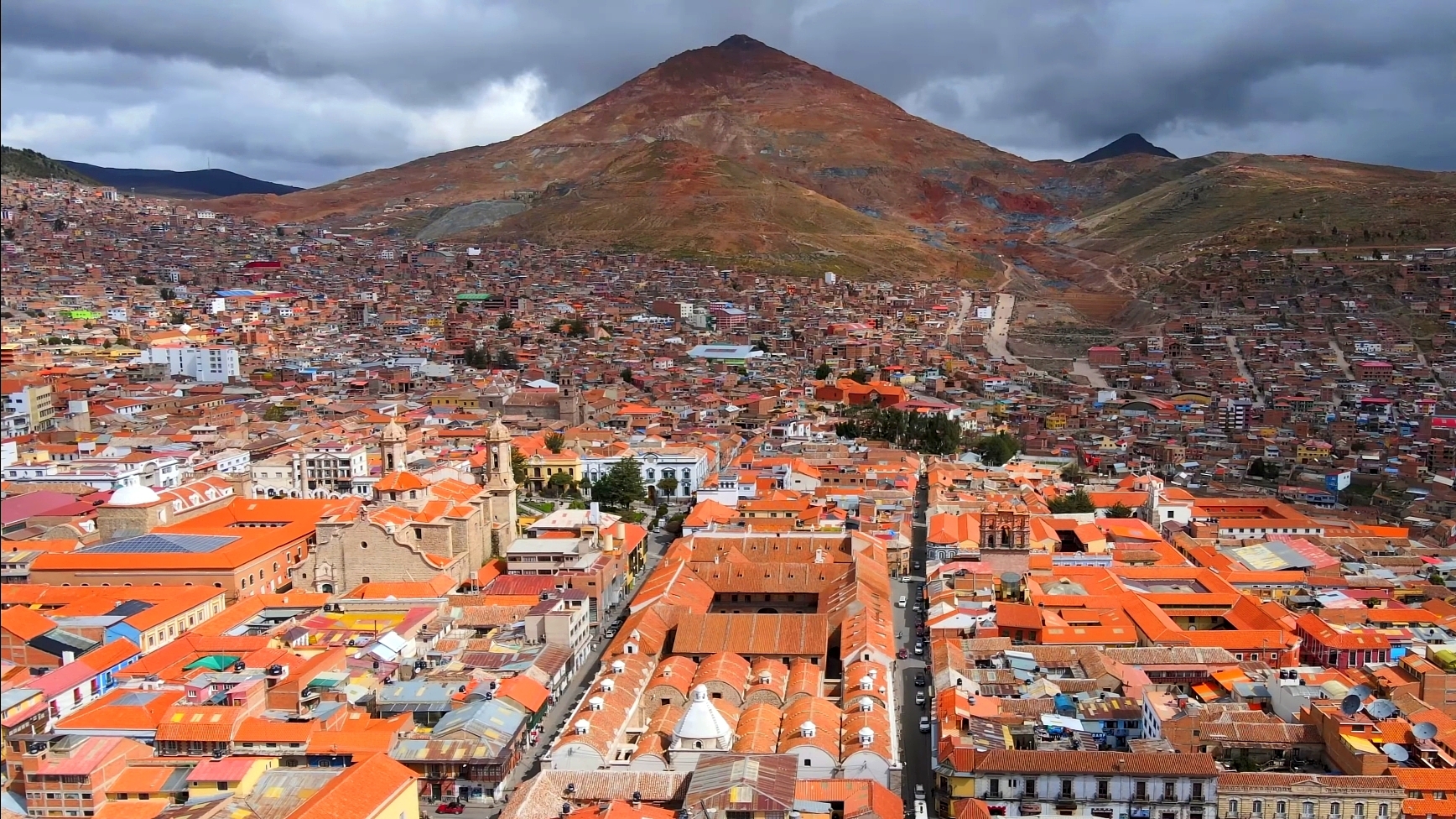
The City of Potosí, located in the highlands of Bolivia, stands as a testament to human ingenuity and the relentless pursuit of wealth during the colonial era. Established in the 16th century, it was once considered the world's largest industrial complex, earning its designation as a UNESCO World Heritage Site in 1987.
More to come…UNESCO Description of the World Heritage Site
In the 16th century, this area was regarded as the world’s largest industrial complex. The extraction of silver ore relied on a series of hydraulic mills. The site consists of the industrial monuments of the Cerro Rico, where water is provided by an intricate system of aqueducts and artificial lakes; the colonial town with the Casa de la Moneda; the Church of San Lorenzo; several patrician houses; and the barrios mitayos, the areas where the workers lived.
UNESCO Justification of the World Heritage Site
Criterion (ii): The “Imperial City” of Potosí, such as it became following the visit of Francisco de Toledo in 1572, exerted lasting influence on the development of architecture and monumental arts in the central region of the Andes by spreading the forms of a baroque style incorporating Indian influences.
Criterion (iv): Potosí is the one example par excellence of a major silver mine in modern times. The industrial infrastructure comprised 22 lagunas or reservoirs, from which a forced flow of water produced the hydraulic power to activate the 140 ingenios or mills to grind silver ore. The ground ore was then amalgamated with mercury in refractory earthen kilns called huayras or guayras. It was then molded into bars and stamped with the mark of the Royal Mint. From the mine to the Royal Mint (reconstructed in 1759), the whole production chain is conserved, along with the dams, aqueducts, milling centres and kilns. The social context is equally well represented: the Spanish zone, with its monuments, and the very poor native zone are separated by an artificial river.
Criterion (vi): Potosí is directly and tangibly associated with an event of outstanding universal significance: the economic change brought about in the 16th century by the flood of Spanish currency resulting from the massive import of precious metals in Seville.
Encyclopedia Record: Potosí
Potosí, known as Villa Imperial de Potosí in the colonial period, is the capital city and a municipality of the Department of Potosí in Bolivia. It is one of the highest cities in the world at a nominal 4,067 m (13,343 ft).Additional Site Details
Area: 2,211 hectares
Number of Components: 1
(iv) — Outstanding example of a type of building or landscape
(vi) — Directly associated with events or living traditions
Coordinates: -19.599112 , -65.749813
Image
© Parallelepiped09, CC BY-SA 4.0 Resized from original. (This derivative is under the same CC BY-SA license.)
World Heritage Research
Discover scientific research and academic studies that deepen our understanding of City of Potosí from its history and significance to its conservation, management, and contemporary challenges.
-
Transmission Vector of E. Coli in Different Areas of the City of Potosí and Its Impact on the SDGs of the 2030 Agenda
A concerning environmental health threat has been identified in the City of Potosí, where the transmission of E. coli poses significant risks to public health and well-being. The study reveals that many areas lack adequate prevention mechanisms, exacerbating a pressing epidemiological issue. Using a descriptive methodology with a cross-sectional approach, researchers assessed the incidence of E. coli across different regions, highlighting its potential impact on the 17 Sustainable Development Goals (SDGs) outlined in the UN's 2030 Agenda. The findings underscore the need for urgent action to mitigate or eradicate the spread of this bacterium, which not only affects health outcomes but also threatens regional sustainability efforts.
Vera, R. C., Salguero, H. C., Fílipps, F. A. S., Cortez, V. G. S., Heredia, J. A. P., & Saavedra, J. M. N. (2023). TRANSMISSION VECTOR OF E. COLI IN DIFFERENT AREAS OF THE CITY OF POTOSÍ AND ITS IMPACT ON THE SDGs OF THE 2030 AGENDA. International Journal of Health Science, 3(59), 2–8. https://doi.org/10.22533/at.ed.15935923110810
View Publication Record | Read Publication -
Mining City: Potosí - Potosí: The Silver City That Changed the World. By Kris Lane. Oakland: University of California Press, 2019. Pp. 272. Illustrations. Maps. Appendix. Glossary. Notes. Bibliographical essay. Select bibliography. Index. $32.95 cloth.
Potosí, the UNESCO World Heritage Site, stands as a testament to the profound impact of silver mining on global history. Kris Lane's 'Mining City: Potosí' reveals how this Bolivian city, once the world's largest silver producer, reshaped economies and societies from the 16th to 20th centuries. The book highlights Potosí's role in fueling European wealth, driving inflation through the influx of American silver, and creating a complex social structure that reflected colonial power dynamics. Lane employs a multidisciplinary approach, integrating historical records, economic data, and archaeological evidence to unravel the city's layered narratives. This comprehensive analysis underscores Potosí's significance not only as an industrial marvel but also as a microcosm of global interconnectedness during the early modern period.
Meuwese, M. (2020). Mining City: Potosí - Potosí: The Silver City That Changed the World. By Kris Lane. Oakland: University of California Press, 2019. Pp. 272. Illustrations. Maps. Appendix. Glossary. Notes. Bibliographical essay. Select bibliography. Index. $32.95 cloth. The Americas, 77(4), 641–642. https://doi.org/10.1017/tam.2020.78
View Publication Record | Read Publication -
Potosí: The Silver City That Changed the World
Potosí is recognized as one of the most significant historical subjects due to its extraordinary silver mines, which played a pivotal role in global trade, colonial society, and environmental degradation. Kris Lane's comprehensive study, 'Potosí: The Silver City That Changed the World,' highlights the city's dual nature—innovation and creation alongside archetypal violence against humans and their environment. The research meticulously uses primary sources, including colonial writings, notary records, and judicial cases from Bolivian archives, along with images and photographs, to present a nuanced narrative of Potosí's history from its discovery in 1545 through the mid-twentieth century. This approach challenges readers to confront the moral ambiguities embedded in Potosí's complex history, offering insights relevant to global historical settings.
Mangan, J. E. (2020). Potosí: The Silver City That Changed the World. Hispanic American Historical Review, 100(4), 692–694. https://doi.org/10.1215/00182168-8646977
View Publication Record | Read Publication -
Potosí: the silver city that changed the world
Potosí, the historic silver city in Bolivia, stands as a pivotal case study in global economic and social transformation. Kris Lane's work reveals how Potosí's vast silver deposits, discovered in 1545, fueled the Spanish Empire's economy, reshaping global trade networks and labor systems. The research employs a 'longue durée' approach, tracing Potosí's evolution from its founding to the wars of independence, highlighting its role as a microcosm of colonial exploitation and indigenous resilience. This study underscores Potosí's enduring legacy in shaping world history through its economic dominance and complex social dynamics.
Bean, R. A. (2020). Potosí: the silver city that changed the world. Canadian Journal of Latin American and Caribbean Studies / Revue Canadienne Des Études Latino-Américaines et Caraïbes, 46(1), 152–154. https://doi.org/10.1080/08263663.2021.1855898
View Publication Record | Read Publication