World Heritage Identification Number: 1147
World Heritage since: 2007
Category: Mixed Cultural Heritage and Natural Heritage
WHE Type: Cultural Landscapes
Transboundary Heritage: No
Endangered Heritage: No
Country: 🇬🇦 Gabon
Continent: Africa
UNESCO World Region: Africa
Map
Ecosystem and Relict Cultural Landscape of Lopé-Okanda: A Unique Interface Between Nature and Culture
The Ecosystem and Relict Cultural Landscape of Lopé-Okanda, inscribed as a UNESCO World Heritage Site in 2007, offers a captivating blend of natural beauty and cultural heritage. Situated in central Gabon, this unique property spans an area of approximately 4,912 square miles (1,897 square kilometers), bordered by the Ogooué River to the north and the Chaillu Massif to the south.
More to come…UNESCO Description of the World Heritage Site
The Ecosystem and Relict Cultural Landscape of Lopé-Okanda demonstrates an unusual interface between dense and well-conserved tropical rainforest and relict savannah environments with a great diversity of species, including endangered large mammals, and habitats. The site illustrates ecological and biological processes in terms of species and habitat adaptation to post-glacial climatic changes. It contains evidence of the successive passages of different peoples who have left extensive and comparatively well-preserved remains of habitation around hilltops, caves and shelters, evidence of iron-working and a remarkable collection of some 1,800 petroglyphs (rock carvings). The property’s collection of Neolithic and Iron Age sites, together with the rock art found there, reflects a major migration route of Bantu and other peoples from West Africa along the River Ogooué valley to the north of the dense evergreen Congo forests and to central east and southern Africa, that has shaped the development of the whole of sub-Saharan Africa.
UNESCO Justification of the World Heritage Site
Criterion (iii): the rich archaeological ensembles of the middle stretches of the River Ogooué Valley demonstrate 400,000 years of almost continuous history. The archaeological sites have revealed the earliest date for the extension of Tshitolien culture towards the Atlantic, as well as detailed evidence for the early use of forest produce, cultivation of crops and the domestication of animals.
Criterion (iv): the collection of Neolithic and Iron Age sites together with the rock art remains appear to reflect a major migration route of Bantu and other peoples along the River Ogooué valley to the north of the dense evergreen Congo forests from West Africa to central east and southern Africa, that has shaped the development of the whole of sub-Saharan Africa. The subsidiary Iron Age sites within the forest provide evidence for the development of forest communities and their relationship with present day peoples.
Criterion (ix): The nominated property demonstrates an unusual interface between forest and savannah environments, and a very important manifestation of evolutionary processes in terms of species and habitat adaptation to post-glacial climatic changes. The diversity of species and habitats present are the result of natural processes and also the long-term interaction between man and nature.
Criterion (x): The diversity of habitats and the complex relationship between forest and savannah ecosystems have contributed to a high biological diversity particularly in relation to the property's flora, making it one of the most outstanding areas in relation to floristic diversity and complexity in the Congo Rainforest Biogeographical Province. Over 1,550 plant species have been recorded, including 40 never recorded before in Gabon, and it is anticipated that once all the floristic surveys and research are completed the number of plant species could reach over 3,000.
Encyclopedia Record: Lopé National Park
Lopé National Park is a national park in central Gabon. Bordered by the Ogooué River to the north and the Chaillu Massif to the south, the park has an area of 4,912 km2 (1,897 sq mi).Additional Site Details
Area: 511,991 hectares
Number of Components: 3
(iv) — Outstanding example of a type of building or landscape
(ix) — Outstanding example representing ecological and biological processes
(x) — Contains most important habitats for biodiversity
Coordinates: -0.5 , 11.5
IUCN World Heritage Outlook
The 2025 Conservation Outlook on Ecosystem and Relict Cultural Landscape of Lopé-Okanda reports the following assessment:
Source: International Union for Conservation of Nature (IUCN) · View assessment
Image
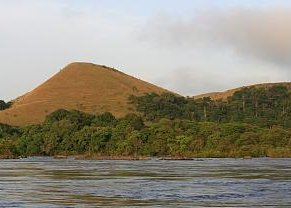
© FX, CC BY-SA 3.0 Resized from original. (This derivative is under the same CC BY-SA license.)