World Heritage Identification Number: 415
World Heritage since: 1987
Category: Cultural Heritage
WHE Type: Archaeological Sites
Transboundary Heritage: No
Endangered Heritage: No
Country: 🇲🇽 Mexico
Continent: Americas
UNESCO World Region: Latin America and the Caribbean
Map
Exploring the Rich Cultural Legacy: Historic Centre of Oaxaca and Archaeological Site of Monte Albán
The Historic Centre of Oaxaca and Archaeological Site of Monte Albán, inscribed as a UNESCO World Heritage Site in 1987, offers a unique blend of ancient indigenous and colonial influences that make it a captivating destination for history enthusiasts and travelers alike. This article delves into the historical, cultural, and architectural aspects of this remarkable site.
More to come…UNESCO Description of the World Heritage Site
Inhabited over a period of 1,500 years by a succession of peoples – Olmecs, Zapotecs and Mixtecs – the terraces, dams, canals, pyramids and artificial mounds of Monte Albán were literally carved out of the mountain and are the symbols of a sacred topography. The nearby city of Oaxaca, which is built on a grid pattern, is a good example of Spanish colonial town planning. The solidity and volume of the city's buildings show that they were adapted to the earthquake-prone region in which these architectural gems were constructed.
Encyclopedia Record: Oaxaca
Oaxaca, officially the Free and Sovereign State of Oaxaca, is one of the 32 states that compose the Federative Entities of the United Mexican States. It is divided into 570 municipalities, of which 418 are governed by the system of usos y costumbres with recognized local forms of self-governance. Its capital city is Oaxaca de Juárez.Additional Site Details
Area: 4,375 hectares
Number of Components: 2
(ii) — Significant interchange of human values
(iii) — Unique or exceptional testimony to a cultural tradition
(iv) — Outstanding example of a type of building or landscape
Coordinates: 17.061579 , -96.725885
Image
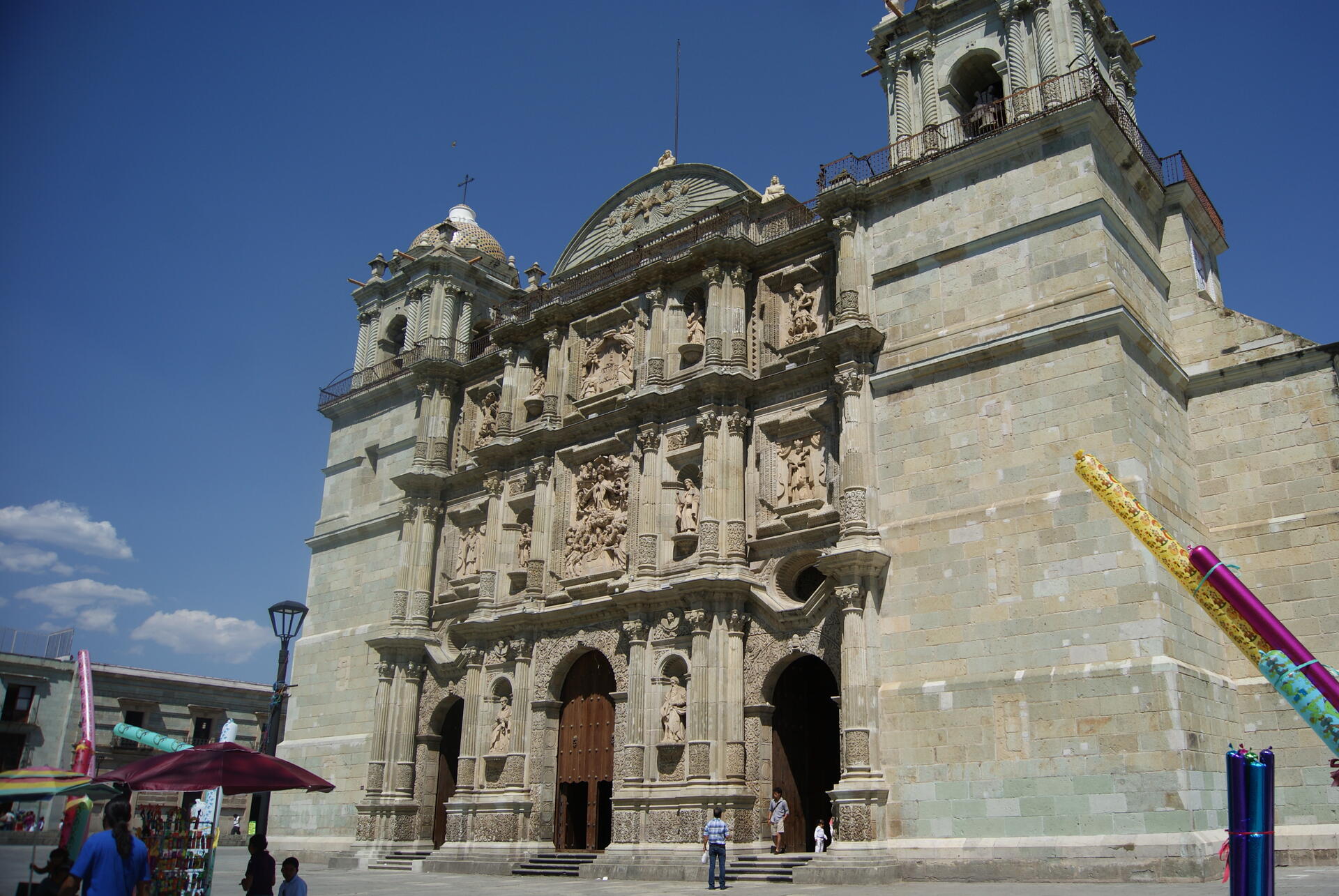
© Luisalvaz, CC BY-SA 4.0 Resized from original. (This derivative is under the same CC BY-SA license.)